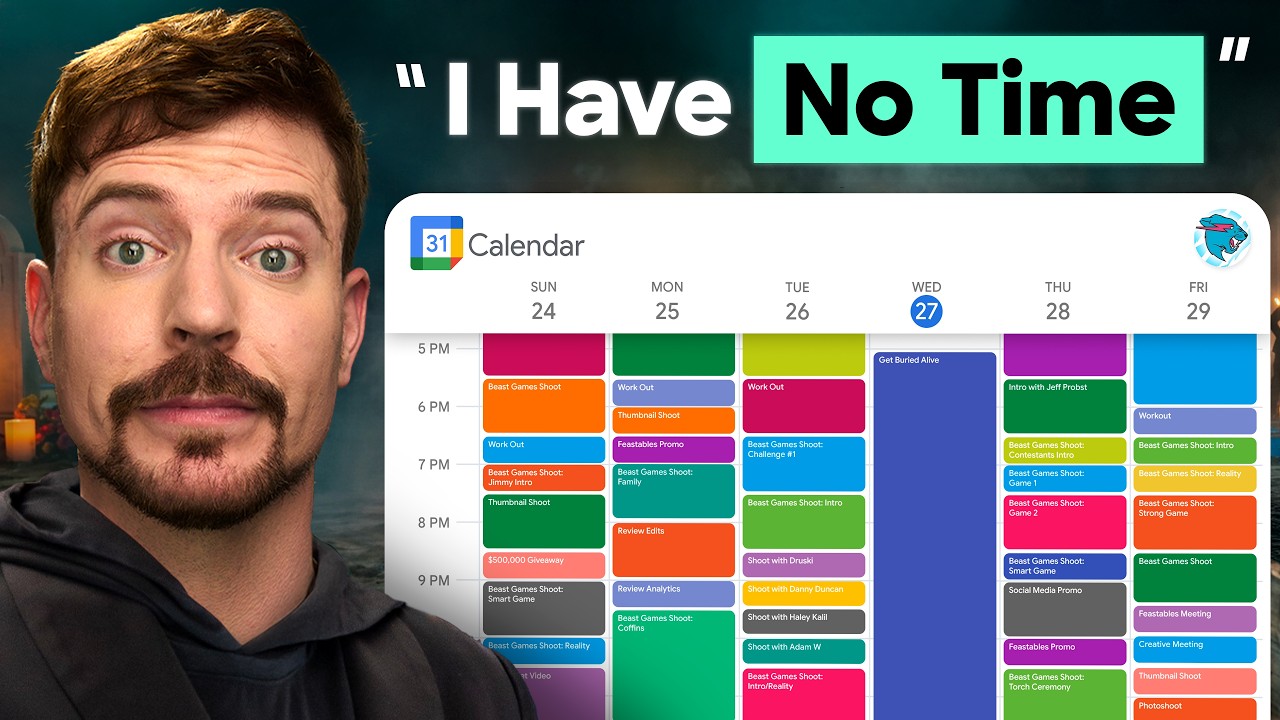
Jimmy Donaldson was crying in his bedroom, posting videos to an audience of four or five people, when everyone around him was already certain he was wasting his life. That early loneliness, absorbed by a kid who would grow into the most-watched creator on YouTube, turns out to be the foundation of a working method so relentless that a day under 15 hours is considered light. For anyone wondering how a single person simultaneously runs a YouTube channel closing in on 400 million subscribers and produces a record-breaking Amazon competition series, Jon Youshaei spent 45 days embedded inside the operation to find out.
The mom who hid $100,000 and eventually let go
Before MrBeast was a company, it was a source of family grief. Jimmy’s mother lost everything in the 2008 financial crisis, and when her son started reinvesting every dollar he earned straight back into videos, her trauma resurfaced. ‘She would literally bawl her eyes out crying,’ Jimmy recalled. The friction reached a peak when she quietly moved $100,000 into a separate account in his name without telling him. Her reasoning was plain: if he went bankrupt, he would at least have something. The money was not stolen. It was parked. The moment she finally stopped fighting his instinct was the moment the company found its footing. ‘She was like, if you want to reinvest and go hard, go for it,’ he said.
That same mother later appeared on camera in one of his videos, where Jimmy handed her a check to pay off her mortgage. She resisted at first, genuinely unable to accept it. Jimmy’s reply: ‘You use me for views and I get to pay off your mortgage. I think it works out pretty well.’
How 350 cameras and a floor grid hold an empire together
The thumbnail operation alone is a study in engineered efficiency. A full-time crew of body doubles and production assistants works a standard nine-to-five schedule mapping out exact grid positions, lighting angles, and stand-in poses so that when Jimmy arrives, he shoots and leaves. ‘I can just go boom boom boom boom, take the photos and get out,’ he explained, ‘because I can’t waste time. Five minutes, I can’t waste it.’ On a single shoot day documented during the 45-day embed, Jimmy moved from a private jet giveaway involving a man who had spent 99 consecutive days living aboard a $2.5 million aircraft, straight to a tiger jump against the world’s highest human jumper, then on to a Beast Games set, and finally to a 3:00 or 4:00 a.m. junkyard shoot where Navy SEALs hid from dogs. The gear budget supporting those shoots sits north of $5 million in equipment, including roughly 350 individual cameras across productions and FPV drones that cost around $25,000 to $30,000 each fully outfitted.
The Beast Games control room, housed inside a truck for the cannon episode, runs an army of story producers monitoring microphones from every contestant simultaneously and tagging moments in real time, a system stress-tested first on YouTube before being scaled up for television. Tyler Conlin, who began as a janitor earning around eight dollars an hour alongside Chandler, now serves as lead director writing the bulk of the creative.
The afternoon Jimmy almost missed his own tiger shoot
Two hours into a scheduled animal segment, Jimmy still had not arrived. He was finishing a Fables meeting, then main channel filming, then vertical content. The production team kept resetting the bait pulley, trying to coax the tiger into a clean jump. ‘We won’t compromise on creative,’ his team said from the set. ‘We’ll wait here until we get the best shot we can get.’ When Jimmy finally appeared and the slow-motion footage rolled back, the reaction was immediate: ‘That’s way cooler than I thought.’ The Guinness World Record high jump that followed, a bar cleared at a height that left the jumper’s knee level with Jimmy’s head, produced the kind of moment the whole system is built to capture. The jumper’s first words after breaking his own record: ‘I feel like I can go higher.’ Jimmy’s verdict: ‘What a freaking maniac.’
Jeff Probst, a seatmate on a plane to Fiji, and the deal that changed both shows
The Survivor collaboration began not in a boardroom but in an airplane seat. A member of Jeff Probst’s team happened to sit next to Beast Games’ head of marketing on the flight to Fiji, struck up a conversation, and texted Probst before the plane landed. Probst replied immediately. Two hours later, after an in-person meeting, he took out a camera for a photo and said, according to the person present: ‘Let’s change television.’ The subsequent crossover episode, filmed on Survivor’s set using Survivor’s own crew on their one day off, gave Jimmy a clean look at a 50-season production machine operating at full precision. Jimmy’s response was to follow Probst’s lead entirely rather than import his own style. Probst’s read on the difference between the two shows was direct: ‘Beast Games is about what would you do for money. Survivor is who are you when stripped of everything.’
The moment that stopped the set
Late in the embed, on a night that had already run past 11:30 p.m., Jimmy was mid-shoot on a commercial when someone in the room noticed something on a monitor. His eyes had been closed for about 30 seconds. The crew fell quiet. He was, for one brief half-minute, asleep sitting upright.
The private jet sat on a runway, already signed over to a man who had lived aboard it for 99 consecutive days, its new owner somewhere in the air heading home to his family.