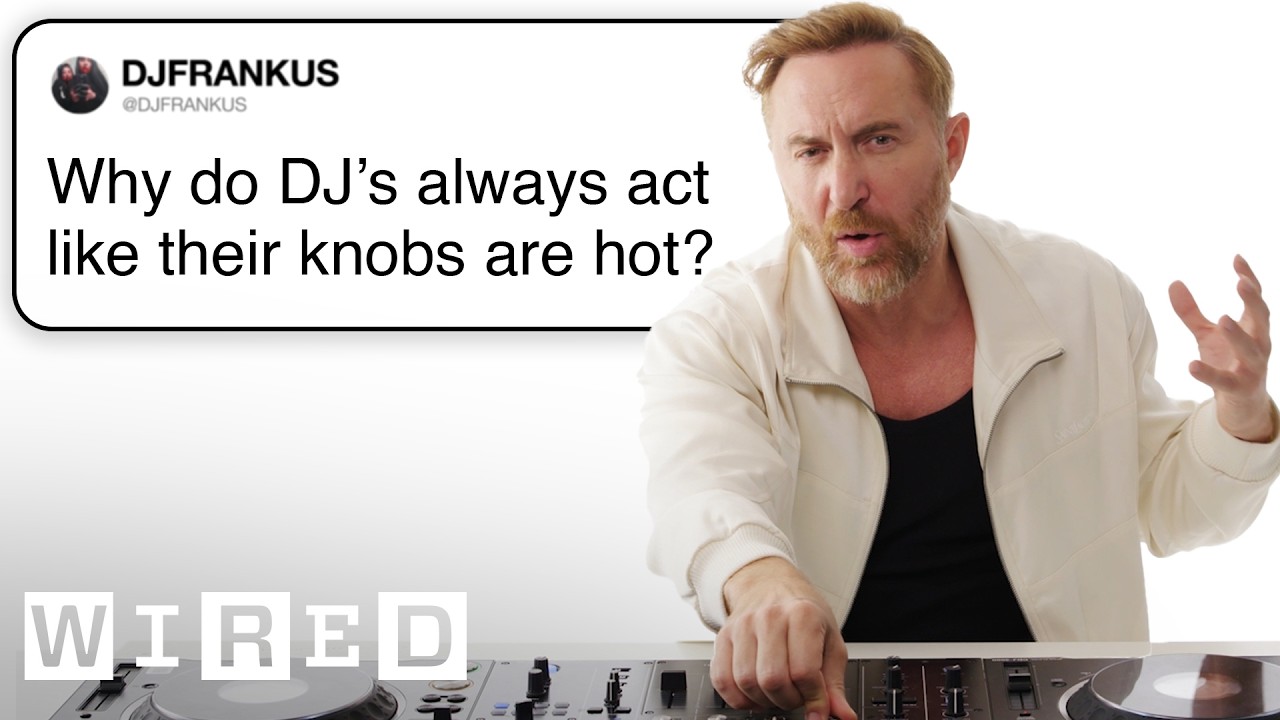
David Guetta is at the decks, one ear on the headphones and one ear on the room, doing what he has spent decades learning to do: read the crowd before they know what they want. That gap between what is playing and what is coming next turns out to be the entire job, and almost nobody outside the booth understands what fills it. Guetta sat down to answer real questions from the internet about the mechanics and philosophy of DJing, and the answers cut closer to music theory and crowd psychology than most people expect.
Why the drop works every single time
The physics of a drop are simpler than the mythology around it. Guetta explains it as pure contrast: take away the kick and the bass, let the tension build until the room is holding its breath, then bring everything back at full force. ‘If you want something to sound loud, it needs to be quiet before,’ he says, and the principle runs deeper than volume. The same logic applies to stereo width, to energy, to almost any sensation in music. Strip away the low end with a filter, hold the crowd in that suspended state for a few bars, and the moment the kick returns, the release feels seismic even if the underlying beat is dead simple. The trick is not the sound itself but the absence that precedes it.
On the question of whether DJs plan their sets or freestyle from memory, Guetta draws a clear line between club nights and festivals. Early in his career, playing residencies six nights a week for up to eight hours at a stretch, the art was reading the room and never repeating himself. Festival slots are a different contract entirely. When he plays a 90-minute set at a major festival, he spends roughly a full month building a skeleton in advance, then adjusts in real time based on what the crowd absorbs. If an underground record lands, he pulls from that playlist. If the room wants singalongs, he has those queued as well. The prepared set is a scaffold, not a script.
The technical parts most people never think about
Beat matching, Guetta is quick to note, is no longer the hard part. He is direct about it: ‘I can teach a kid that is 10 years old how to beat match in a couple of hours because today it really became easy.’ The skill that separates good DJs from great ones now is mixing in key. He demonstrates by blending a track in C minor with one in F sharp minor, pointing out how the clash registers as unease even for listeners who cannot name it, then shifting the second track to G, which forms a perfect fifth with C and resolves cleanly. Key-aware mixing is the level beyond beat matching, and it requires a working knowledge of music theory most DJs quietly skip.
The headphones, meanwhile, serve as an insurance policy. One ear monitors the room through the booth speakers; the other previews the incoming track privately, checking that the timing is right and that the energy of the next record actually follows from the current one before it is committed to the sound system.
On the questions about EQ knob theatrics, he is diplomatically honest: some of it is a genuine tick, some of it is show, and a lot of it is unnecessary in a well-engineered room.
For anyone playing their first 3 a.m. gig and wondering how to stay upright, Guetta has one practical answer: a one-hour nap before the set, no longer, followed by 30 minutes to shake off the fog before stepping behind the decks. He calls it the disco nap. It does not fix the broken sleep pattern that comes with the job, but it is the one thing that actually helps.
The jog wheel that started with vinyl
The jog wheel on a modern controller is a direct inheritance from the physical practice of nudging a vinyl record forward or backward on a turntable to correct a drifting beat. Guetta traces it back without nostalgia, treating it as a practical tool that survived because it works, not because of any romance attached to the format it replaced.
The full circle of the night closes the same way it opened: one ear in, one ear out, the room breathing in the gap before the kick comes back.