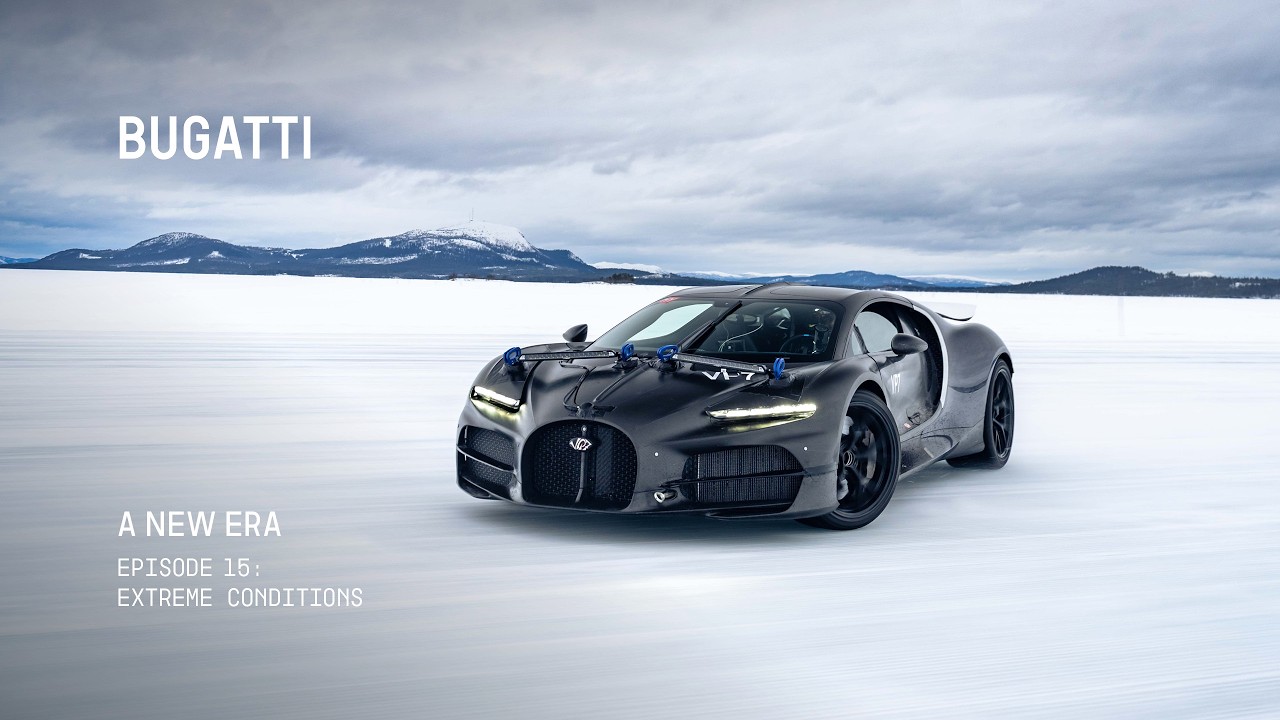
Mirl Slavich pressed the throttle to the floor on a sheet of polished ice in Arjeplog, Sweden, and did not touch the steering wheel. The car tracked straight, composed, and utterly unfazed. That kind of behavior does not happen by accident with 1,800 horsepower on a surface offering less than 0.3g of grip, and the story of how Bugatti made it happen is the story of six engineers working two shifts a day for four straight weeks in temperatures that dropped to minus 30 degrees Celsius.
What four weeks at minus 30 actually looks like
Slavich is the chief test and development driver for Bugatti, and he brought a core team of six to the Colmisse proving ground to validate what the company is calling the BR1 project, its Tourbillon platform. The objective was to stress every layer of the car’s electronic nervous system: the HRAC all-wheel-drive system, ABS, electronic stability control, traction control, and torque vectoring, all under what engineers call low-mu conditions. Mu is the coefficient of grip, and below 0.3 to 0.4g, the tire’s relationship with the road becomes genuinely unpredictable.
The team worked through ice, packed snow, asphalt, and slush. They also ran what Slavich called ‘mu jumps’, braking runs that start on dry or heated asphalt and then continue across polished ice mid-stop, forcing the system to recalibrate its grip model in real time. When temperatures climbed and daytime ice conditions softened, the team shifted to night sessions to protect surface quality. The window was fixed: four weeks total, and this was intended to be the last winter session in the car’s development program.
Around 20 people rotated through the site across the full period, but the core six stayed the whole time without regard for weekends. As Slavich put it plainly: ‘We don’t care if it’s Saturday, Sunday. We love this job. We really enjoy it.’
Three modes, three entirely different cars
One of the central calibration tasks was tuning the car’s three drive modes: comfort, sport, and track. In comfort, the balance tilts toward the front axle to maximize stability, and the stability control envelope is deliberately tight. Lifting off the throttle in a corner requires no counter-steer and no correction. In sport mode, torque shifts toward the rear and the balance settles closer to 50/50 between the axles, allowing the driver to engage side slip with a full throttle input while the car’s controls manage the consequences. Track mode opens the envelope further. Beyond that, all systems can be switched off entirely.
The team also validated the climate control system, including windscreen defogging measured both by objective instruments in climatic chambers and by the subjective comfort of passengers inside the car, and worked through the interaction between the brake-by-wire system, regenerative braking from both the front and rear electric powertrains, and the conventional hydraulic foundation brakes.
Reindeers at the fence line
A small group of reindeer walked close enough to the car during one session that the team stopped to take photographs, a moment Slavich described as unforgettable alongside a Northern Lights display that appeared on one of the overnight shifts.
The polished ice at Colmisse is quiet now, the season closed. Back in the development calendar, the next phase moves to open roads, where the team will chase the worst-case ABS and electronic stability control scenarios that a proving ground cannot fully replicate. The reindeer, for their part, offered no grip data whatsoever.