The tiniest screw in the room turned out to be the biggest one in the entire watch. That was the moment, hunched over a workbench at the Tudor manufacture in Switzerland, when the full absurdity and beauty of a mechanical wristwatch snapped into focus. A $1,000 smartphone synced to a satellite will be a paperweight in a decade. A well-kept mechanical watch, with no battery and no circuits, will tick in exactly the same way a hundred years from now. That contrast is the whole story of watchmaking, and it turns out there has never been a better moment to understand it.
The vocabulary nobody told you about
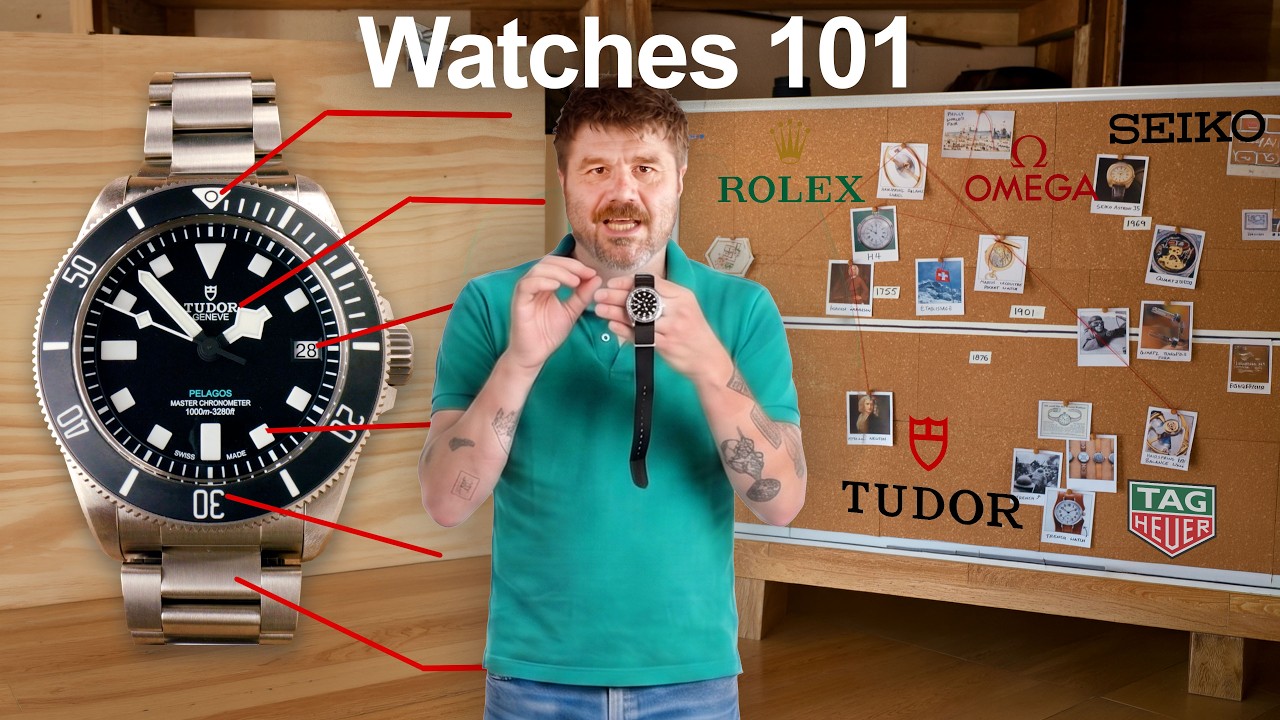
Before anything else, the words matter. Call the face a ‘face’ in front of a watch collector and, as Speeed puts it, everyone will know instantly that you spent $20,000 on a Rolex because you wanted people to know how rich you are and you don’t actually respect the thing. The correct word is dial. What holds the crystal in place is the bezel. The strap connects via lugs, not just the case diameter, and lug-to-lug distance is just as important when sizing a watch to a wrist. The stopwatch function is a chronograph; the buttons controlling it are pushers. Every additional function, a date aperture, a GMT hand tracking a second time zone, a moon phase display, carries one collective name: complications. The term is literal. Each one makes the movement harder to build.
The GMT hand has a particularly good origin story. Until commercial aviation opened up in the 1950s, there was no practical reason to track time across zones. Rolex built the GMT-Master specifically for pilots crossing the globe, and suddenly a watch needed a second hour hand rotating on a 24-hour cycle. We were, as the channel frames it, traveling faster than time itself and had to invent a way to keep up.
Five hundred years of tiny machines, one very bad screw
The first portable watch, made in Nuremberg in the early 1500s, lost up to two hours a day. Its spring delivered less force as it unwound and it had no real regulator. The hairspring balance wheel, the fix that dropped that error to a few minutes per day, is still inside every mechanical watch made today. Sailors needed even more precision, and the obsessive work of John Harrison on a 5-inch pocket watch eventually cracked the longitude problem for navigation at sea.
Switzerland entered the picture almost by accident. Calvinist Geneva banned jewelry in the 1500s as sinful excess, but tools were exempt. Goldsmiths pivoted to watches. The industry spread into mountain valleys where farmers spent half the year snowed in and needed income. A decentralized network formed organically: one family makes gears, another makes screws. By the time Swiss watchmakers visited the Philadelphia World’s Fair in 1876 and watched American industrial machines do in seconds what took them hours, they launched what can only be described as a coordinated espionage campaign against US manufacturing methods, absorbed the automation, and dominated the industry for the next century.
Then, on Christmas Day 1969, Seiko released the Astron 35SQ, the first commercially available quartz watch. A rock, a tuning fork of quartz crystal, vibrating at a fixed frequency replaced the balance wheel. A microchip replaced the mechanical escapement. Swiss watch brands collapsed from 1,600 to 600. Sixty thousand jobs disappeared. By the late 1970s a $10 quartz watch kept better time than a $10,000 Rolex. The Swiss survived by accepting a truth that reshaped the entire luxury market: most people buying expensive mechanical watches were never really buying precision. They were buying a story.
What to actually look for before buying
Size is the first practical filter. Case diameter gets most of the attention, but lug-to-lug span determines how much wrist real estate the watch actually occupies. A rough starting formula: measure wrist circumference in millimeters, divide by three, and aim for 60 to 70 percent of that number as a safe case diameter. A dollar bill, for reference, runs about six inches.
Cost does not equal quality in any simple ratio. Quartz movements are cheaper, require no winding, and do not need resetting after sitting unworn for three days. Mechanical watches need periodic servicing, and for premium brands that bill can run from several hundred to a couple of thousand dollars depending on the complexity of the movement.
For brand orientation, the field is wide. Omega sits at the entry point of genuine luxury. Rolex is the industrial benchmark, though gray-market speculation has made the culture complicated. Cartier takes a jewelry-forward approach and a casually worn, scratched-up Santos reads as genuinely cool. Seiko is the Toyota Corolla of the segment: well-built, utilitarian, reliable. Grand Seiko is something else entirely, handmade by craftsmen who have dedicated their working lives to a single technique, with no real parallel in the industry.
Speeed is transparent about his own affiliation: he serves as an informal brand ambassador for Tudor, the Rolex sister company, and explains the appeal directly. Tudor runs on Rolex manufacturing knowledge at a more accessible price point, and the parent Hans Wilsdorf group operates as a charitable foundation rather than a profit-driven shareholder company. When U.S. government research grant cuts eliminated funding for several academic programs, the group quietly stepped in to cover them. When he suggested they talk about that publicly, the response he got back stopped him cold: ‘That’s not why you do nice stuff.’
The fifth and most important consideration is the simplest. Buy the one that connects to something you already care about. Aviation, polar exploration, laboratory science, motorsport, scuba diving: almost every serious environment that pushed human endurance generated a watch built specifically for its demands. The IWC Engineer was shielded against magnetic fields for scientists. The Rolex Explorer 2 carries a fixed 24-hour bezel because in polar regions, day and night each last for months. The JLC Reverso was designed so its crystal flips protected against shattering during polo matches. None of that requires actually going to the North Pole.
The screw that got away
At the Tudor factory, after watching machinists work with parts so small that the largest screw in the entire movement still looked invisible, the attempt to seat one into its hole ended with a drift so dramatic it felt like the hand had moved a foot. The guide running the session confirmed what had just happened, completely straight-faced, and moved on.
Somewhere on a workbench in a Swiss valley, that screw is probably still in a tray, waiting.
The same valley, it turns out, is where farmers spent their winters machining tiny gears for cash three hundred years ago, and where the industry has never actually left.