Jeremy Clarkson screamed his way onto the A303 in a motorhome built from an airplane fuselage, and the roof was already trying to kill him. That is the kind of engineering problem that only Top Gear could create, and it is also the reason 90 minutes of the show’s most unhinged challenges still feels like it ends too soon. Three men who arguably should not be trusted with anything heavier than a bicycle repeatedly decided that the answer to a practical problem was a military vehicle, an airship, or explosives, and the results were, without exception, spectacular failures that were more entertaining than any success could have been.
When demolishing six houses takes all day and still does not work
The Christian Fields housing estate in Kent was the proving ground, and the professionals arrived with conventional equipment and a pre-demolition briefing covering BS EN 6187 demolition code of practice, complete with method statements and risk assessments. The Top Gear team’s safety briefing was shorter: ‘Don’t have an accident. If you do have an accident, remember it was an accident.’ James May had chosen a 434 armored recovery vehicle weighing 15 tons on the basis that if the crane failed, he could use it as a battering ram. Hammond had selected a white Combat Engineering Tractor that had just returned from the Middle East after clearing 100 anti-tank mines, which was precisely the wrong tool for knocking down houses. Clarkson pointed this out immediately. Hammond pointed out that the cab sat on hydraulic rams that sensed your weight and cushioned you from a blast. Clarkson pointed out, again, that there was no minefield. There was, however, a water main, which Hammond hit. There were also explosives, which Clarkson deployed, and which succeeded only in blowing off a single door. The professionals finished their six houses and stood waiting while the Top Gear machines continued to wallop concrete and occasionally each other. May eventually winched Hammond’s tank free from a collapsed roof, and the day ended with a generous round of applause for the people who had actually done the job.
A Lamborghini, a flying caravan, and 13 knots of trouble
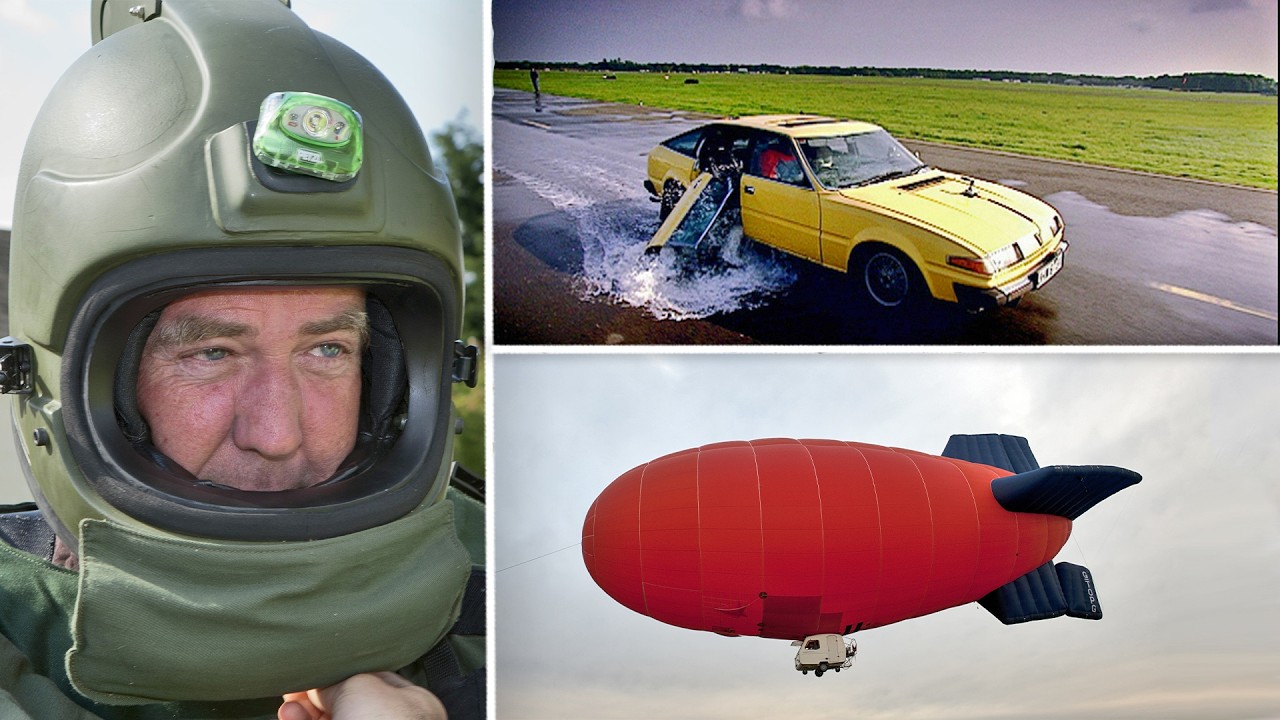
The caravan airship segment is the kind of idea that sounds completely reasonable for about 45 seconds. The machine was 125 feet long, held up by 110,000 cubic feet of hot air, and still had the gas burners where the cooker would go and beds fitted where you would expect beds. May floated it serenely over the English countryside while Hammond drove a Lamborghini Gallardo Balboni, a rear-wheel-drive tribute to Lamborghini test driver Valentino Balboni, which cost 163,000 pounds, toward a succession of caravan sites that kept having to be changed. The airship’s top speed was 17 mph, and it could not make headway in a headwind of more than 13 knots. When the wind hit 12 knots and climbed, May began drifting sideways over controlled airspace near Norwich Airport, radioing that he was approaching a KLM Cityhopper and requesting, politely, that the police helicopter was really not necessary. Hammond, below, was burning through gears in a rear-wheel-drive Lamborghini on B roads through villages he described as places he would never otherwise have seen. As May put it during the final approach over the trees, with the caravan swinging and the gas bursting in short panicked blasts: ‘What I’m actually doing here is helping to realize a dream that was held by many great men. Count Zeppelin, Neville Shute, Barnes Wallis, this is for them.’
Lamar, still somewhere in London
Somewhere in the side streets of central London, a car with no functioning navigation and a driver who had lived in the city for 21 years was circling Harrods for what its passenger described as the eleventh time. Lamar, acknowledged by the transcript itself as one of the gentlemen of pop and nominated for best UK male at the Brits, had finally stopped being polite. ‘You’ve picked me up. You’ve driven me round and round in circles in London. Left, you’re telling me to go right. I’m not taking this anymore. Open this damn door.’
Back at the A303, somewhere near Cornwall, a Lotus with only its minute hand working on the clock was making good time, and a man in a Citroen with the rear door removed to improve airflow was still screaming.