ErikDoesVFX sat at his computer for the better part of four days, watching a whale simulation render, and the number that kept him there was eight. Not eight hours, but the exponential rule that governs every water simulation in Hollywood: double the quality of your voxel grid and the simulation takes eight times longer. That cold math sits at the center of one of cinema’s most misunderstood crafts, and it shapes everything from a one-minute student exercise to the 10 petabytes of simulation data that filled the servers on Kingdom of the Planet of the Apes. To understand why Avatar: The Way of Water looks the way it does, Erik set himself three time-boxed challenges, one minute, one hour, and one hundred hours, and let the results speak for themselves.
How water stopped being drawn by hand
Before computers changed everything, animated water was drawn frame by frame. When a moving surface was too complex to redraw, artists would shoot a single frame and drag a rippled glass pane across it to fake motion. That shortcut held until 1998, when a film became the first to use computer-simulated water, producing results Erik diplomatically called ‘decent.’ Six years later the tools had advanced far enough to flood a city convincingly on screen, and today the same core technique powers every major studio.
The mechanism underneath it is a marriage of two things: particles, which conserve mass reliably, and a smoke simulation, which handles the pressure calculations that give water its surface behavior. Push the particles through the smoke solver and you get something that looks and moves like real water. The bottleneck is the smoke side. Smoke is computed on a voxel grid, a three-dimensional lattice of blocks, and the cost scales brutally. Four times the quality means roughly sixty-four times the compute time. That exponential curve is why a note asking for a bigger splash can mean two days of waiting before anyone knows whether the fix worked.
Erik’s software of choice is Houdini, the industry standard, because it exposes every layer of that process. Rather than a single ‘water button,’ it offers a node-based toolkit where effects are built block by block, and any node that does not exist can be written from scratch in its own scripting language.
One minute, one hour, then the whale
The one-minute simulation was deliberately minimal: a water container, a source, gravity, and a blue color tag. Blocky and thick from the low particle count, it nonetheless produced something recognizable as water in the time it takes to make a cup of coffee, an outcome Erik noted ‘would have been unimaginable 20 years ago.’
The one-hour build went further. Inspired by a Hunger Games sequence where black sludge floods and then hits a wall in a large splash, Erik filmed a real location plate, tracked the shot, built matching 3D geometry for the water to collide against, added viscosity to thicken the fluid, and composited a wet map to mark the darkened ground. The result held up, though the resolution stayed limited by the clock.
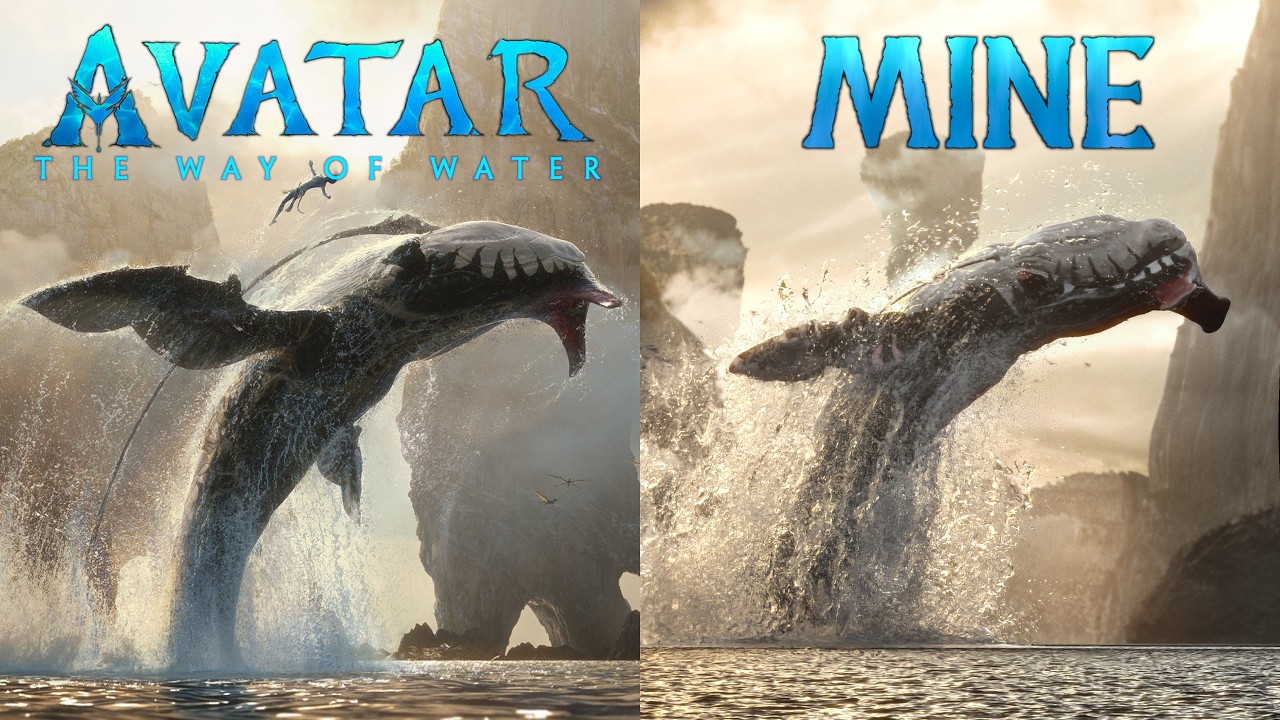
The hundred-hour shot was the one he actually wanted to make. A whale breaching the ocean surface in the style of Avatar, specifically a piece of concept artwork by Dylan Cole that Erik had found and decided he had to recreate. He purchased a whale model, animated it against real whale footage and the film itself as reference, ran iterative low-resolution simulations for weeks of wall-clock time, and when the main water surface looked right, began a separate white-water pass: all the foam, bubbles, and spray that studios simulate and render apart from the base water for finer control. The final render alone ran forty hours. Mountains, floating rocks, birds, fog, and clouds were added around the simulation afterward, because as Erik put it, ‘the environment around the water simulation is almost as important as the water itself.’
The frame that took four days to finish
Somewhere in those hundred hours, the whale’s tentacles sat in a single held pose, waiting for a simulation to confirm whether the motion looked natural.
When the fog settled and the render completed, the ocean surface displacement applied to the water’s edges matched the surrounding ocean plane without a visible seam, and a creature that does not exist landed in water that was never wet.