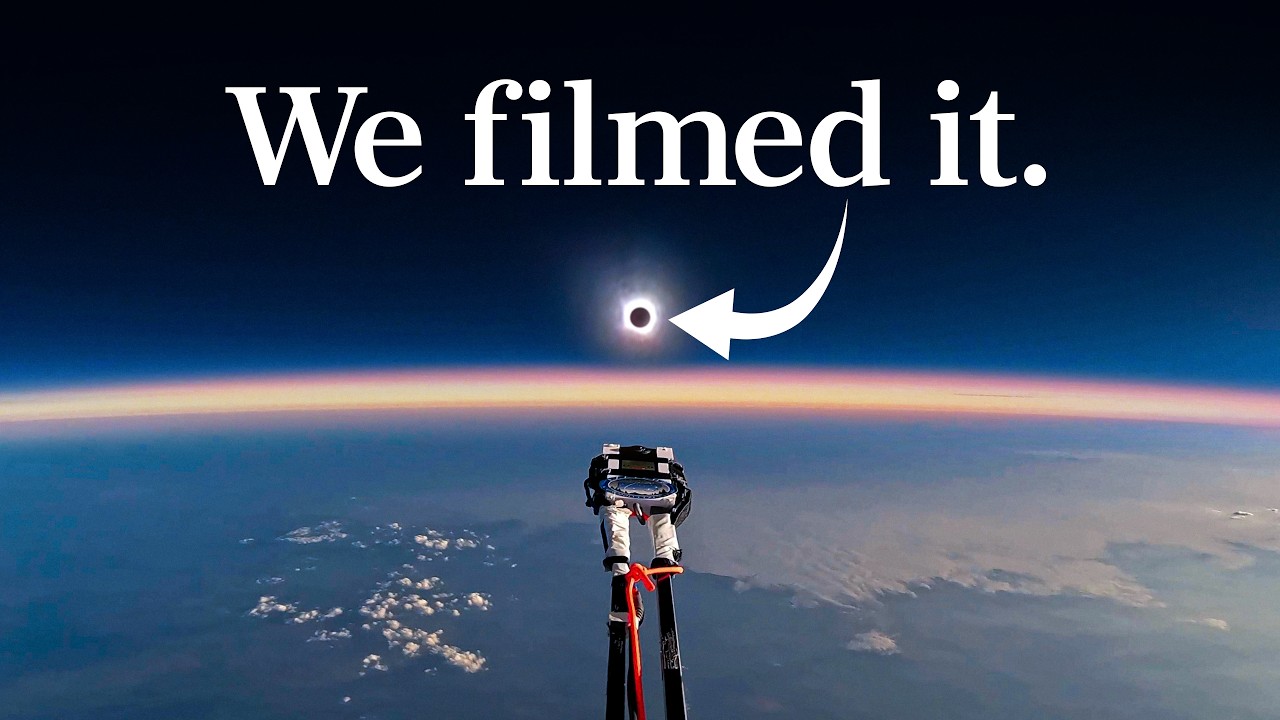
Burgos, Spain went quiet on a morning in 2026 as the moon’s shadow swept across a city that had not seen a total solar eclipse in over a century. For anyone who has only read about totality, the difference between knowing it intellectually and standing inside it is, as one spectator shouted to the Veritasium crew mid-darkness, enough to make your life. The team traveled to Burgos specifically because it sat at the center of the moon’s shadow, and they brought NASA-funded balloon teams, unanswered physics questions, and a sheet of white cardboard that would help chase one of science’s oldest open mysteries.
Why Spain landed in the shadow twice in under 12 months
Angela from the NASA Nationwide Eclipse Ballooning Project, solar eclipse nail art and all, put the rarity plainly: pick any random point on Earth and a total solar eclipse repeats there roughly every 300 years. The fact that Spain was due for a second totality within 12 months is the kind of orbital coincidence that draws veteran eclipse chasers who have already seen eight or even 12 of them.
The Northern Hemisphere gets about 15% more total solar eclipses than the Southern Hemisphere, and the geometry behind that gap is elegant. Because Earth’s orbit is elliptical, the sun appears roughly 7% smaller in July than in January, making totality more likely in summer. The Northern Hemisphere happens to tilt toward the sun in July, so the shadow falls there more often. In about 9,500 years, precession will flip the advantage to the south.
The yearly eclipse count also surprised the crew. Crunching 5,000 years of data, there has never been a year on record with zero solar eclipses. A minimum of two always occur because the eclipse season, the 34-day window when the moon’s orbit crosses the Earth-sun plane, is always longer than the 29.5-day gap between new moons. You cannot pass through an eclipse season without the new moon falling inside it at least once. Partial eclipses near the edges of multiple seasons can push the annual total to five.
What the balloon cameras and a Cold War bomber were actually chasing
The Burgos launch team, working with what one engineer cheerfully called ‘cowboy engineering,’ filled water bottles with rocks as ballast because shipping actual weights to Spain seemed unnecessary. The balloon climbed to roughly 92,000 feet, around 30 kilometers, filming the shadow from the edge of space while the crew signed NASA stickers destined for that altitude.
About 3,000 kilometers away, NASA was also flying a 70-year-old Cold War-era bomber at 460 miles per hour, extending totality to around three minutes compared to the two minutes and 18 seconds available on the ground. The same chase logic was applied in 1973, when the Concorde flew at Mach 2 and held totality for 74 minutes. The jet’s value is not just duration: its stability allows far more sensitive instruments than a balloon, instruments aimed at the corona, the same region that once fooled scientists into naming a fake element. The bright spectral line discovered during the total eclipse of August 18, 1868, led French astronomer Jules Janssen and English astronomer Norman Lockyer to name a new element ‘helium,’ after Helios. A second unexplained line, found in the corona, was believed for 70 years to belong to a new element called coronium. In 1939 it turned out to be iron so hot that 13 of its electrons had been stripped away.
The shadow bands nobody can fully explain
In the final seconds before totality, the team stretched a white sheet on the ground and watched. The faint rippling lines that appeared, moving like slow dark waves, are called shadow bands, and they are still not completely understood. The leading theory links them to narrow beams of light refracting through atmospheric layers of varying temperature and density, the same mechanism that makes starlight twinkle. But an army engineer in Burgos, during the 1905 eclipse at this very location, launched a hydrogen balloon with white sheets underneath specifically to test that theory, and the bands appeared on his hands and on the basket but not on the sheets, suggesting something else is also at work. Angela noted that the moon’s own uneven surface creates multiple point sources of light in the final instants before totality, and those overlapping light sources interfere with each other to amplify the effect, like multiple spotlights crossing on a theater stage. It is, she said plainly, ‘absolutely an open question.’
The sheet of cardboard with rocks from the field
The water bottles, still full of Spanish gravel, sat in the grass after recovery, the balloon having drifted considerably farther than the forecast predicted before landing in what was probably a farmer’s field somewhere outside the city.
When the shadow finally arrived and the corona flared white around the blacked-out sun, one local man spotted the Veritasium crew in the crowd, learned they had come from the other side of the world specifically for this, and announced with complete sincerity that it had made his life. He was not alone. The 360-degree sunset along the horizon, the white corona, and the two minutes and 18 seconds of cataclysmic darkness left the entire square in Burgos briefly unable to form sentences. The corona is white, it turns out, not yellow, and the familiar orange color seen in most eclipse photographs is simply the filter most cameras use. Without the filter, during the two minutes when looking up is finally safe, the sun is just white.