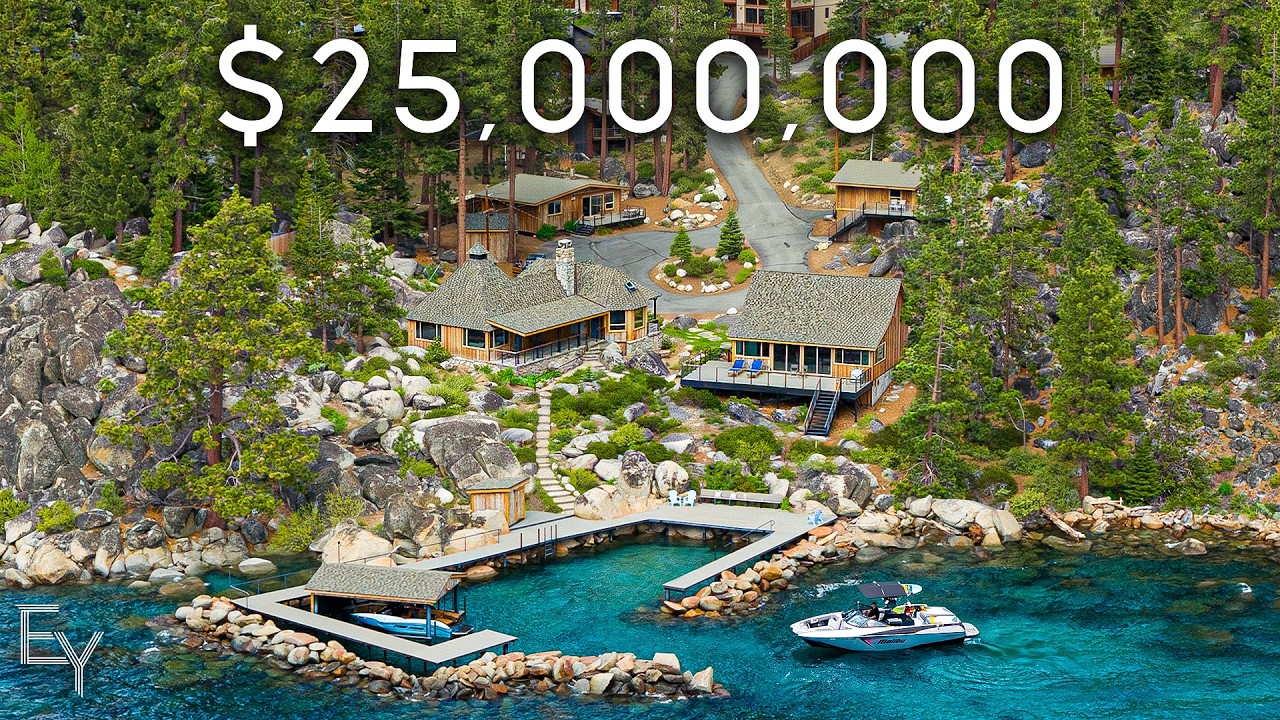
The steel columns go straight through the boulders. At the East Shore of Lake Tahoe, in Glenbrook, Nevada, a 3.77-acre compound sits at the edge of the water with 230 feet of lake frontage and a private marina anchored to granite that has been there since before any permitting authority would allow it today. For anyone who has ever wanted a piece of this lake, this property carries something money alone cannot manufacture: a grandfathered infrastructure that simply cannot be recreated.
A marina that could not be built from scratch
The jetty alone covers roughly 1,900 square feet of deck space. Steel columns and beams support Ipe decking, and because the water is freshwater rather than saltwater, that infrastructure is expected to last for generations with little more than occasional resurfacing. The covered boat slip includes a hydraulic lift so a wake boat can be raised clear of the water when not in use. Getting in and out is straightforward because the surrounding boulders form a natural harbor, shielding the slip from the chop and wind that can make open sections of the lake genuinely difficult to navigate with smaller watercraft.
Enes Yilmazer, who led the tour, put the marina’s significance plainly: ‘You either have it and that’s grandfathered in, or you don’t.’ The Tahoe Regional Planning Agency, the local federal body that governs development on the lake, would not permit a new private structure of this kind today. The boulders that form the harbor walls are not decorative. Metal poles are drilled and bolted directly into them, and the decking is built around and on top of the granite rather than displacing it.
There is also a stainless steel commercial-grade sink on the pier for cleaning fish, a shallow beach entry for swimming, and enough open deck space to add outdoor seating or a fire pit. One detail that genuinely surprised the touring party: the lakefront properties in this area draw their drinking water directly from the lake through on-site filtration systems, and this compound is no exception. The lake is large enough and clean enough that this has been standard practice for these shoreline estates.
Five cabins, all built in 1931, all remodeled in 2020
The five separate structures were originally built in 1931 using pine and granite sourced from the surrounding land, and they were remodeled in 2020. The communal cabin functions as the social heart of the property, with a bar, two full bathrooms, a kitchen in light blue cabinetry with a chiseled-edge stone countertop, Thermador appliances, and a loft space tucked under low ceilings that works best for children. A deck extends out from the main gathering space with lounge beds and a direct view of Mount Tallac across the water.
The primary cabin is the most expansive, with vaulted ceilings, a gas fireplace with a live edge wood surround, a bar with a live edge countertop, heated bathroom floors, cement tile throughout the wet areas, and a loft that extends further than expected, eventually revealing skylights, ceiling fans, a tiny bathroom with kitchen cabinet hardware on the door, and additional storage beyond that. The remaining cabins each follow a consistent two-bedroom, one-bath layout with colored cabinetry, sage in one, dark blue in another, stone countertops, and the same pine-clad exterior that ties the compound together visually.
The listing agent, Greg Ochoa, noted that all five structures currently account for 5,011 square feet, while the parcel carries 33,000 square feet of allowable coverage under TRPA entitlements. The land also carries six residential units of use, with only five currently occupied. Building costs in Tahoe run roughly $1,500 to $2,000 per square foot for a high-quality modern home designed for both summer use and winter snow loads.
The 1984 Jeep Grand Wagoneer parked in the motor court
Parked in the asphalt motor court between the pine trees sits a 1984 Jeep Grand Wagoneer with full wood trim, a brown interior featuring teak, walnut, and mahogany, and doors that close with the solid thud of a different era of manufacturing. It has been there long enough to feel like part of the estate rather than a vehicle someone drove in.
Glenbrook sits on what locals call the Banana Belt of Lake Tahoe’s East Shore, a stretch that receives more direct sun and slightly less snow than the western side, with an unobstructed view of the sunset across the full width of the water. The same boulders that anchor the jetty run through the grounds and up the hillside, and the five cabins step around them rather than removing them, exactly as the original builders did in 1931.
The jetty, the granite, the freshwater. None of it goes anywhere.