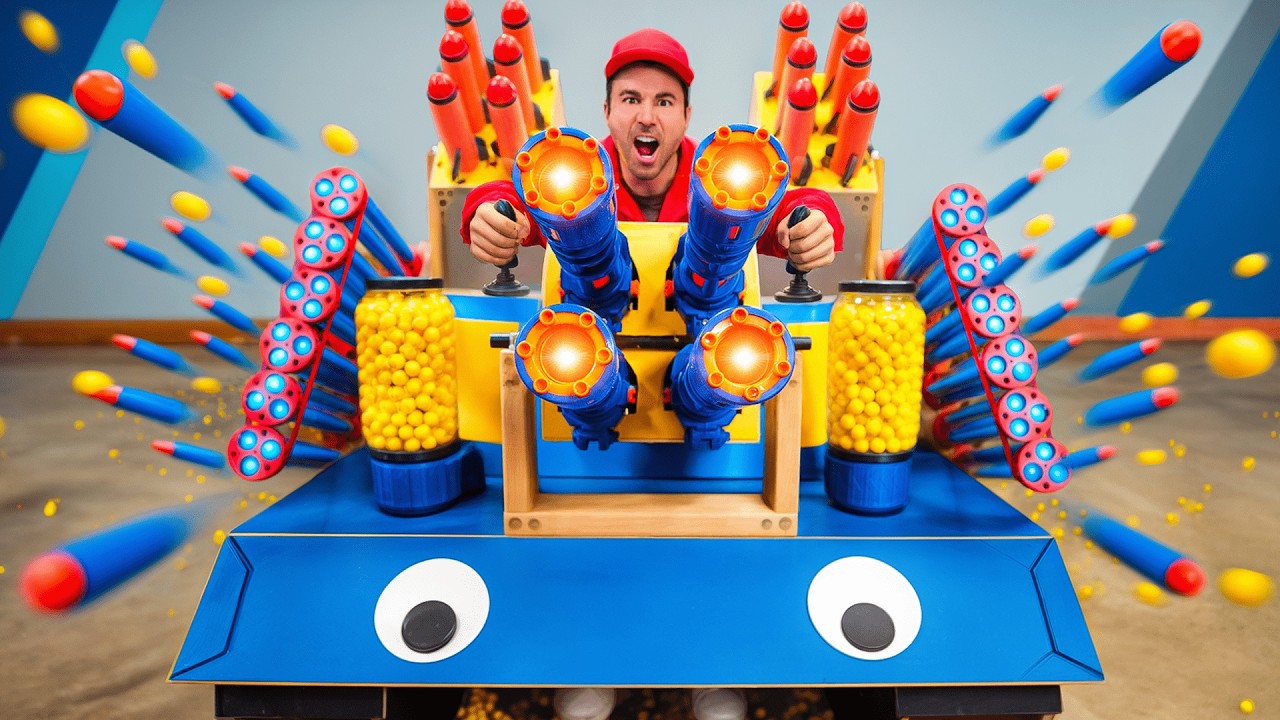
On the frozen surface of Europa, 390 million miles from Earth, a Nerf war broke out. Mark Rober, engineer and Camp Crunch Labs host, had just introduced a custom-fabricated rapid-fire multi-weapon Nerf artillery vehicle to a group of kids and one very surprised Zach King, and the backyard of space camp was about to get loud. For any kid who has ever wanted to know why Nerf darts sting less than a rock but fly faster than a pillow, the answer turns out to live in a concept called impulse. And for the week four campers, the lesson arrived via a tungsten block and a slow-motion camera.
The science hiding inside every foam dart
Before a single blaster was loaded, Rober walked campers through the physics that make Nerf work. He lined up four objects: a handkerchief, a block of foam, a steel weight, and a chunk of tungsten, one of the heaviest non-radioactive metals on Earth. Each one sailed toward a hoop, and each one behaved differently. ‘You have to have this balance,’ Rober explained, framing the engineering problem the original Nerf designers had to solve back in the 1960s. Non-expanding recreational foam had to be heavy enough to carry momentum but soft enough to collapse on impact, spreading the force over time instead of delivering it all at once. He pressed a blaster against a steel plate and fired. In real time, the dart looked fine. In slow motion, it pancaked completely flat before bouncing back into shape. That squish, he told the campers, is the trick: the dart moves fast, but the impulse stays low.
Guest Gio, who recently competed against 100 adults on a Mr. Beast production, tried to sneak a peek at the answer to a trivia question about what Nerf actually stands for. Rober caught him immediately. The answer, for the record from the source itself, is Non-Expanding Recreational Foam.
Three games, one disqualification, and a Nerf tank
The mega experiment scaled up fast. Game one put butterfly nets on Roombas and gave every player 60 seconds to land foam balls in a constantly moving target. Rober sank 58 balls into his own net, by far the most of anyone, then watched his net tip over from the sheer force. He was disqualified. A camper named Hanley won with 16 balls, edging Gio’s 15 and Zach King’s 12. Game two strapped the nets to players’ backs, inverting the objective: fewest balls in your own net wins. Rober finished last in that round too, carrying so many balls the count was described as not worth announcing. A camper named Aurora won.
Game three split the group into red and blue teams and gave each side 10 minutes to build defensive fortifications from raw materials before racing to push 100 foam balls through the opponent’s target. Sticky grenades could freeze a player in place until they returned to base and squeezed a screaming rubber chicken. Red team hit 100 first. Blue team finished with 63. Rober, playing for blue, disappeared briefly after the final whistle and returned pushing the custom Nerf artillery vehicle he had built in secret. The machine fired in every direction. The apology came immediately after.
The episode also introduced the week four at-home super challenge: build a diorama or miniature world, photograph or film it, and submit to Camp Crunch Labs within 10 days. Rober, who grew up making shoebox dioramas with peepholes, said he genuinely cannot predict what kids will create and finds the results ‘so delightful.’
The rubber chicken that controlled the battlefield
Somewhere in the chaos of game three, the red team’s rubber chicken disappeared. Players on both sides were shouting its location. A timeout meant nothing without it: under the rules, a player hit by a sticky grenade had to return to base, find the chicken, and squeeze it until it stopped screaming before re-entering the game.
The camera eventually found it on the floor of the base, slightly away from where anyone expected it to be, surrounded by scattered foam balls and a lot of unfinished strategy.
By the time Rober rolled out the artillery vehicle and the white flag went up, Europa’s icy surface had been thoroughly warmed over. The Roomba targets were still moving somewhere in the background, faithfully vacuuming up 100 rounds of non-expanding recreational foam.
 Wake up to Only Happy News!