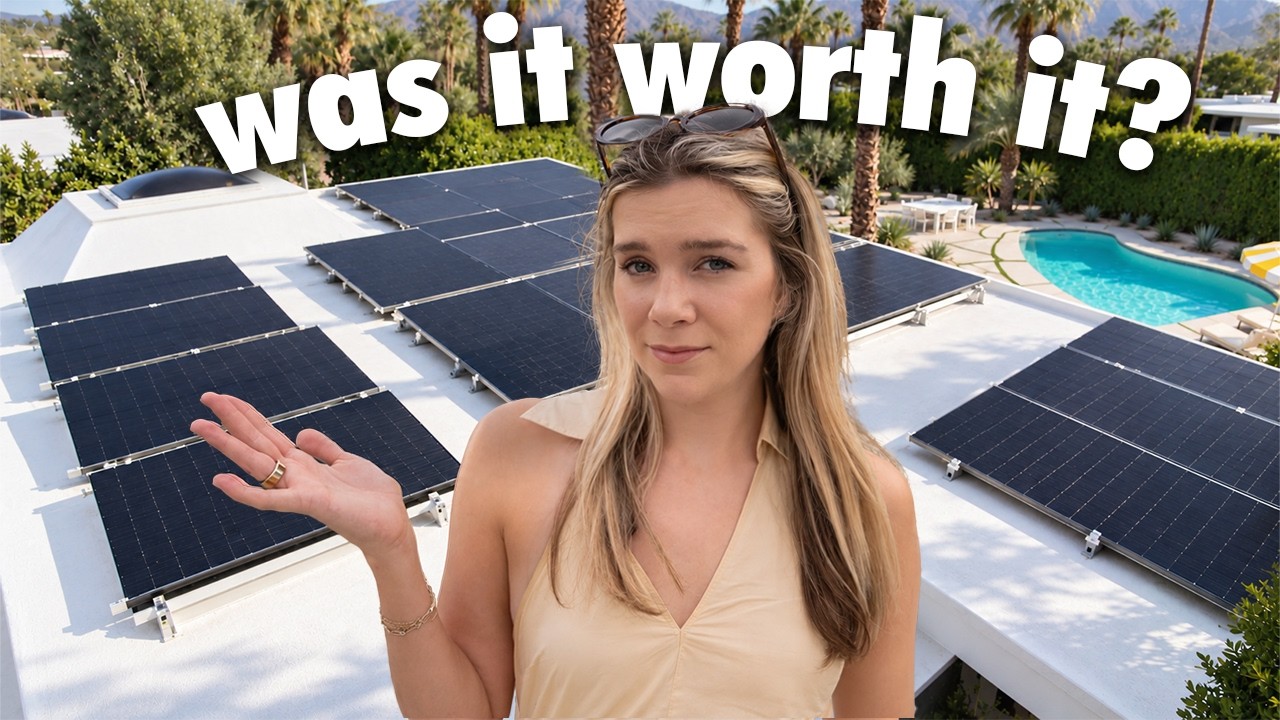
Shelby Church‘s Palm Springs house is barely 1,200 square feet, roughly the footprint of a modest apartment, yet two years ago her electricity bill was running $600 to $800 a month. That number, staggering for a small desert home, is what pushed her toward a $20,000 solar investment and a very public experiment in whether the math actually works. Two years of real utility bills later, she has an answer: the system has already returned $10,000 in savings, and she is now projecting a full payback period of just four years.
From $7,500 a year down to $2,400
Before the panels went in, Church was spending roughly $7,500 a year on electricity at the Palm Springs house. The first year with an 8 kW system brought that figure down to around $3,000, a drop of about 60 percent. Year two went further. Running from October 2025 through September of the following year, her bills averaged roughly $200 a month, or $2,400 for the full year. Part of that additional reduction came from an unexpectedly low-tech fix: she installed blackout blinds in the living room. Keeping the desert heat out of the glass meant the air conditioning ran less, and less AC meant less draw on the grid during the hours when electricity costs the most.
Inflation sharpened the case further. Electricity rates in her area climbed 10 to 14 percent between 2023 and the time of her update, with delivery charges up 10 percent and the actual electricity rate up 14 percent. The $7,500 annual bill she used to carry would now cost closer to $8,500 if she had never installed panels. Church put it plainly: ‘There’s going to be a time where if I didn’t have solar, the electric bill would be like $2,000 a month.’
Why the battery changes the calculation for new buyers
The more consequential update in year two was not the blinds but a 5 kWh battery and smart panel system that Church added to the setup. The smart panel connects to her main electrical panel and lets her select up to 10 circuits to keep running during a power outage, including the refrigerator, Wi-Fi, and lights in specific rooms. Palm Springs logged six grid outages in the past year, none from storms, all from routine maintenance, which matters because Church rents the house on Airbnb and cannot leave guests without power for four-hour stretches while food in the fridge spoils.
The battery’s financial logic is built around time-of-use pricing. Solar panels generate their strongest output between roughly 9 a.m. and 1 p.m., but the grid charges peak rates from 4 p.m. onward. Without a battery, a homeowner sells cheap power back in the morning and buys expensive power in the evening. Church scheduled the battery to charge between 10 a.m. and 3 p.m. and discharge between 4 and 9 p.m., covering the house during the priciest hours entirely from stored solar. She estimates that shift will save her several hundred dollars a year on top of the panel savings alone.
For anyone installing solar today rather than two years ago, the battery’s value is even greater. Church was grandfathered into a net-metering arrangement that let her sell surplus power back to the grid at close to retail rates. That program is no longer available to new customers in her area. A neighbor installing the identical 8 kW system today would pay more on their bill than Church does, at the same usage, simply because they cannot get credit at the old rate. A battery sidesteps that problem by keeping more of the generated power in the home rather than sending it to a grid that now pays less for it.
The switchover no one notices
When the grid drops, the battery system shifts the selected circuits over in 20 milliseconds.
For guests asleep in a house that has already had six outages in a single year, that gap is effectively nothing. The fridge keeps running. The Wi-Fi holds. The lights stay on.
Two years into a $20,000 bet on a small desert house, half the investment is already back. The blackout blinds cost almost nothing. The battery cost $10,000, a price Church notes would have been closer to $30,000 for comparable output a few years earlier. At $200 a month and rates still rising, the ledger keeps moving in one direction.
 Wake up to Only Happy News!