The Leaning Tower of Pisa leans exactly 15 feet off true, and the people gathered around its base are mostly trying to make it look like it is resting in their hands. Malini Angelica watched them for a moment, then admitted she got involved anyway. That small, self-deprecating surrender to the tourist ritual is what Tuscany does to even the most determined traveler: it pulls you in slowly, then all at once, province by province, until a lunch stop in a medieval hill town becomes the best meal you have had in years. The region is bigger, stranger, and more varied than any single postcard ever suggested, and the journey through it begins at the place everyone passes through and not enough people actually stop to see.
Pisa after dark, when the crowds thin out
Most visitors arrive in Pisa, photograph the tower, and leave. That is a miscalculation. The city spent nearly 300 years, across the 11th through the 13th centuries, as one of the Mediterranean’s dominant sea powers, sending ships measuring up to 150 feet in length across open water and rivaling Venice and Genoa for control of trade routes. That wealth built the Piazza dei Miracoli, a sequence of three monuments on a manicured lawn that the city itself nicknamed the Field of Miracles. The cathedral’s facade, covered in golden mosaics and layered columns in the Romanesque style particular to Pisa, was completed more than a century before the Renaissance began. Michelangelo reportedly came to study it. The bell tower started leaning almost immediately after construction, because the ground beneath it was too soft and the foundation too shallow. Architects across the centuries tried and failed to correct it. People still climb to the top.
By evening the piazza empties and Pisa becomes something else entirely. Locals drift out for the passeggiata along the banks of the River Arno, the heat finally dropping, and that stroll tends to settle naturally into aperitivo on an outdoor terrace. ‘You forget because these towns are full of these old beautiful relics,’ Angelica observed. ‘Pisa is a force with the leaning tower and the Duomo, but they will come to life in the evening, and this is when you get a real sense of what local culture is all about, when everybody’s out on the street just living their life.’
Volterra, alabaster, and nearly 3,000 years of the same craft
Tuscany’s history runs deeper than Rome. The region takes its name from the Etruscans, whose civilization was flourishing here when Rome was still a minor settlement. Volterra was one of the most important Etruscan cities, protected by a four-mile wall, and its ancient gate, the Porta all’Arco, still carries the carved outlines of three heavily eroded Etruscan heads in sandstone. The stone is worn almost smooth, but it is still there, still part of a working entrance into the town.
The Etruscans also worked alabaster, quarried from the hills around Volterra, and that tradition has continued with barely an interruption for close to 3,000 years. Only a handful of workshops remain in the historic center. In one of them, a sculptor named Gabrio had just finished a life-size Labrador carved entirely from local alabaster. It had taken him two days. He explained that alabaster is softer than marble, which makes fine detail easier to achieve, and the dog’s fur showed exactly that: individual strands, rendered by hand, in a material that glows faintly when held to the light.
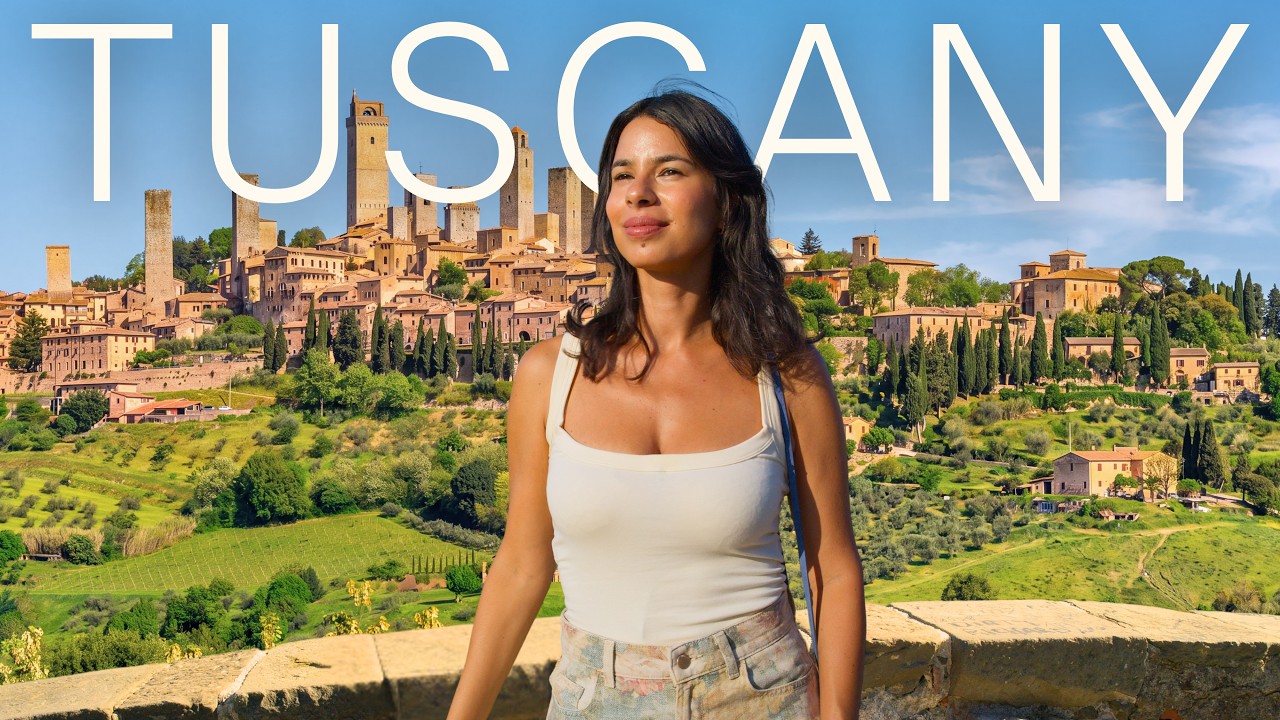
The province of Siena holds the landscapes that most people mean when they say Tuscany: rolling green hills, lanes of cypress trees, vineyards, and medieval hilltop towns. San Gimignano rises above it all with a skyline of tall stone towers, 16 of the original 60 still standing, built by wealthy families as fortified homes to protect against rival city-states. In a small shop near the Piazza della Cisterna, wild boar salami arrived on a wooden board alongside a glass of Vernaccia, a local white wine made from the grape of the same name. It was the first Italian wine ever to receive DOC status, in 1966. The salami had a noticeably more intense, slightly gamey flavor than standard pork, which is the point.
Further north, the province of Lucca trades rolling hills for dramatic marble peaks and Alpine forest. The city of Lucca is enclosed by Renaissance walls that have stood since the 16th century and were never destroyed. Inside, the Piazza dell’Anfiteatro occupies the exact footprint of a Roman amphitheater, its oval shape still intact, the surrounding buildings constructed directly on top of the old arena walls. A medieval tower nearby, built by the Guinigi family as a symbol of status, has mature trees growing from its roof. In the smaller hill town of Barga, lunch at a local osteria meant tortelli al ragu, a steak, and a tiramisu, all of it paired with a red from the region. The marble quarried from the mountains visible from Barga’s cathedral supplied material for the statue of David and much of the artwork now in Florence.
The alabaster Labrador on Gabrio’s workbench
On the bench in Gabrio’s workshop in Volterra, the finished Labrador sat next to the tools that shaped it: chisels scaled for detail work, a stone surface worn smooth from years of use, and a block of raw alabaster still waiting. Two days of work, one dog, the same material the Etruscans used.
That is the version of Tuscany that takes the longest to find and is the hardest to leave: not the tower or the towers or the vineyard views, but the craftsman still at his bench in a city that has been doing this since before Rome existed, pressing his card into a visitor’s hand so she can find his website later.
 Wake up to Only Happy News!