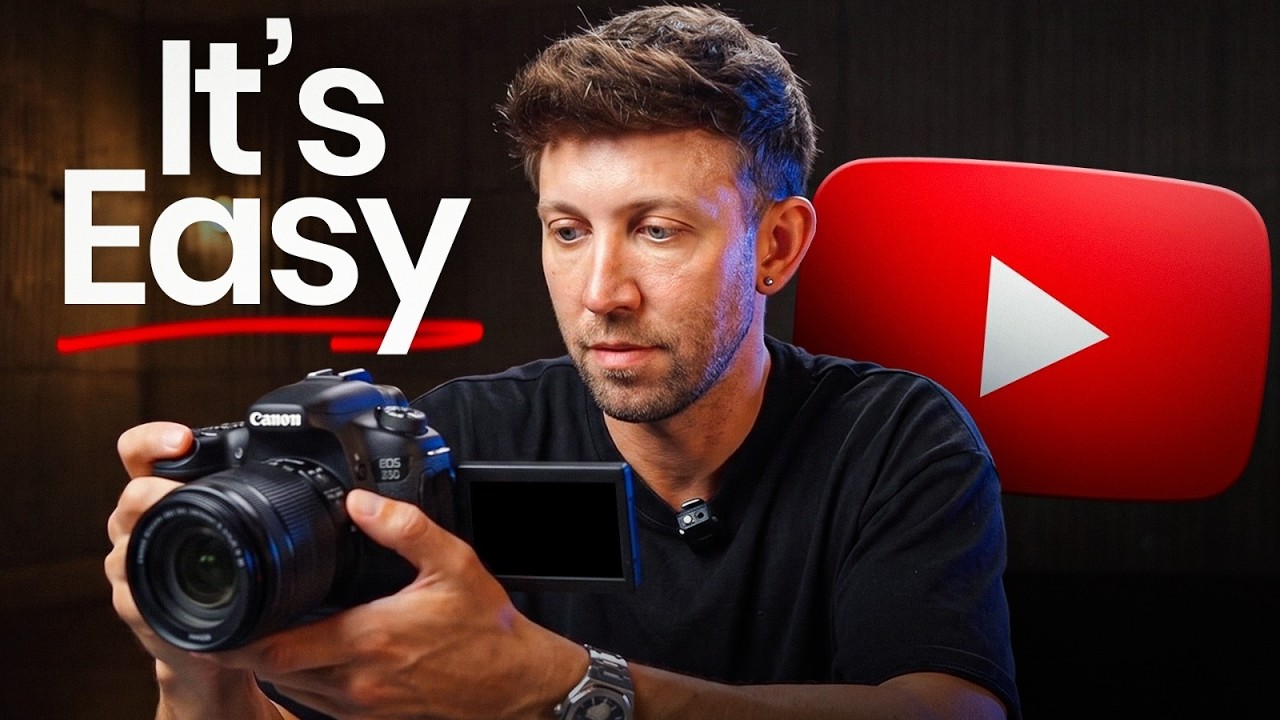
The record light flicks on, and suddenly the person who had so much to say goes completely blank. It happens to almost every new creator, and it is not a personality flaw or a talent gap. It is a solvable mechanical problem, and a creator who spent nearly two decades building an audience of over 15 million subscribers has mapped out exactly how to solve it, one unglamorous rep at a time.
Why the camera freeze happens and how to kill it fast
The awkwardness on camera has a specific cause: the moment the record light turns on, attention shifts inward. The fix is to redirect that attention outward, toward a single imagined viewer rather than toward one’s own reflection on the monitor. Three concrete mechanics help that shift happen quickly. First, lock eyes directly on the lens, not the screen; eyes drifting down to a monitor read as uncertainty to anyone watching. A small sticker or arrow placed next to the lens gives a focal point. Second, know the first two lines cold before hitting record, because the freeze almost always happens in those opening seconds. Third, warm up out loud before filming, running the intro a couple of times until the voice actually sounds like itself.
The camera also quietly drains about half of the energy a person brings to it, which means what feels slightly over the top in the room usually reads as simply engaged on screen. Natural hand gestures help too: standing frozen signals nerves, while movement signals calm. And beginners who restart every time they stumble lose momentum and spiral further into their heads with each take. The better habit is to keep going, fix it in the edit, and let a rhythm build.
Getting comfortable is only the beginning
Comfort and watchability are two completely different things. Once the camera fear is managed, the next skill is how to actually talk, because a comfortable but boring creator will still lose the audience in seconds. Three rules govern this. Get to the point immediately: every second spent on ‘hey guys, welcome back’ is a second someone might use to leave. Every sentence must earn the next one by either moving the story forward or setting up a payoff. And open a loop early, something the viewer wants the answer to, and do not close it until later, so there is always a reason to stay.
Purposeful pausing matters more than most beginners realize. Silence feels dangerous on camera, so new creators rush through everything at the same speed. A well-placed pause after an important point makes the audience lean in and signals that what was just said actually mattered.
The third skill is the one nobody wants to hear about: reps. As the creator put it plainly, ‘the reps are the shortcut.’ It took years to reach the first 10,000 subscribers, with many near-quit moments along the way. Then, after reframing slow growth as training rather than failure, the jump from 10,000 to one million happened within the following year. A fitness creator he worked with nearly walked away when his videos were stuck under 1,000 views with barely 100 followers. A few weeks later, after staying in it, that same creator had videos hitting 1, 2, and 5 million views and left his job entirely. Same person, same camera, same face.
The sticker next to the lens
Somewhere in a beginner’s setup right now, there is a phone or a camera with nothing taped next to the lens yet.
The whole system collapses or holds right there. Knowing where to look turns out to be the first thing, and the smallest thing, that changes everything about what a viewer feels when they watch.
 Wake up to Only Happy News!