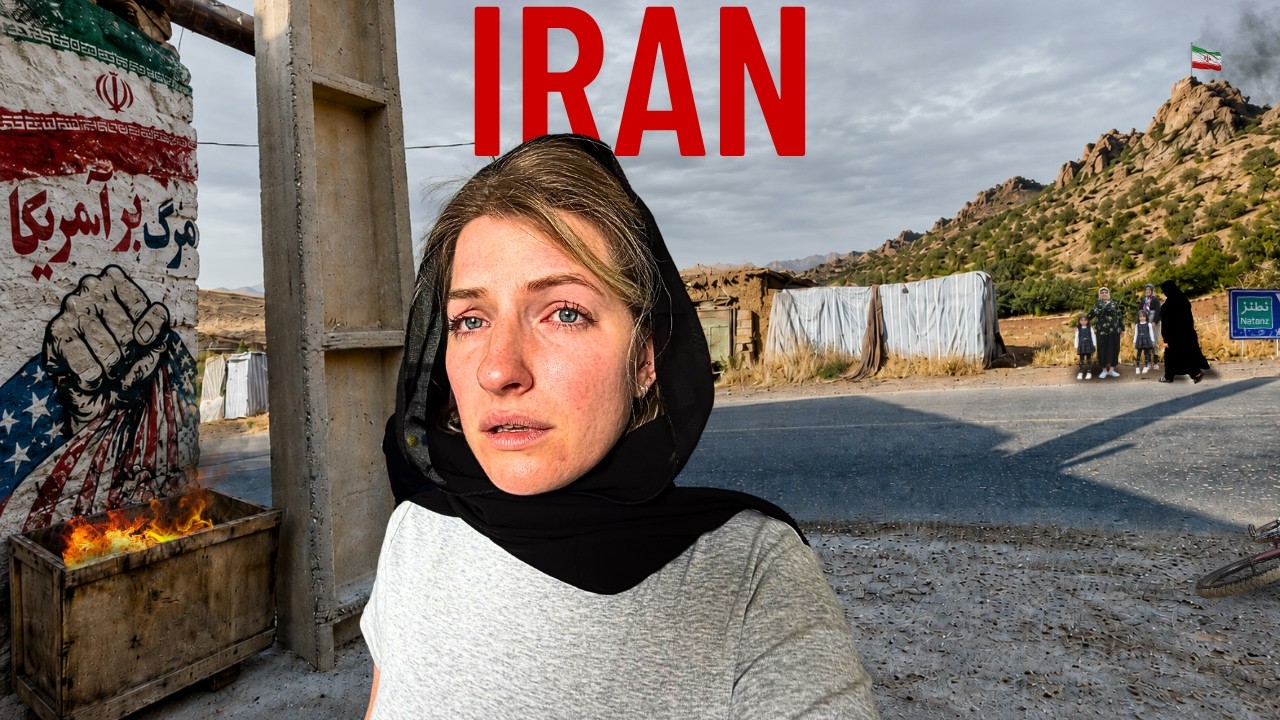
A dust road climbs for five kilometers through the Zagros mountain range before it reaches Dulab, a Kurdish village so remote and so quiet that the midday silence feels like a presence of its own. Matt and Julia had spotted it on a map the previous evening and decided to drive up with their guide Amin, who had never been there either. What they found at the top was a view that makes the white-knuckle ascent feel entirely worth it, and a country that looks almost nothing like the one broadcast in the news.
The journey begins at the UNESCO World Heritage site of Persepolis’s spiritual counterpart, an ancient Zoroastrian temple that announces immediately how layered Iranian history runs. From there the route turns northwest into the Kurdish mountains, where the landscape opens into vast brown peaks and plunging valleys. The last stretch of road to Dulab is unpaved, and the car’s passage along a crumbling track above a long drop prompts a candid admission from Julia that her nerves were fully engaged.
Inside a house that hasn’t changed much in centuries
At the top, the village appears almost uninhabited in the midday heat. The houses are built from mud and stone pulled directly from the mountainside, with thatched wooden roofs and verandas facing the view. Water tanks and satellite dishes confirm the village is connected to the outside world, but just barely. A Kurdish woman working there offers to show the pair around her parents’ house, a sprawling multi-room structure with a second kitchen, additional floors, and a carpet in what their guide identifies as the Kan pattern, a city style distinct from the more famous medallion design. Julia remarks that the people here carry a calm and genuine warmth: ‘They’re happy to tell you about their life, what they do, their family, where they study.’
Fresh bread appears from a roadside encounter on the way back down, passed through a car window by a shy local woman who had just slapped the dough onto a hot surface moments before. The bread is refused, handed back, refused again, and eventually accepted with warm ceremony.
Old Russian rubles and eggplants in Hamadan
The route curves toward Hamadan, described as one of the oldest cities on Earth and the first capital of Iran. The covered bazaar there runs busier than expected for the hour, a stream of shoppers moving past stalls piled with grapes, eggplants, and cuts of meat. Inside one shop tucked into the old caravanserai, a merchant produces a full album of Russian Imperial rubles from 1910, brought back from Baku by his grandfather who traded there regularly. Alexander III lottery tickets surface next. The Russian ambassador, Amin explains, once offered to buy the collection and was turned down flat.
Dinner that evening is served inside a converted hammam, its chandelier suspended above the old bathing chambers. The dish is a lamb stew with chickpeas, onion, tomato, and potato, cooked for at least ten to twelve hours until every ingredient collapses into the broth. The sauce is separated, the solids are mashed, and the result is ladled back together at the table.
A beach that holds a complicated feeling
A six-hour drive northeast brings a landscape shift so abrupt it reads as surreal. Brown desert mountains give way to gray cloud and deep green, and then the Caspian Sea opens up. Families sit with cars parked right at the waterline, shisha smoke drifting off the seafront. The beach is also scattered with litter, and a syringe turns up near the water’s edge. Amin mentions that during the era of the last Shah, this stretch was slated to become a casino destination and major resort. It did not happen. The stray dogs roaming the seafront are enormous and everywhere, an unexpected detail in a country where dogs are technically considered haram.
The Caspian shares its shores with Russia, Turkmenistan, and Kazakhstan on the other sides, each with entirely different political histories pressing up against the same body of water.
The nutcracker at the back of the caravanserai
Back in the Hamadan market, an ornate antique object passes between hands in the collector’s shop. Matt assumes it is a book clasp for binding spines. The merchant demonstrates it is a nutcracker. The moment lingers.
The dust road up to Dulab had looked, from the bottom, like a bad idea. From the top, with a Kurdish family’s home spread across multiple floors behind them and the entire mountain range laid out below, it looks like the only possible choice.
 Wake up to Only Happy News!