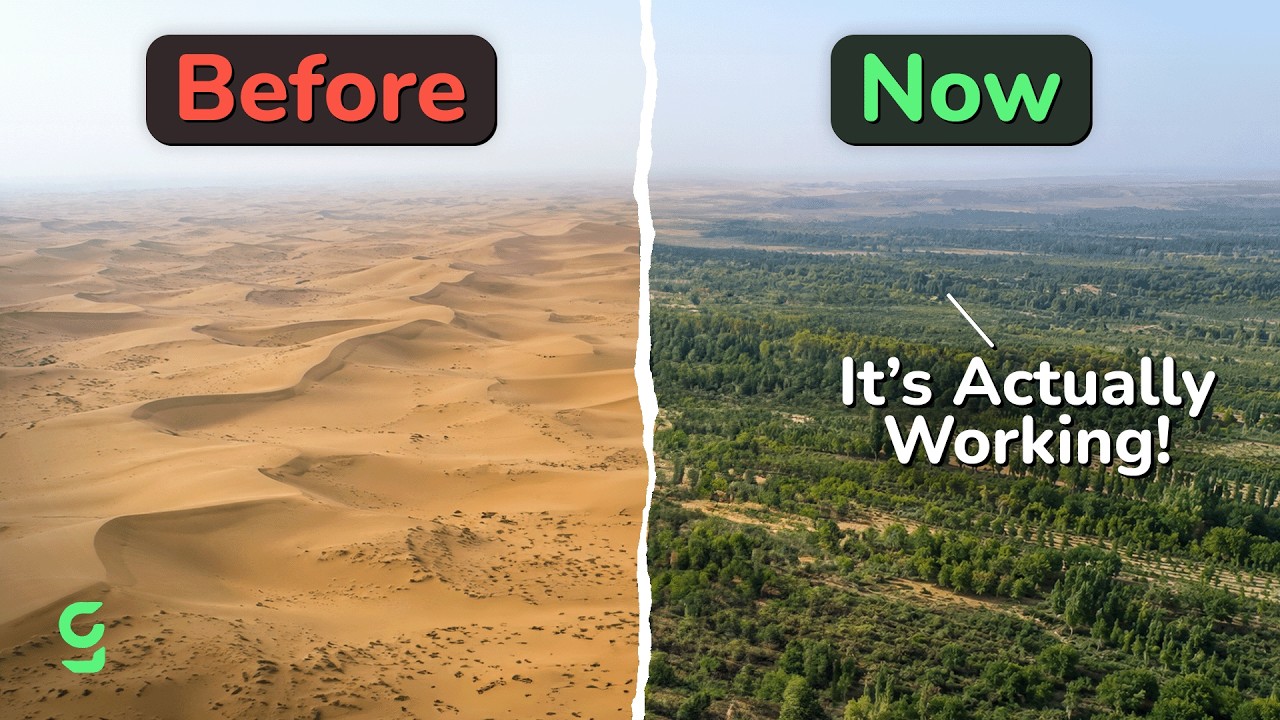
Straw and sticks. That is what millions of workers pressed into the sands of northern China over five decades, arranging them into grids across a landscape that was swallowing itself. The Gobi Desert was expanding at more than 10,000 square kilometres a year back in the 1980s, an area roughly double the size of Greater Tokyo vanishing into dust annually. A new study has now confirmed that the effort to stop it is working, and the proof ripples outward into forests, oceans, vaccines, and electricity bills across nearly a dozen countries.
The straw checkerboards are the unglamorous engine of China’s Great Green Wall, a manmade forest system that will soon cover an area the size of Germany. The grids slow wind, trap moisture, and hold sand in place long enough for young trees and shrubs to take root. Since 2000, northern China has been reclaiming more than 1,000 square kilometres of desertified land every year. Overall, the country’s desertified land has declined by around 10%, and forest cover across the project region has nearly tripled. Early plantings suffered because workers relied on a single tree species, leaving whole stands vulnerable to disease. China eventually began mixing in native plants, and researchers now stress that restored landscapes need decades of ongoing maintenance and community involvement to hold.
When the grid on your electricity bill disconnects from the gas price
Solar energy generated a quarter of the European Union’s electricity during a single month for the first time ever. According to a report from Ember, solar produced a record 52 terawatt-hours in June 2026, enough to power around 180 million households for an average month, making it the single largest source of EU electricity that month, ahead of nuclear, gas, wind, and hydro. A decade earlier, in June 2016, solar accounted for only around 6% of EU electricity. It took five years to climb to 10%, then another five years to reach 25%.
Spain made that acceleration tangible this year. When global gas prices surged following the conflict between Iran and the United States, many expected household electricity bills to follow. They did not. According to a separate Ember report, Spain’s growing network of solar farms and wind turbines had decoupled electricity pricing from gas pricing to a significant degree, saving the average household around 10 euros a month. Across Spain’s roughly 19 million households, that adds up to nearly 190 million euros in savings every single month.
The forests that started gaining ground around 2010
A study published in Science found that mangrove forests are staging a global comeback. After declining from the 1980s through the late 2000s, something shifted around 2010: globally, gains began to outpace losses. Existing forests are also becoming denser, storing even more carbon than before. Mangroves can store up to four times more carbon compared to forests on land. Researchers credit stronger conservation laws, reduced deforestation, and the mangroves’ own remarkable ability to recover and expand naturally onto new coastlines.
The ocean floor is also recovering where it has been given the chance. Scotland’s South Arran Marine Protected Area banned bottom trawling in 2016. Scientists have since documented that protected parts of the seabed now support twice as many species compared to nearby areas where the practice continues.
Elsewhere, the numbat, a small termite-eating mammal and one of Australia’s most iconic animals, has climbed from roughly 300 individuals in the 1970s to around 2,500 in the wild as of 2026, the result of decades of conservation work.
UNESCO added 12 new Global Geoparks to its international network this year, including Tunisia’s very first entry, a landscape of dramatic desert terrain, ancient cave houses, and traditional oil factories. A geopark in China documents how Tibet was shaped over millions of years and hosts a yearly pilgrimage festival. A Russian geopark preserves the remains of a coral reef that existed around 300 million years ago, with rocks dating back as far as one billion years. A small Greek island holds one of the best-preserved volcanic craters formed around 150,000 years ago, including the Stefanos Crater, which has become a natural laboratory for volcanology.
On public health, a new United Nations progress report notes that more than 90% of the world’s population now has access to electricity, up five percentage points since 2015. Internet access has grown from 40% to nearly 75%. The global mortality rate for children under five has fallen by as much as 13% since 2015, new HIV infections have dropped by over 30% in the past decade, and 47 countries have been declared malaria-free by the World Health Organization.
Cigarette smoking among American adults has fallen to its lowest level ever recorded: only about 1 in 11 adults smoke today, compared to roughly 1 in 2 in the 1960s.
And researchers have developed a swab-based screening tool for oral cancer that correctly identified the disease with more than 95% accuracy while delivering results in about an hour, compared to the current standard of a surgical biopsy that can take weeks. Larger clinical trials are underway, and the researchers hope it could reach hospitals and clinics within the next two years. HPV vaccination, meanwhile, has already driven cervical cancer deaths dramatically lower in high-vaccination countries. In England, where around 90% of women in their early 20s were already vaccinated, not a single woman in that age group died from cervical cancer between 2020 and 2024.
Microphones added to a hillside above Lake Victoria
At Old Bonjoge, a community beside Lake Victoria in Africa, soil had been washing off bare hillsides for years, carrying farm chemicals into the lake and triggering sudden floods whenever it rained hard. Workers brought in drones equipped with laser scanners to identify the best planting sites, fixed sensors to the trees to track growth and health, and installed microphones in the forest to listen for returning animals. Eighty thousand trees were planted and monitored for three years.
The Great Green Wall began with straw pressed into sand by hand. Fifty years later, the desert is retreating, and the forests are listening for what comes back next.