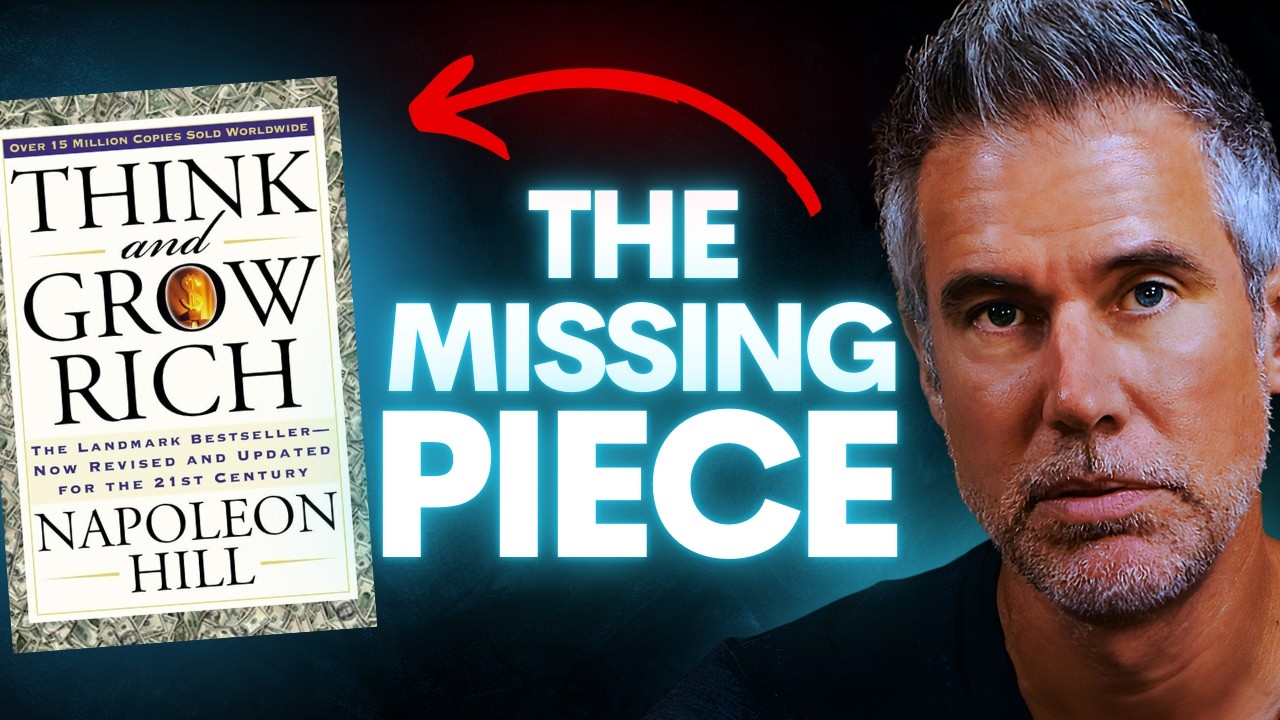
David Bayer was standing on a hotel porch in Mexico, watching a whale breach off the coast, when he turned to his wife and asked a question that would eventually land them on a 3-acre property in Puerto Rico surrounded by jungle and backing onto a lake. That moment, and the years of searching and almost giving up that followed, is how Bayer opens his deep reading of Napoleon Hill’s ‘Think and Grow Rich‘, a book built on 13 principles Hill extracted from studying the most successful people of his era over 25 years. For anyone who has ever wondered why effort alone does not seem to be enough, what Bayer lays out here is a framework for understanding why, and what is actually missing.
Where desire ends and the other twelve begin
Hill’s first principle is desire, and Bayer is quick to note that most people spend more energy cataloguing what they do not want than getting precise about what they do. The Puerto Rico story is his lived proof: he and his wife held a specific vision, a retreat-style home with enough space for private client work, for family, for friends, and they refused to settle for overpriced condominiums or golf-course communities that could have been anywhere. When they nearly gave up, his mother-in-law surfaced a listing online that matched almost exactly. Three years after moving in, a friend pointed to a vision board on the wall from 2012, and the house on it, a Japanese-style home Bayer had cut from a magazine, was structurally identical to their Puerto Rico property, minus two decorative turrets.
From desire, Hill moves to faith, which Bayer grounds in behavioral psychology and neuroscience rather than leaving it abstract. The brain, he argues, is a goal-achieving machine: belief shapes thought, thought shapes feeling, feeling drives action, and action produces results that confirm the original belief. Henry Ford’s line gets a mention here, though Bayer pushes further, drawing on Neville Goddard’s concept of a fourth dimension of imagination where every possible desire already exists in energetic form, waiting to be materialized through deliberate alignment.
Principle three, autosuggestion, is where Bayer diverges most sharply from Hill. He is direct about it: ‘I found early on in my journey that affirmations actually made things worse, because I’m saying these things and it doesn’t feel right to me, and then I move into thinking this is never going to change for me.’ His argument is that you cannot plant new programs in soil full of weeds. Limiting beliefs and unprocessed patterns have to be cleared first. Affirmations work, he says, but only after the field is ready.
The principle that holds the other twelve together
Principle thirteen is persistence, and Bayer calls it the quiet force most people overlook. Hill’s logic is straightforward: without sustained effort, even the strongest desire collapses at the first real obstacle. Bayer’s addition is more nuanced. He draws on Bruce Lee’s image of bamboo, strong but able to bend, to argue that persistence does not mean rigidity. It means showing up flexible and humble, trusting that a plan which does not survive contact with reality is not a failure but information. ‘Things not going as planned,’ Bayer says plainly, ‘is the plan.’
The intervening principles cover organized planning, decisiveness, the mastermind group, subconscious mind training, the brain as a broadcasting and receiving station for thought, intuition, and the mastery of six specific fears Hill identifies: poverty, criticism, ill health, loss of love, old age, and death. Bayer links the fear principle directly to the nervous system, noting that daily practice of the other twelve gradually shifts a person from the fight-or-flight state of the primal mind toward what he calls the parasympathetic mode. That shift, he argues, is what the ninth-step promises in Alcoholics Anonymous are also describing, just through different language.
Hill’s central claim, that success begins in the mind, is one Bayer accepts without reservation. His own specialization, combining behavioral psychology, neuroscience, spirituality, and entrepreneurship, grew directly from a history of worry, addiction recovery, and 12-step work. None of it was pursued strategically. It assembled itself, and he recognized it only by looking backward.
A vision board from 2012
The image is still there behind Bayer’s desk in Puerto Rico: a Japanese-style home he pinned to a board fourteen years before he moved into a house that mirrors it almost exactly. Nobody put it there as a reminder. It has just been sitting in place, doing what vision boards apparently do when the other twelve principles are running underneath.
Hill published his findings, and Bayer has spent years pressure-testing them against his own life and the lives of the entrepreneurs he works with. The framework keeps holding. Persistence, he argues, is what turns the other twelve from ideas into results, not because it forces outcomes but because it keeps a person in the game long enough for the architecture of coincidence to do its work.