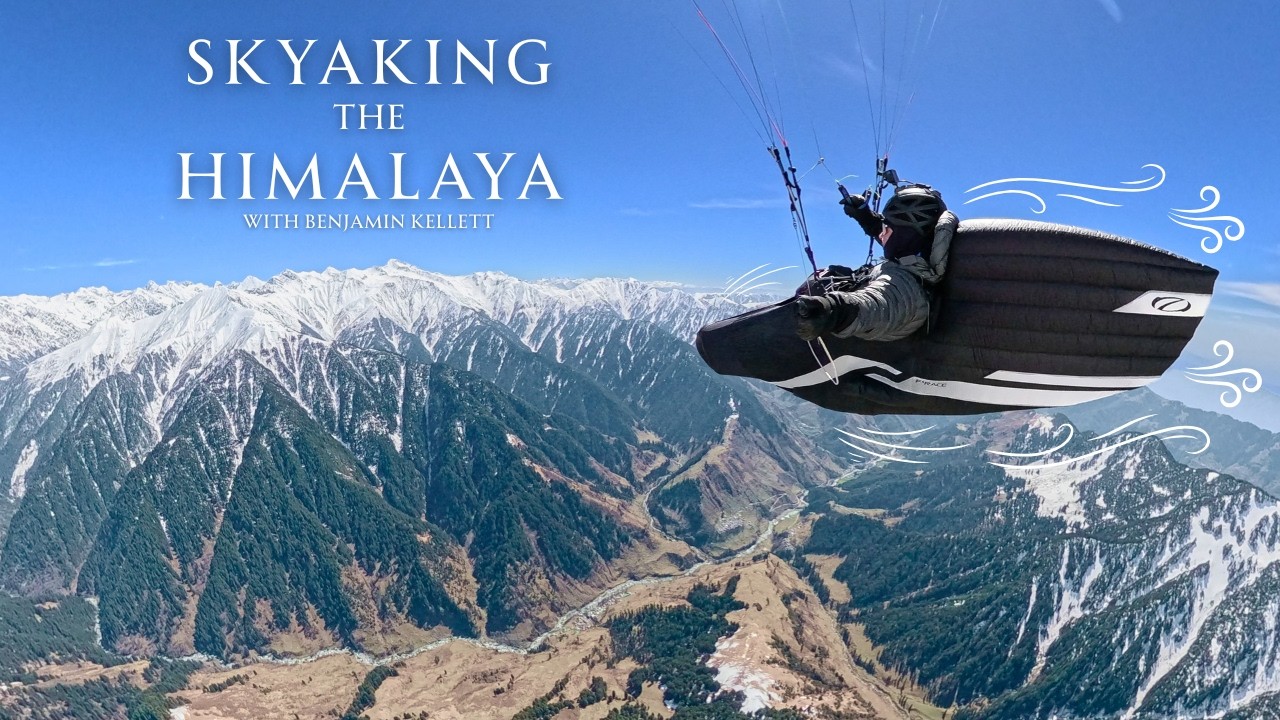
Bir, in the mountains of northern India, is where Benjamin Kellett stood on a slope with everything he needed to survive strapped to his back: a tent, a sleeping bag, food, and a lightweight paragliding wing. For four days, the plan was to never return to the valley at day’s end. Instead, land somewhere remote, sleep in the mountains, and take off again at dawn, reading the ridgelines the way a kayaker reads white water. The Himalayan vultures were already up there doing it, climbing thousands of meters without a wingbeat, drifting from one valley to the next on columns of air heated by the morning sun. Kellett intended to follow them.
How the first crossing nearly ended in a mudfield
Day one launched from the Bir Billing takeoff, a site known across the paragliding world for its massive thermals and the sheer scale of terrain on offer. Kellett pushed immediately for the ridge separating the Kullu and Kangra valleys, climbing to 5,000 meters and making the crossing toward Kullu with roughly 100 kilometers of flying in range. The vultures were constant company, and occasionally unwelcome. One tucked in close enough that Kellett had to shout it away from his wing. At 4,200 meters, just below cloud base, he made the transition across the Kullu Valley, Manali visible up the far end, the valley floor a long way down with almost nowhere to land.
The afternoon unraveled fast. Pushing into an unfriendly valley with trees crowding every field, he took a bad line and paid for it immediately. ‘What have I done?’ he said aloud, already committing to a glide into the head of the valley with dwindling options. The landing was a mud field. No power lines, which was the small mercy he counted. He packed up, walked 12 kilometers up a road to a mountain pass, found a historic fort in the forest above, and made camp there at sunset. Day one: one rough landing, one hard hike, one good night’s sleep at altitude.
When the vultures started flying formation with him
By day two, thermalling began before 9:00 in the morning. Kellett launched from the fort, climbed to 3,600 meters by 9:00 a.m., and pushed east through country that kept producing valleys with no landing options and turbulent air close to the trees. After a particularly rough climb out of a valley, he punched through a cloud pass at 4,600 meters. ‘When you bust through a cloud like that,’ he said, ‘it’s like you unlock a new level on a video game or something.’ Later that afternoon, somewhere around the 100-kilometer mark, two Himalayan vultures joined him on a glide and simply stayed. They flew S-turns beside him the entire crossing, one nearly landing on the glider itself before Kellett laughed them off. He bivouacked at a campsite he recognized from an earlier trip with a friend named Leo, built a fire, ate freeze-dried soup, and watched the vultures circle overhead as the light went.
Day three carried him deeper into unfamiliar terrain to the east, an area he had never flown before. Low cloud base and shade on the southeast faces made the flying slow and strategic, with long periods of waiting for the sun to come around. A group of locals came to meet him at his third campsite, curious about the figure who had dropped out of the sky. Google Translate’s Hindi setting bridged the conversation.
Day four brought a change of direction. Cloud developing to the southeast and a strengthening easterly convinced him to reverse course and fly northwest, back toward Bir, with the wind at his back. Traveling at around 65 kilometers per hour on trim, he crossed valleys he recognized from the days before, spotted the first other paraglider he had seen in three or four days heading east into the headwind he had just left behind, and finally decided, somewhere above a wide valley in what he believed was Himachal Pradesh, that the trip was done. He landed in a paddock near a helipad. Children came sprinting across the field. One of them recognized him from an Indian news broadcast from a previous spring trip. ‘I made it to Indian news,’ Kellett said, laughing.
The vulture that would not leave the climb
At the day-two campsite, after the pair of Himalayan vultures had escorted him across the final glide of the afternoon, one of them simply kept circling the spot where he had landed, still working the thermal, unwilling to come down.
Four days. Roughly 100 kilometers on the longer flying days. A mud field, a mountain fort, a lakeside ridge camp, and a paddock full of running children. Kellett had started the whole thing in Bir, one of the most famous paragliding sites on the planet, and ended within reach of it again, the mountains having handed him back more or less where he began.