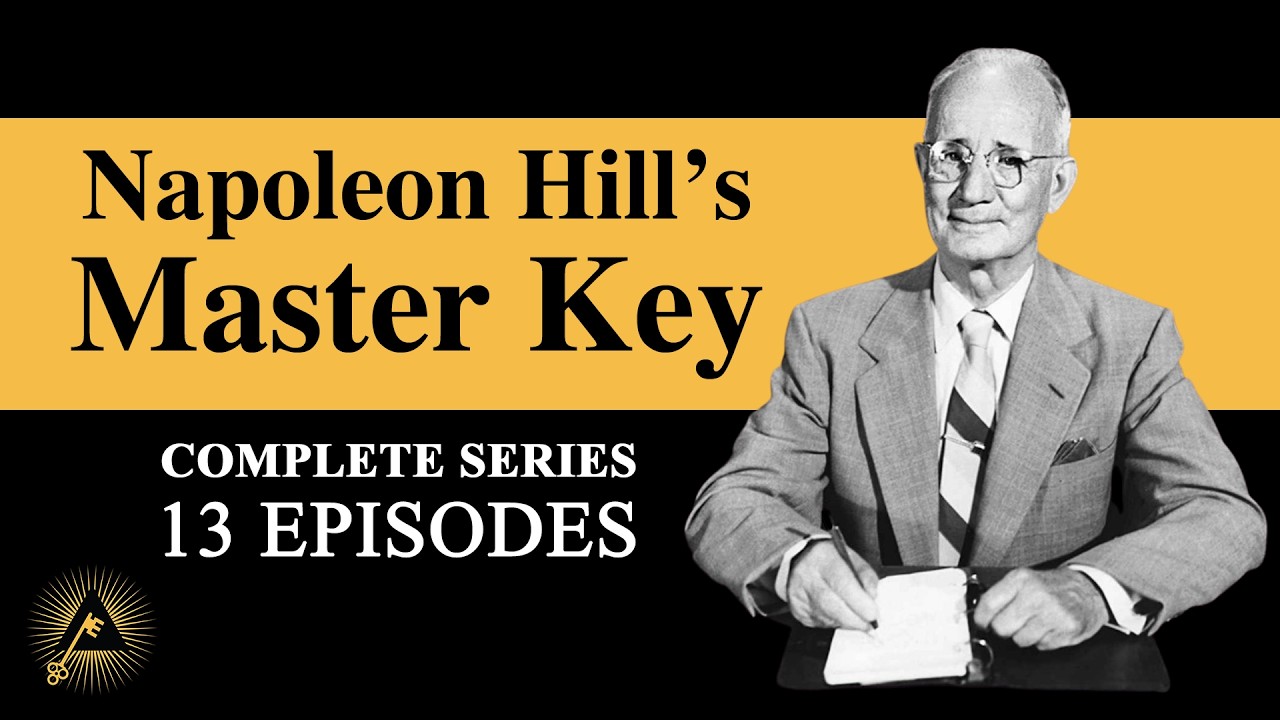
Napoleon Hill leans forward in his chair, addresses the viewer by eye, and opens with a promise: tell him the one thing you want most from your entire lifetime, write it on paper so he can read it, and he will hand over the master key to its attainment. The promise is direct enough to stop most people cold, because it demands something most never do, which is commit to a single specific desire in writing. Hill, who spent more than 20 years organizing what he called the science of success after being commissioned by Andrew Carnegie to do exactly that, believed the act of writing the desire down was not a ritual but a mechanism, the first movement of a mind taking possession of itself.
What makes these 13 recorded talks remarkable in 2026 is not nostalgia. It is the density of actionable instruction packed into language plain enough for anyone. Hill wastes almost no time on atmosphere. Within the first minutes he introduces the sentence he says psychologists had identified as the natural law underlying all personal success: ‘whatever the mind can conceive and believe the mind can achieve.’ He points immediately to Thomas Edison, who left formal schooling after three months and became, in Hill’s words, ‘the world’s greatest scientist in the field of invention.’ The point is not inspiration. The point is that the ceiling is self-installed.
The two sealed envelopes everyone carries from birth
Carnegie’s framing, as Hill recounts it, is the single most arresting image in all 13 talks. Every person arrives in the world carrying the equivalent of two sealed envelopes. The first is labeled with the riches available to anyone who takes possession of their own mind: sound health, peace of mind, a labor of love of their own choice, freedom from fear and worry, a positive mental attitude, and material riches in a quantity of their own choosing. The second envelope contains the penalties owed by anyone who neglects that possession: ill health, fear and worry, indecision, frustration, poverty, and what Hill lists without softening as ‘a whole flock of evils consisting of envy, greed, jealousy, anger, hatred and superstition.’ Hill’s instruction for opening the first envelope is a pocket-sized notebook, page one reserved for a clear description of the major desire, page two for an equally clear statement of what the person intends to give in return, and both pages memorized and repeated at least a dozen times daily.
Going the extra mile and why the farmer proves it works
The third principle Hill describes is the one he credits most directly to natural law. He calls it going the extra mile, rendering more service and better service than one is expected to render, always in a positive mental attitude. He reduces it to a formula he names QQMA: quality of service plus quantity of service plus mental attitude equals the space you occupy in your calling and the compensation you receive. His illustration is a farmer, who must clear, fence, plow, and plant without any compensation before handing the job to nature and waiting. Nature then germinates the seed and returns it multiplied, in his telling, as many as a hundred times. The farmer who skips that unrewarded preparation gets nothing. Hill’s argument is that the same arithmetic governs every occupation without exception.
Hill put the principle plainly when describing the one secretary he kept for more than a decade after losing all the others to better-paying employers within a year: ‘I married her to make sure I wouldn’t lose her. Of course, there were other considerations too.’
The talks cover 13 of Hill’s 17 success principles in sequence, from the master mind alliance through applied faith, self-discipline, enthusiasm, personal initiative, learning from adversity, creative imagination, accurate thinking, and cosmic habit force, the law he describes as the mechanism by which repeated thought patterns become the physical circumstances of a life. The through-line across all 13 is identical: the only thing any person controls completely is the direction of their own mind, and that control, used or neglected, determines everything else.
A small notebook sits open to page one
The pocket-sized loose-leaf notebook Hill holds up on screen and describes in specific physical terms, neat, small enough to carry, page one waiting for the one major desire written out in a clear hand.
Hill closes his final recorded talk the same way he opened the first, with the same prayer of gratitude he recommends repeating twice daily, asking not for more riches but for the wisdom to use the riches already given at birth in the form of a mind that can be directed to whatever end its owner chooses. Seventy-two years after these talks were recorded, that notebook and that first page are still empty for most people who hear the instruction, which is precisely the condition Hill said the talks were made to change.