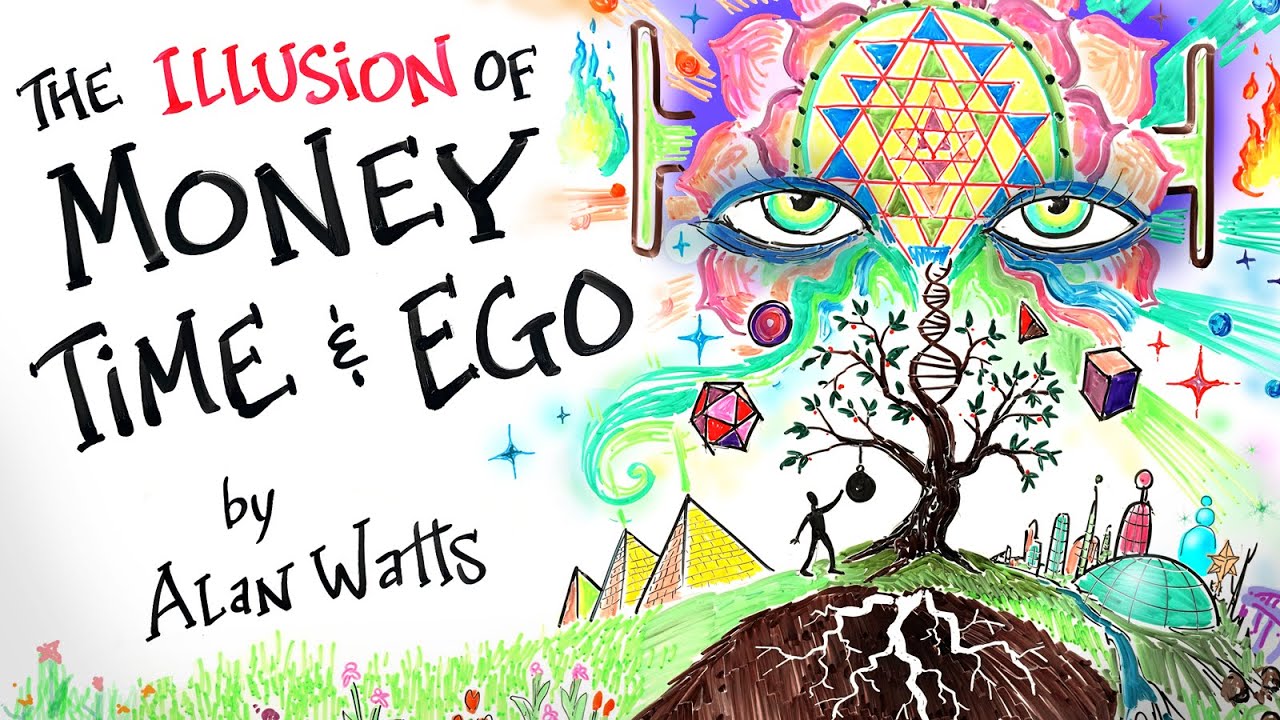
Alan Watts opens with an unusual request: before deciding whether to save the planet or destroy it, stop. Not with the performative solemnity of a memorial moment, where everyone frowns and forces serious thoughts, but with something far rarer. Real silence, the kind where thinking itself goes quiet. Most people have never tried it, and Watts suspects that is exactly the problem. He spent decades arguing that the surface confusions of modern life, anxiety about money, fear of death, chronic busyness, all trace back to the same root: mistaking a concept for reality. His argument, rendered in the drawings and narration that After Skool has become known for, moves through three illusions with the patience of someone who has watched audiences resist each one in turn.
The menu is not the dinner
Watts starts with money because it is the most concrete example of the confusion. Money is a measurement, he explains, in exactly the same way that inches measure length or grams measure weight. The measurement is useful, but it is not the thing itself. You cannot eat a dollar bill. Strand someone on a desert island with a fantastic quantity of stock certificates, and what they would actually need is food, animals, and company. The certificates would be useless.
The problem is not that money exists. It is that people have come to prefer the symbol over the substance. Watts puts it plainly: you cannot drive five cars at once even if they are all Cadillacs. You cannot live in six houses simultaneously. There is a hard physical limit to what one person can actually consume, and chasing the measure of wealth past that limit is, in his framing, eating the menu instead of the dinner.
The ego that somebody else named
The second illusion is more personal. The self most people defend and worry about is not the living organism that breathes and moves. It is the personality, the ego, a crude and limited conception assembled from what other people have said about you over the years. Watts once talked with a woman who told him she was afraid of death. After a long conversation, she arrived at something more specific. She said, ‘what I’m really afraid of is what other people are going to say, they’re going to say poor old Gert, she couldn’t last it through.’ The fear was not of non-existence. It was of a reputation, a label assembled by outside voices, losing its reviews.
The wake does not drive the ship
Time gets the sharpest treatment. Watts observes that on any standard watch, the present is represented by the thinnest hairline possible, just barely visible. That is how seriously most people take the only moment that actually exists. The past is not a force pushing the present forward, he argues. It flows behind like the wake of a ship off the prow. The wake does not drive the ship, any more than the tail wags the dog.
Yet the habit of tracing everything back through history to find blame is almost universal. He tells the story from Genesis: Adam blames Eve, Eve blames the serpent, and the serpent says nothing. Everyone passes the buck backward over their shoulder. ‘The truth of the matter,’ Watts says, ‘is it all begins here. This is where creation begins and you’re doing it.’
Plans made without presence are, in his view, structurally hollow. When they finally work out, the planner will have moved on to the next worry and will not be there to enjoy them.
The woman who found the real fear
Somewhere in After Skool’s archive is the sketch of that woman, her name rendered as Gert, sitting across from Watts and working out that her deepest anxiety was not about her own ending but about a social verdict she would never hear. That realization sits unresolved, which may be the point.
Watts closes the argument where he opened it: in the present, which is the only real time there is. There never was a future, and there never will be. The present is not an infinitesimal dividing line between past and future. It is the only actual territory. Everything else is accounting.