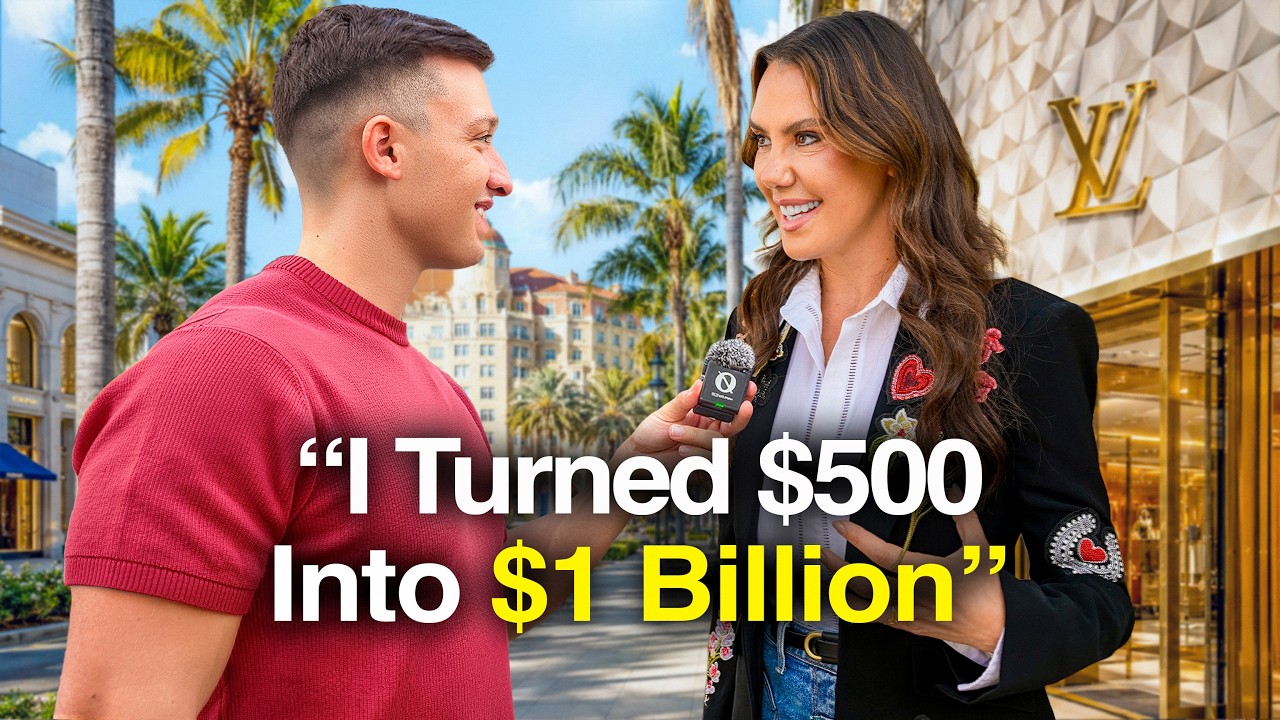
She was a college student sharing a 700-square-foot dorm room with four roommates, and all she had to her name was $67. That was the seed money for Salt XL, a hygiene brand that now pulls in over $20 million in a single year. The story of how that $67 became an eight-figure soap empire is the kind of financial origin myth that sounds impossible until the founder is sitting right across from you, walking you through every step. Across a cross-country trip from Orlando to Beverly Hills, four self-made women with a combined business portfolio spanning soap, jewelry, real estate lending, and a $235 million tech exit opened their books and their playbooks.
From a dorm room to a million dollars in 30 minutes
The founder of Salt XL, based in Orlando and originally from Miami, started her company in college with that $67, no outside capital, and a product that most aspiring entrepreneurs would dismiss as too boring to scale. ‘People don’t think to sell soap or oil,’ she said. ‘It’s boring. It’s not fun. But it’s a need, and I met a need.’ She hit her first million dollars in revenue before turning 25, and she reached it in part by rejecting the idea that her market was overcrowded. ‘I don’t believe in an oversaturated market. It’s a myth, because what’s for you is for you.’
The business nearly didn’t survive. She was robbed, in the financial sense, three times over: by her CFO, by her accountant, and by a mentor who placed someone on payroll without authorization. The hard lesson she pulled from each of those moments was the same one her grandfather used to press on her. ‘A hard head makes a soft,’ and she was determined not to need the same lesson twice. She kept her personal expenses deliberately small during the climb. ‘I was a multi-millionaire driving a Nissan Altima and living in a 700-foot apartment,’ she said. ‘The goal is still the goal.’
Her growth engine was organic marketing, word of mouth and an unguarded online presence, long before she layered paid advertising on top. ‘Get online and take the mask off,’ she told the interviewer from School of Hard Knocks. ‘Authenticity sells. It’s easy to tell somebody what they need, but to convince them that they need it, that’s a whole different ballgame.’
Selling companies to Goldman Sachs and building a billion-dollar jewelry brand
In Beverly Hills, Trixie Castro, who described herself as 48 but tells her kids she is 38, traced her own financial roots to a grandmother from Cuba who signed documents with a thumbprint because she could not read or write. Castro started her first entrepreneurial venture at 14 with Crayola markers and computer paper and within one month was earning more cash than both parents combined. She eventually built a private money lending company in the distressed real estate space and sold it to Goldman Sachs, then built an online distressed real estate auction company and sold that one to Fidelity National Title. Her lending operation reached several billion dollars a year in volume at its peak.
Her scaling philosophy was simple and almost counterintuitive for founders who built their companies themselves from scratch: learn when to get out of the way. ‘In the beginning, you have to do all things and you’re applauded for it,’ she said. ‘But as you grow the team, you have to learn there’s no ego here. Whoever is the best person for the job, set the pavement for them.’ On where wealthy people put their money, her answer was immediate: real estate, starting with single-family fix-and-flip, then fix-and-hold, then ground-up development, then multifamily. ‘As your knowledge grows, so does your business.’
A third entrepreneur, who sold a B2B software and internet advertising company for $235 million, credited a $10,000 loan from her grandmother as the bet that started it all. ‘She didn’t know what the internet was, and she gave me the money,’ she recalled. ‘That bet turned into a hundred times back her money.’
Kendra Scott, who founded her jewelry company in the spare bedroom of her Austin, Texas home, went to her first sales calls while pregnant, carrying samples in a tea box, selling them on the spot so she would have enough cash to fill the orders she had just written. She reinvested every dollar for ten years straight, running on credit card debt and a line of credit with no outside capital. By the time of the interview her company was approaching 170 retail stores and had given nearly $100 million to women and youth charities over the previous decade. ‘It’s not about the billion-dollar brand,’ she said. ‘I built a company that is fashion for philanthropy. That’s what gets me up every morning.’ Her core advice landed with the same plainness as everything else she said: ‘If you build it, they will come. Be patient.’
The tea box that went to 170 stores
Kendra Scott’s original tea box, the one she packed her jewelry samples into before walking into stores in Austin, still sits somewhere in the story of a company now worth billions.
All four women started with almost nothing, and none of them stayed small by accident. They stayed small on purpose, for just long enough.