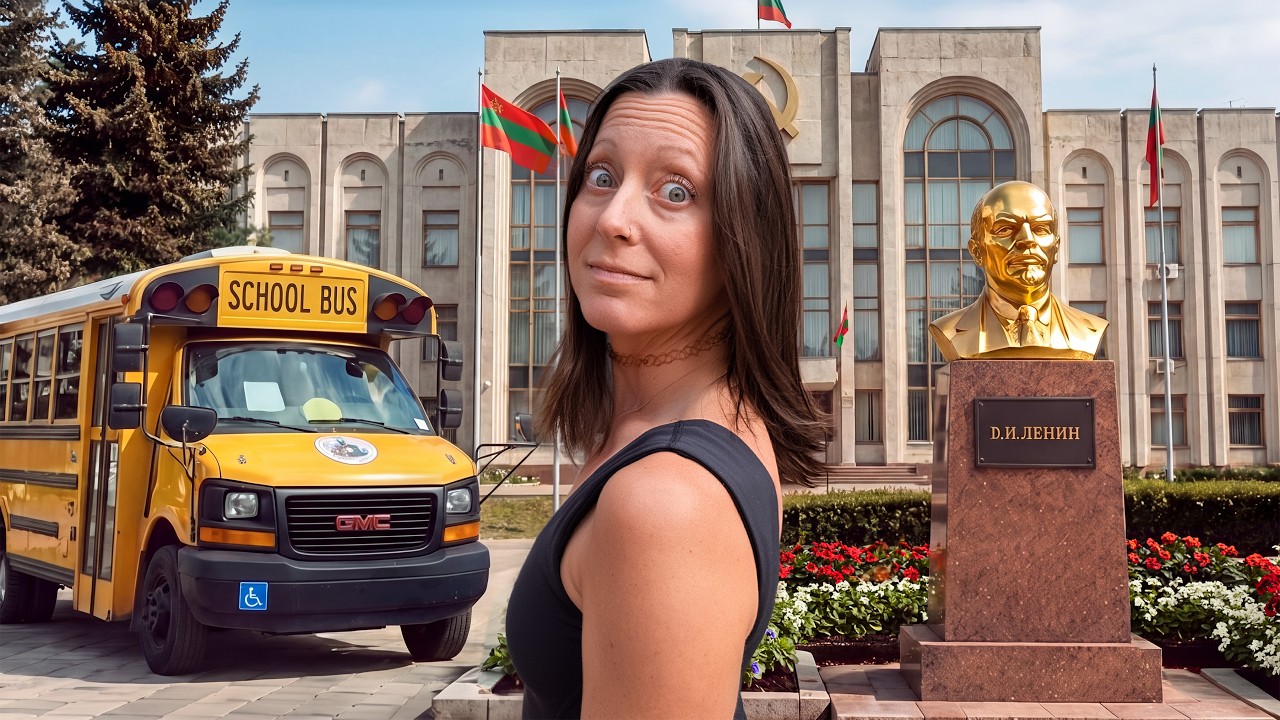
The yellow school bus from Colorado pulled up to a checkpoint where a Russian tank sat parked on either side of the road, two military guards flanking it. Nobody asked for a document. One guard simply waved the nine Americans through. That moment, somewhere on the thin strip of land wedged between Moldova and Ukraine that calls itself a country without any other country agreeing, set the tone for one of the strangest 24 hours of the entire Mongol Rally. Every year, roughly 100 teams attempt to drive more than 5,000 miles from Europe to Asia in small, underpowered cars. Kara and Nate did it differently: they bought a retired government school bus, shipped it across the Atlantic to Germany, and drove it to the Prague start line with a team of nine.
A place that runs on Soviet beer and Harry Potter statues
The bus rolled into the capital to honks, waves, and at least one person filming from the roadside. Roads were older and worn, Soviet-era architecture lined the streets, and the official hammer-and-sickle still appeared on every government stamp and document. But the city felt less like a frozen time capsule and more like a normal Eastern European town with a heavier-than-usual layer of Soviet relics.
Their local guide was Tim, an American who has lived in Transnistria for 16 years. He walked the group past Dом Советов, the old House of Soviets that now serves as city hall, a Lenin statue, and the Transnistrian flag, which still carries the hammer and sickle in the top left corner. Then he stopped them in front of a fountain. Students at the local university had been asked to vote on what statue they wanted installed. They chose Harry Potter. Tim noted it plainly: ‘There are two statues in the world of Harry Potter. One is in London, one is here.’
Lunch was at a privatized Soviet communal cafe, still decorated with authentic flags and period antiques, none of it imported reproduction. The group ate borscht, minced vegetable rice, chicken, and pig meat, accompanied by a local beer called Star Clubos, a non-pasteurised, chemical-free brew that cannot be exported because it expires within seven days of production. Nine glasses of kvass, the low-alcohol Soviet summer drink first served to keep workers functional in the heat, cost two dollars total.
Moonshine, a village cellar, and a gun garage full of live grenades
Rain changed the afternoon plans. Tim brought the group to the home of a local family, a working dacha where everything from the vegetables to the wine to the 80-proof spirit is made on the property. The backyard ran to roughly two acres and produced enough food to sustain the household through winter, with surplus sold locally. In the cellar, shelves of canned fruit and preserved vegetables stretched wall to wall. The host, speaking no English, handed out homemade wine and then a second bottle as the group tried to leave, along with a bag of sweets and fresh tomatoes.
The spirit she offered, what Tim described as Soviet moonshine, turned out to be functionally useful beyond the table. He mentioned that some village drivers, when out of petrol and unable to afford more, have used the homemade 80-proof in older car engines as a substitute fuel. Not a Tesla, he clarified.
The day’s final stop was a private collection belonging to a highly decorated veteran of both the Soviet and Transnistrian armies. Bazookas, land mines, World War I Mosins, World War II hand grenades with iron-shard fragmentation, modern Russian grenades loaded with steel BBs for a 360-degree blast radius, and a Taliban gun belt brought back from Afghanistan. The pins, Tim confirmed, were still in the grenades. Also in the collection: a test pilot helmet worn once by Yuri Gagarin. One member of the group put it on.
Asked why he stays, Tim kept it direct: ‘It is real simple because I can have a really free life here.’
The front of the bus, partially
A front headlight dangled loose when the group returned to the road. On closer inspection, the entire front panel of the bus had come loose on the rough Moldovan roads. A piece of scrap metal was bent, wedged in, and reinforced with duct tape. The disco ball, installed in the ceiling, had already been duct-taped back after falling during an earlier stretch. A Romanian border inspector later hit his head on it twice, once entering and once leaving.
That night the group parked Big Bertha in front of the main government building and checked into Hotel Russia. By morning they were back on the road for Bucharest, seven hours south, with two border crossings ahead and an emergency alert arriving on every phone near the Ukrainian border warning of possible falling objects from the surrounding airspace and advising residents to take shelter in basements for the next 90 minutes.
They kept driving south.
The bus eventually reached the Black Sea shore at the town of Corbu after a detour through a privately gated beach that nobody owned at that hour. From inside the tents, you could hear the waves.