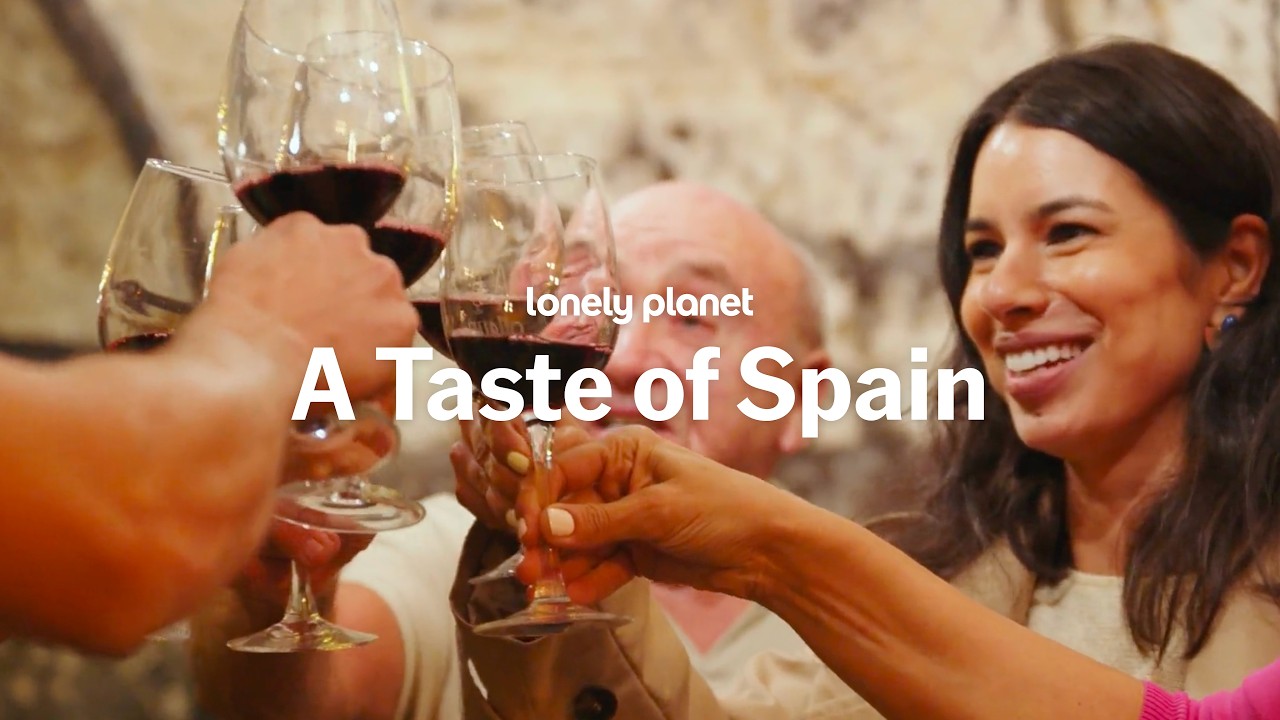
Malini tilted a porron above her mouth somewhere between the vines of Valtrakones and a chori pan cooked over dried grapevine shoots, and the Muga rosé came out in an unbroken arc. She caught most of it. The moment captures something true about wine country in northern Spain: the most memorable part is rarely the glass itself. Across La Rioja and Castilla y León, a journey through ancient cellars, organic pollination gardens, and underground restaurants reveals why two of Spain’s most storied wine regions still feel alive.
Where centuries-old cellars sit next to gravity-fed modern bodegas
The journey begins in Haro, the heartbeat of La Rioja, with a balloon ride above a blanket of cloud that reveals vineyards stretching in every direction. Down on the ground, local wine expert Inma leads the way to Lecea, where traditional grape stomping is still part of the process, and then to Bodegas Muga on Haro’s famous Barrio de la Estación, the Golden Mile of centuries-old wineries where barrels are still shaped and fired by hand. Juan Muga, third generation of the Muga family, hosts a lunch in the vineyards built around sarmientos, dried grapevine shoots that give the grilled meat a deep, smoky character before it goes straight into a chori pan.
Also along the Golden Mile is Roda, one of the younger arrivals, with a modern philosophy anchored to individual vineyards and the specific character of each vintage. Below it runs a 19th-century underground cellar, a reminder that in La Rioja, new ideas and old stone tend to share the same address. The private calados, underground cellars that run throughout the region, tell a quieter version of the same story. At the Martinez Palacios family’s private calado, a reserva and an olive oil both make the case that La Rioja’s depth goes beyond the grape. Further outside Haro, the Baigorri winery is built vertically into a hillside so that gravity moves the grapes and wine through each stage of production without a pump in sight.
Logroño’s pincho bars and the road into Castilla y León
Logroño, the capital of La Rioja, centers its daily life on Calle Laurel, a street of pincho bars where each one has built its reputation on a single dish done right. Bar Angel is known for El Champí. Blanco y Negro draws the crowd for El Matrimonio, a sandwich that looks simple and tastes considerably better than that. Back in the winemaking side of the city, one bodega explains that in the 18th century Logroño had around 53 urban wineries, making in-city production entirely ordinary for the time. Just outside town, Viña Ijalba combines an organic approach with a commitment to reviving lesser-known Rioja grape varieties.
The road then crosses into Castilla y León and the Rueda Verdejo vineyards, where Finca Menade has been working the same land with the same grape for more than 200 years. Rita’s family now runs it with a focus on organic farming and biodiversity, including a pollination garden on the property designed to keep insects active in the fields and deliver natural yeast to the grapes. As Rita put it, the garden exists so the insects ‘bring them to the fields to give us this natural yeast to the grapes.’ Finca Menade holds the distinction, according to the family, of being the first organic winery in northern Spain. Tasting a 100-year-old wine drawn straight from the barrel makes the continuity feel physical, not historical.
The final meal takes place 20 metres underground in Bodega Yllera’s 15th-century cellars, where chef Nauset Betancourt serves a paired menu at Aloupe. The Verdejo poured there becomes, by Malini’s own reckoning, the single best wine of the entire trip.
The porron, still sitting on the vineyard table
Back in Valtrakones, the porron rests on the table beside the remains of a grapevine fire and a half-eaten chori pan. Nobody has put it away yet.
The answer to what makes a great glass of wine, by the end of all this, turns out to be an awkward pour into an open mouth, an 18th-century cellar beneath a city street, and a garden kept alive specifically for the bees.
 Wake up to Only Happy News!