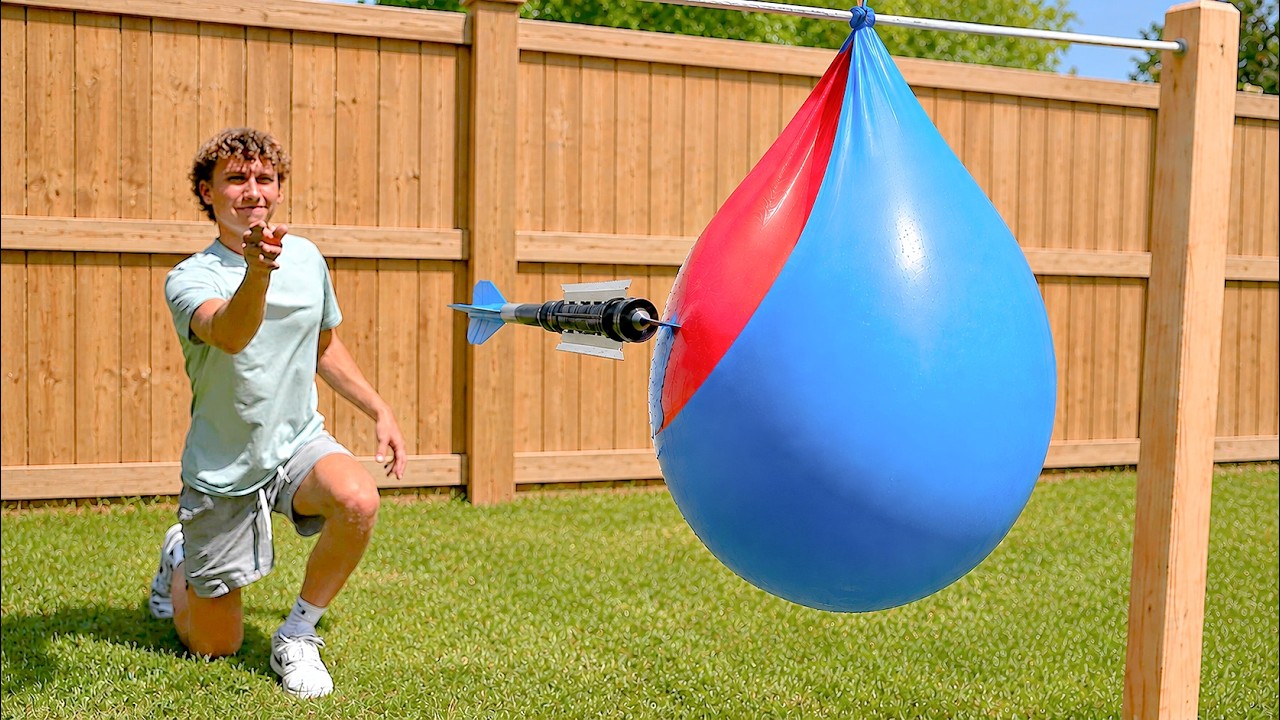
The plan was simple: throw a wedding ring onto his wife’s finger. The problem was that he had already broken one ring attempting trick shots, and the real one was absolutely not going in the mix. Over 365 days, the creator behind That’s Amazing built a collection of 22 shots with odds so remote they barely register as attempts, each one a small experiment in physics, patience, and the specific kind of stubbornness that turns a bad idea into something genuinely spectacular. What started as a single crazy notion, whether you could slice only the outer layer of a balloon with a custom-built dart, grew into a full year of 6 a.m. rock-skipping sessions, a duck that seemed personally opposed to trick shots, and a phone that survived being shattered only to film the ring shot anyway.
When the target is cardboard and the bees are not optional
The frisbee shot consumed 13 hours and a constant swarm of bees that orbited the thrower for the entire attempt. The cardboard target was custom-designed and then built by his father-in-law, but before that was even finished, an accidental shot produced one of the craziest unplanned moments in the entire project, and it happened twice. Once the target was ready, a passerby on the trail behind him was so amazed he handed over his own phone and asked to be subscribed on the spot. ‘Yeah, I’m going to share you all, bro. Keep this up,’ the man said before walking away. The frisbee eventually cleared the cardboard entirely and dropped clean into the target, but the cameras missed it. Rather than take the lucky break, the shot was reset and landed again nine minutes later.
The ping pong anti-gravity shot took a full day and came from a failed hypothesis. The original idea involved a drill and a cup spinning fast enough to catch a ball, but the ball kept flying out the sides. A chip container from the pantry, some string, a camera tripod, and duct tape wrapped around the outside for weight eventually solved it. The ball had to hit a spinning surface at exactly the right angle so friction pulled it into circular motion, and then it still had to drop into a second cup below. Matthew kept going for 30 extra minutes past dinner before it landed.
Eight rocks, one duck, and the second-to-last shot
The rock-skipping sequence lasted nine days and cost several hundred dollars in purpose-bought skipping stones retrieved by hand from the water. A duck made its feelings known by swimming directly into the throwing path, stopping, sitting, and turning back every time it seemed about to leave. By the final session, only eight rocks remained, meaning every throw carried real financial and logistical consequences. The shot landed on the second-to-last rock.
The bowling alley required a custom obstacle to protect the lane, and the tennis ball trick, getting a ball to lodge inside a racket on purpose, was completed in 40 minutes with help from his wife’s siblings. That was considered fast: the shot designated as level one, meant to be the easiest, took Matthew three hours.
The Goodwill record that gave its life for the shot
Smashing a vinyl record dead center with a baseball required three separate trips to Goodwill, where records cost $2.99 each. Most hits broke the record without the clean center strike that made it satisfying on camera. The winning record turned out to be a copy of a ‘Sing and Learn Reading Readiness Record.’ Its loss was acknowledged without apology.
For the ring shot, cheap rings from Target stood in for the real one throughout the attempt. She held out her hand for hours while rings landed on the wrong fingers repeatedly. The real wedding ring stayed safely off to the side.
The phone that shattered during the water bottle balance shot somehow still worked well enough to film the ring attempt that followed.
 Wake up to Only Happy News!