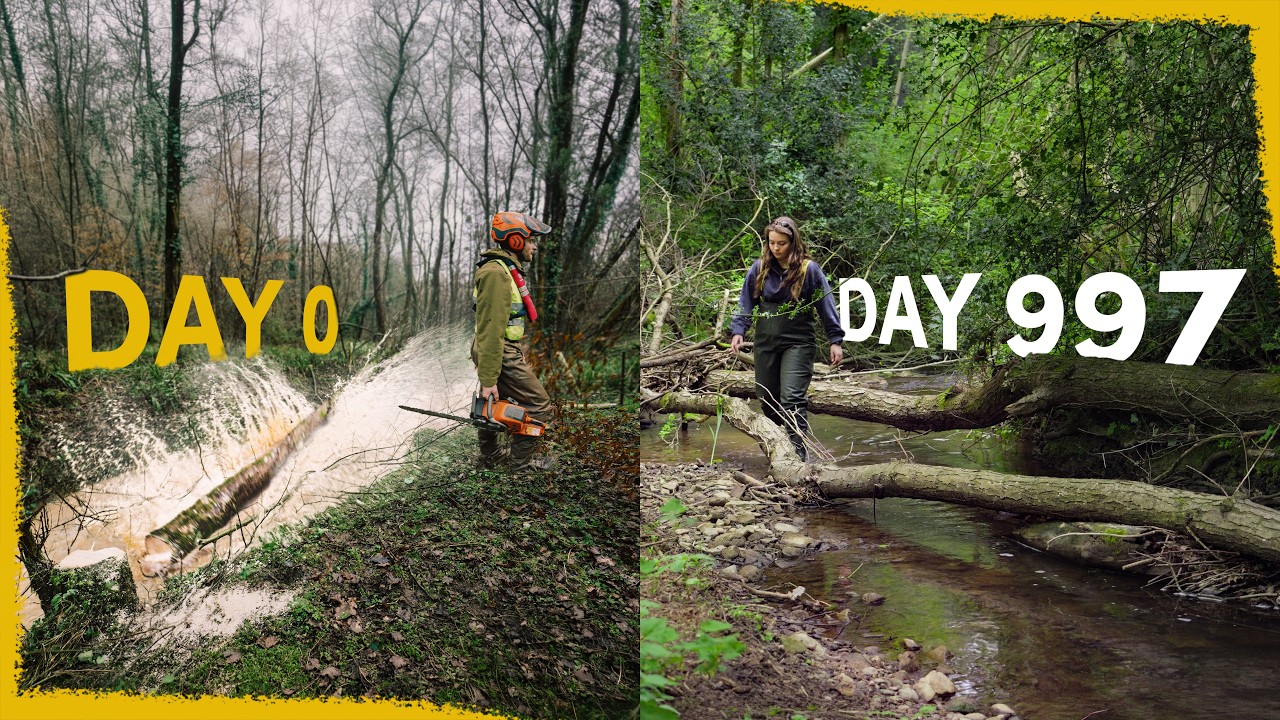
Lily, a UK-based biologist, waded into Lord’s Wood on a grey English morning and stood next to a tree that had been deliberately felled into a stream. Three years ago, that act looked like vandalism. Now the tree is doing exactly what the science predicted: catching debris, redirecting flow, and coaxing a straight, degraded channel into the gentle curves of a real river. The question was never whether nature could recover. The question was whether the data would prove it fast enough to matter.
What was actually wrong with these streams
The River Chew’s tributaries in the southwest of England had been shaped by centuries of the wrong kind of human attention: historical damming, agricultural runoff, and livestock trampling had squeezed the waterways into unnaturally straight channels. Water raced through without slowing, picking up sediment and turning the streams a mucky brown that smothered the gravel beds where Atlantic Salmon and Brown Trout need to spawn. The two tributaries targeted by this project are the Candlestick Stream and the Bathford Brook, both feeding a catchment that had lost most of its ecological richness.
Mossy Earth partnered with the Bristol Avon Rivers Trust, known as BART, in 2023 to address this through a combination of small, targeted interventions. The total budget across three years came to £58,449, funded entirely through Mossy Earth’s monthly member subscriptions, and it covered not just the physical work but the rigorous monitoring that made the results meaningful.
The interventions came in three forms. First, seven cross-drain tracks were built along a steep section of path at Lord’s Wood. Before the drains existed, heavy rain would flood down the path, strip sediment, and deliver it straight into the river. The stone layers now siphon that water sideways through vegetation and soil, filtering it before it reaches the stream. Second, wetland scrapes, essentially shallow ponds dug into the floodplain and connected to the river by a small channel, were introduced to slow flood peaks and expand habitat. Jacob from BART described the cumulative logic: ‘if you’ve got more and more scrapes going all the way down you start to really build up a cumulatively large amount of water.’ Third, and most visibly, 29 woody debris structures were installed in two phases: nine in 2024 and twenty more in 2025. These include fully felled trees, hinged trees that remain rooted and continue growing above and below the waterline, and brushwood berms, strategic piles of branches that trap fine sediment and eventually consolidate into new bank material.
The scores that turned ‘vibes’ into evidence
Mossy Earth’s approach is explicit about not accepting good feelings as proof. The project used two standardised frameworks: the MorPh5 river condition assessment, which scores stream health against the expected quality for that river type, and macroinvertebrate surveys, which track the diversity of small invertebrates as a proxy for both water quality and habitat complexity. Macroinvertebrates matter because they sit at the base of the aquatic food chain, transferring energy from algae up to fish, amphibians, and birds. More diversity in that layer means the whole food web above it is better supported.
The scores have improved year on year across all four monitoring points. Qualitatively, the upstream section of the Bathford Brook has moved into the ‘fairly good’ category for its river type, and the downstream section of the Candlestick Stream has climbed out of ‘moderate’ to reach the same threshold. Both tributaries are now in ‘fairly good’ territory. Sedimentation has decreased, habitat complexity has increased, and the macroinvertebrate diversity scores are climbing in parallel.
One word from the formal assessment report caught the attention of the team: richness. As a scientific term for the variety of species present, it landed differently when applied to rivers that had been losing species for decades.
A fledgling that stopped the survey team in their tracks
Mid-tour, near a large old yew tree at the edge of the site, the group came across a baby Tawny Owl sitting on the ground. A quick search confirmed that owlets fledge early and spend time away from the nest before they can fly properly, so the bird was safe. The team moved on.
The felled tree behind Lily has already pushed the stream off its straight path. A pool is forming where the current scours the bed. Insects colonise the submerged wood. The meander is just beginning.
 Wake up to Only Happy News!