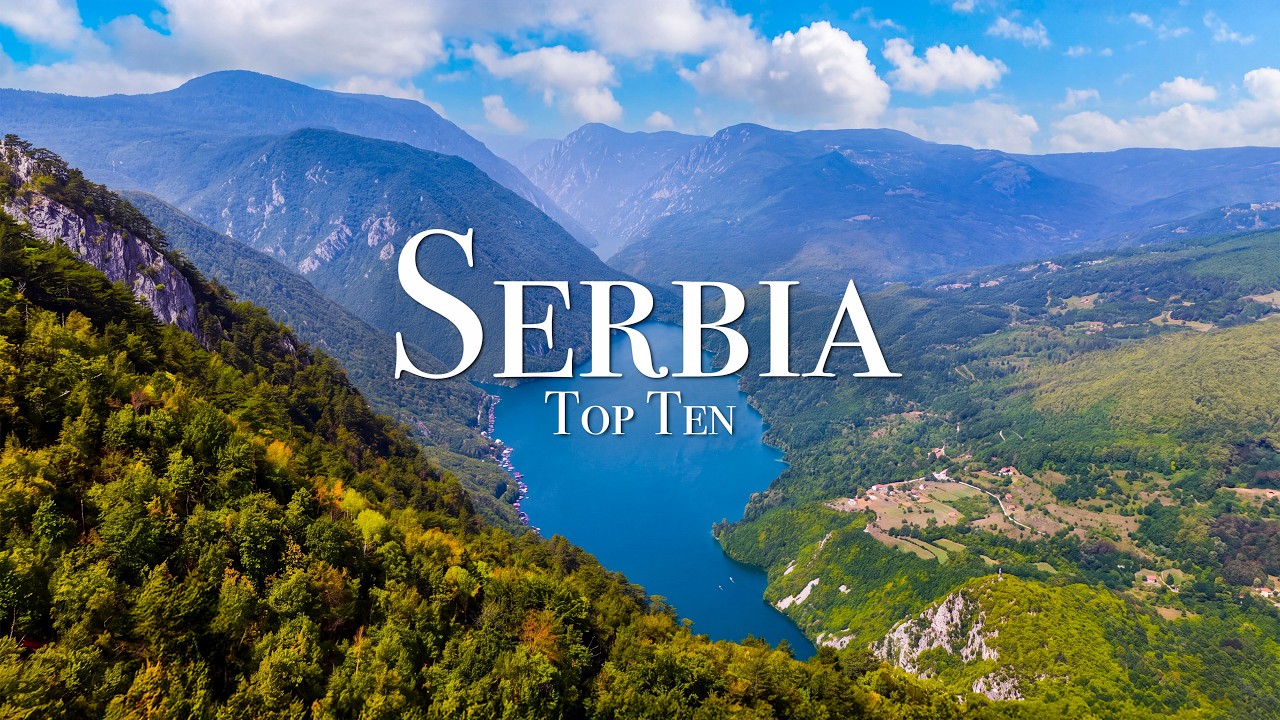
Ryan Shirley had not expected to be standing at the edge of a massive cliff drop, staring down into a hazy valley along the Drina River, quietly reconsidering everything he thought he knew about the Balkans. Serbia had been a surprise at every turn, from medieval fortress walls thick enough to hold off empires to a cable car stretching longer than any other panoramic ride on the planet. For travelers who overlook this landlocked country in favor of its flashier neighbors, Shirley’s journey through ten of its most remarkable corners makes a case that is hard to dismiss.
Belgrade and the fortresses that bookend the Danube
The countdown opens in Belgrade, Serbia’s capital and its largest city, home to roughly 1.7 million people in the north-central part of the country. What distinguishes it from other European capitals is age: it ranks among the oldest continuously inhabited cities on the continent. The Belgrade Fortress, constructed in 279 BC, sits atop a hill with commanding views of the Danube River below. Shirley singled out the Zindan Gate, a structure flanked by two circular towers, as a particular favorite. Beyond the fortress walls, the city delivers a striking contrast between modern construction and brutalist architecture, including the Genex Tower, buildings whose angular, unconventional shapes Shirley described as some of the most unique he had ever seen.
About two hours from the capital, the Golubac Fortress rises at the entrance of the Iron Gate Gorge along the Danube. Built during the 14th century, it controlled river trade for centuries under Serbian, Ottoman, and other imperial rule before the Prince of Serbia received it in 1867. Three internal compounds make the structure feel like its own small world. ‘One of the most impressive and peculiarly shaped fortresses I’ve ever seen in Europe,’ Shirley said, and the garden at the entrance alone justifies the entrance fee.
The Manasija monastery, roughly another two-hour drive from Belgrade, rounds out this trio of fortified history. A Serbian Orthodox monastery established in the early 15th century, it is ringed by 11 towers of medieval walls, a defensive perimeter Shirley noted he had never seen surrounding any other church. Inside those walls, the atmosphere turns quiet and still.
Mountains, canyons, and a river house built for swimmers
Novi Sad, Serbia’s second largest city about an hour from Belgrade, earns a reputation as the country’s most beautiful city. The Petrovaradin Fortress, nicknamed the Gibraltar of the Danube, took 88 years to complete after construction began in 1692. The Catholic church known as the Holy Name of Mary stands in the central square with one of the most colorful steeples on the route.
Zlatibor, a mountain resort town at just over 1,000 meters elevation, draws visitors in both summer and winter. Its gold gondola holds the title of world’s longest panoramic cable car at over 9 km, with tickets running around 17 euros for the ride up to Tornik mountain peak. Nearby Kopaonik, about three and a half hours from Belgrade, houses one of the biggest ski resorts in Southeastern Europe. The village of Mokra Gora, 40 minutes from Zlatibor, sits in scenic mountain terrain beside an ethno village built as a film set for ‘Life is a Miracle,’ reachable by a ride on the Sargan Eight train.
Midzur Peak, on the Bulgarian border in Eastern Serbia, is the country’s highest point at 2,169 meters. The round-trip hike covers roughly 15.6 km and takes several hours, rewarded by views Shirley described as simply stunning despite the range’s gently rolling profile.
Uvac Canyon in southwestern Serbia, about four hours from Belgrade, cuts a serpentine path through the landscape in a shape unlike any ordinary gorge. The Molitva viewpoint requires only a five-minute walk from the parking area and opens onto boats threading the river far below. Uvac also hosts one of Europe’s largest colonies of griffon vultures; several circled through the canyon during Shirley’s visit.
The Drina River, forming the border with Bosnia, holds a small wooden hut built in the 1960s by locals as a shelter for swimmers. Shirley admitted he regretted leaving without renting a kayak or paddleboard.
A cliffside view that stopped the entire hike
Tara National Park closes the countdown, and Shirley suggested it may be the most beautiful region in the entire country. Located in western Serbia near the Bosnian border, the park is forested and home to Serbia’s largest brown bear population. Zaovine Lake, an artificial mountain reservoir with five distinct bays, draws swimmers and those simply looking for a quiet shore. From the park, a drive leads to Banjska Stena, a viewpoint reached by a 15-minute walk from the parking lot. The drop to the valley below is steep enough to catch even a prepared visitor off guard. Shirley noted that walking past the main crowded platform and continuing uphill opens quieter vantage points with equally powerful sightlines.
The gondola car sitting at the top of the Tornik summit
At the Tornik mountain peak above Zlatibor, the upper station of the world’s longest panoramic cable car sits largely empty on a clear weekday, wind moving through the observation area with nothing between it and the next ridgeline for kilometers in every direction.
The haze that softened the view from Banjska Stena on Shirley’s visit, likely from nearby forest fires, did nothing to blunt his verdict: a highlight from the entire trip. He planned to return on a clear morning, ideally at sunrise, when the Drina River and its mountain walls come into full, unobstructed view.
 Wake up to Only Happy News!