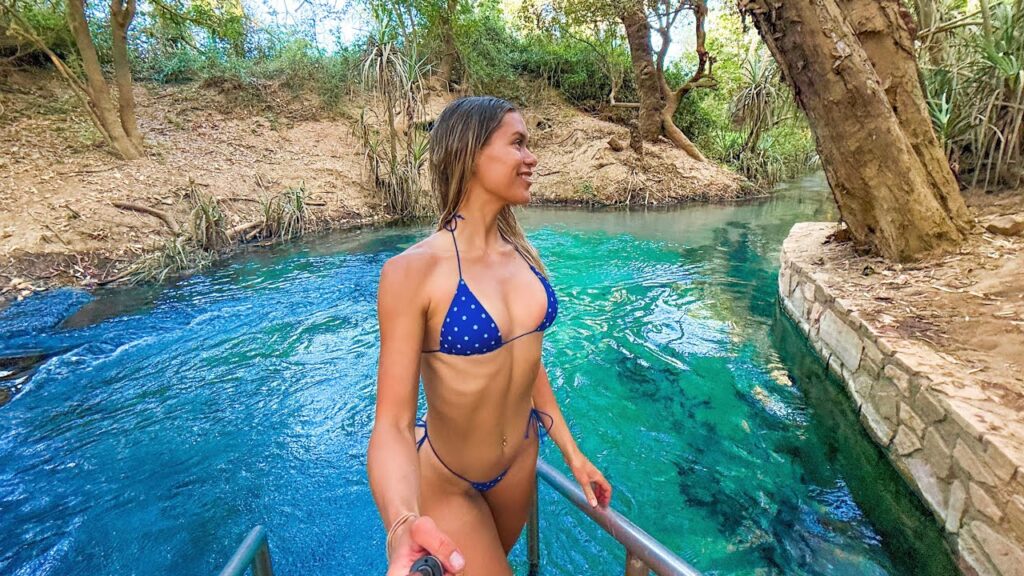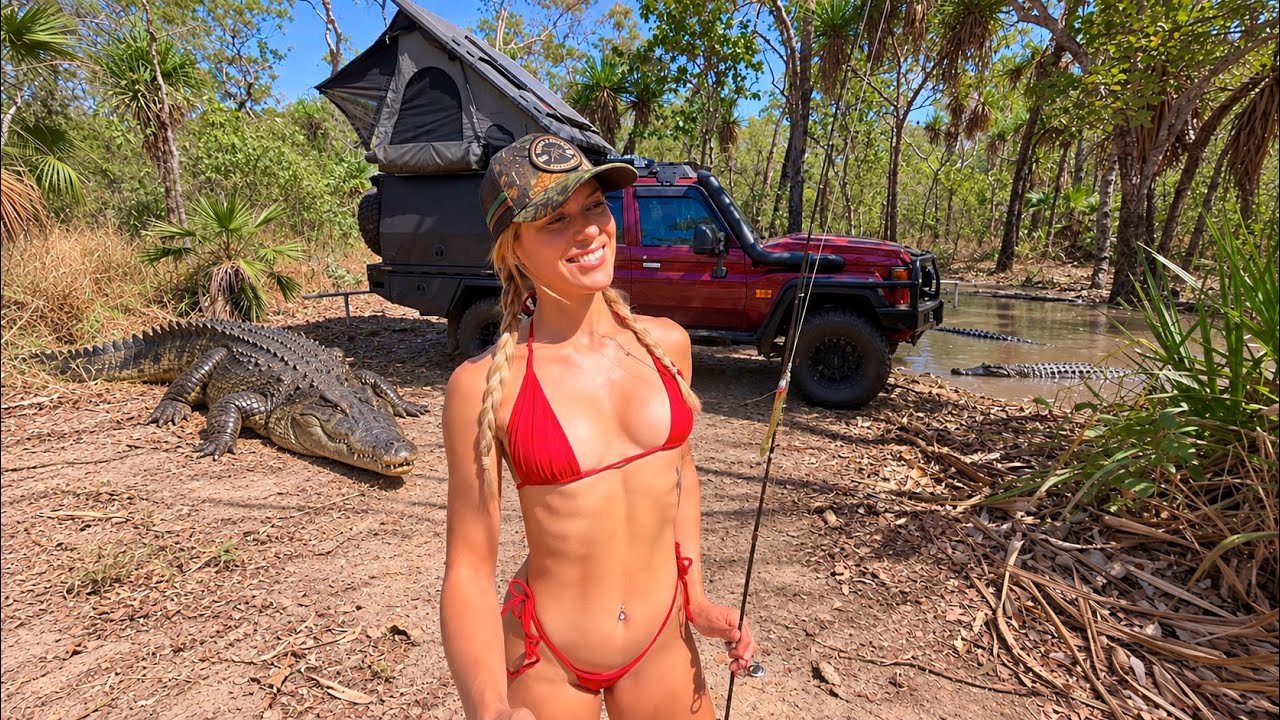
The first crocodile appeared almost immediately after the park gate. Molly Dixon had barely crossed into Australia’s most dangerous national park before a saltwater crocodile materialized along the waterway, an early signal of just how thick with wildlife the next two days would become. Kakadu National Park, home to more than 10,000 crocodiles, covers nearly 20,000 square kilometers of remote Northern Territory terrain, beginning roughly 150 kilometers east of Darwin along the Arnhem Highway. It is roughly the size of Wales. For a solo traveler who had originally planned to spend the year in Western Australia, this detour would turn out to be one of her most memorable.
Eight sets of eyes in the dark
The first night at Cahills Crossing was the kind of experience that is almost impossible to describe in daylight. Dixon had picked up a handheld spotlight before leaving Darwin specifically for this moment. Standing on the rocks above the East Alligator River with the moon just beginning to rise, she swept the beam across the water. Every point of reflected light was a crocodile. More than 50 to 100 saltwater crocodiles can gather to this stretch of river at this time of year, drawn by incoming tides pushing muddy water and fish upstream, triggering what she described as active feeding behavior. The crossing itself is the gateway to Arnhem Land, protected Aboriginal land requiring a special permit to enter, so the far bank remained unreachable and the river between belonged entirely to the animals.
She scrambled down the rocks with a GoPro strapped to her chest and a fishing rod in hand, casting for barramundi during the peak window between 9 and 11 at night. It was 10:44 when she decided to try for another 15 minutes. As she put it plainly: ‘It is not very often that I’m fishing with eight sets of croc eyes watching me.’ She did not land a fish, but she did not come away empty-handed either. ‘You can never catch a fish if your lure is not in the water,’ she noted before climbing back up to camp.
A $15 campsite with hot showers in the bush
Merl Campground, exactly 1.6 kilometers from the crossing and 1.6 kilometers from the main lookout, cost $15 a night and offered something almost unheard of at a remote bush camp: flushable toilets and hot showers. The individual sites were so generously spaced that neighboring campers were invisible from one another. Dixon spent the first morning in a hammock, letting the sunrays do their work before heading back toward the crossing for a daytime look at the crocodiles.
By day, Cahills Crossing revealed a different kind of spectacle. The crocodiles stretched their front and back legs wide in the current, a behavior that increases body surface area and allows the pressure-sensitive dots covering their skin to detect the slight movement of fish brushing past their limbs. Dixon tried her luck again with a hard-body lure and a midday cast. Barramundi was not on the dinner menu that night either, but the afternoon still led somewhere extraordinary: the indigenous rock art at the lookout nearby, with some paintings estimated to be up to 20,000 years old, serving as a visual record of spiritual beliefs, laws, history, and survival knowledge passed across generations.
The timing turned out to matter more than anyone planned. The area was closed the following day as rangers moved in to contain the scattered bush fires that had been visible and smellable throughout the trip, a smell Dixon had flagged the first night with genuine unease before spotting the actual flames from camp.
The crossing at low tide
The concrete causeway at Cahills Crossing sits at the center of everything in this corner of the park. Seasonal rains can make it completely impassable, and people who attempt to cross fast-flowing flood water are sometimes swept off the rocks into the river.
Two evenings running, Dixon sat at the lookout above it and watched the sun go down over a landscape she described as absolutely stunning, a word she earned by staying long enough to see the fire, the moon, the crocodiles, and the light all at once.