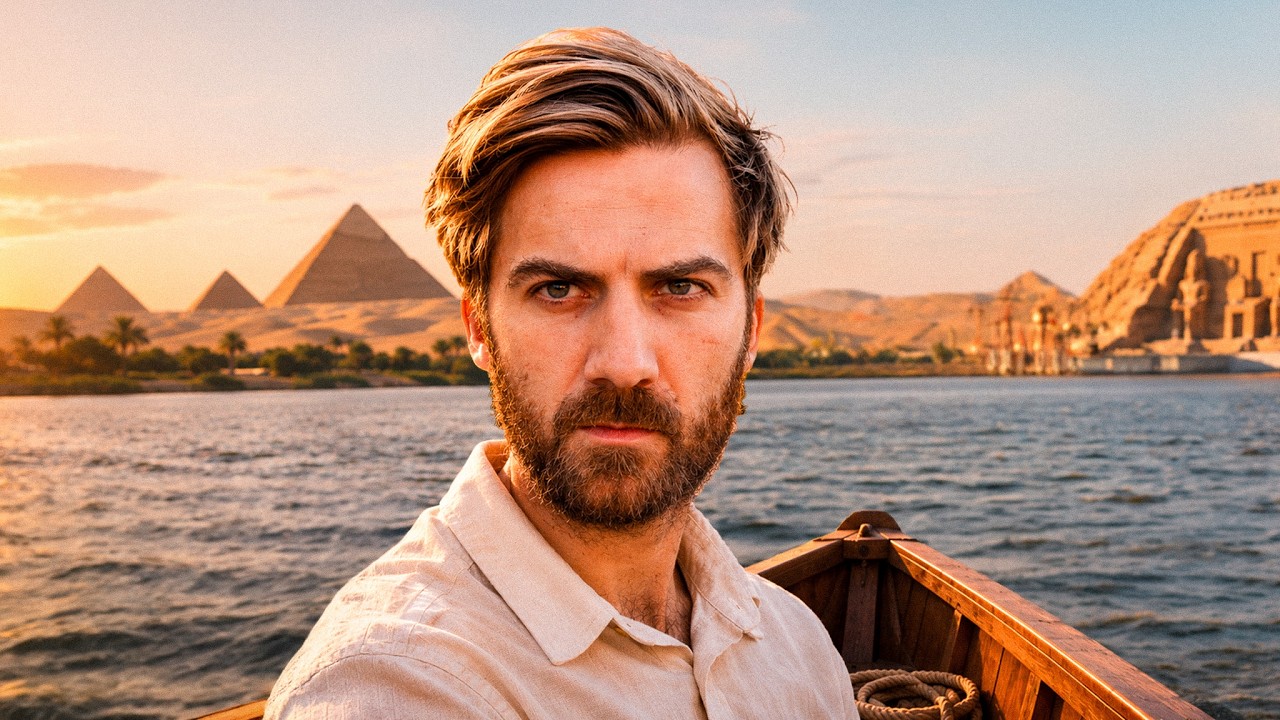
Maru, a father from the Ethiopian highlands, kept missing Johnny Harris‘s mouth at dinner, and it turned out the aim was deliberate. The gesture, Harris learned later, is a mark of respect among the people who live at the headwaters of the Blue Nile. That detail, small and easy to miss, is the kind of thing you only discover when you slow down long enough to drift the entire length of a river with the people who depend on it. Over 100 million people cling to the Nile, and the question of who controls its water is no longer ancient history. It is a live argument between nations.
In The Human Element S1 E1, Harris began in the mountains of Ethiopia, at Lake Tana, the source of the Blue Nile, known locally as the Abay. Young men fish from papyrus boats on the same lake where Christian monasteries have stood since the 300s, before Christianity reached most of Europe. A 95-year-old island elder was sitting under a tree reading his Bible when Harris found him. That evening, the community broke out honey wine, slow-roasted the coffee beans they had harvested on the island, and danced with their shoulders. Harris put it plainly: ‘I’ve never felt so free in my entire life.’ What he did not say out loud, though his local fixer reminded him as dark fell, was that a civil war was active in the region and a foreign visitor represented potential ransom money. The dancing ended. The boat left.
The dam that rearranged everything
From Lake Tana, the Blue Nile falls down the Ethiopian highlands and, until recently, continued north into Sudan without interruption. That changed when Ethiopia completed the Grand Ethiopian Renaissance Dam, nearly two kilometers wide across the river. For Ethiopians, many of whom had lived without electricity, the dam was a turning point. Villages that had never had power got connected. Egypt, downstream, called it an existential threat, and negotiations between the two countries went nowhere. Ethiopia built it anyway.
The river then joins the White Nile in Sudan and crosses into Egypt, where Harris boarded a wooden boat named True Dream with his producer Lama, his cameraman Ramzi, a young Nubian crew member named Lulu who was studying to be a nurse, and their captain Muharram. On a sandy dune beside a Nubian village, Harris met Abu Yusuf, who described what the High Dam of the 1960s did to his people: ‘Something like if you take a fish from water and put them in desert.’ Over 100,000 Nubian people were relocated as the reservoir rose to cover their villages, their temples, their fields, and 5,000 years of a way of life rooted in the river’s annual flood.
Mangoes off the tree and barbed wire around the pumps
Muharram pulled the boat to a green bank on a promise, and what unfolded was a kind of abundance that belongs to a different Egypt than the one guarded by armed checkpoints. A family was shaking mangoes out of their trees when the crew arrived. Lama, who partly grew up in Egypt, filled her pockets. A mango farmer named Midu, who turned out to be a chef and a displaced Nubian himself, joined the boat and cooked the crew potatoes, eggs with tomatoes, cheese, and salad from provisions picked up at a riverside camel market. Midu made a point that cut through the politics cleanly: since the High Dam stopped the annual flood from delivering volcanic sediment down from the Ethiopian mountains, farming in Egypt runs on industrial chemical fertilizer and water pumped through man-made canals to places that were never meant to support crops. ‘We don’t need that one,’ Midu said. ‘We need the plants.’ Harris noticed that the pumping stations along those canals were protected by barbed wire, security checkpoints, and armed guards: the same infrastructure most countries use on a national border.
Further downriver, a fisherman named Douai who lives aboard his boat was joined every morning by the same white bird he called his friend. He had not lost his home to the dam and offered a different reading of the river than Midu or Abu Yusuf did. The contrast was quiet but clear.
The mango Lama couldn’t stop thinking about
Lama, pocket full of fruit from the green bank, described the Egyptian mango as ‘very nostalgic’ as the boat pushed back into the current.
By the time Harris reached Cairo, the largest city in Africa with over 20 million people, the whole arc of the river was visible at once: the pyramids built from the surplus wealth of the annual flood, and along the same waterway, the lit towers of a modern city powered in part by the dam that ended that flood. Ancient Egypt was built by working with the river. Modern Egypt was built by seizing control of it. The people with the longest memory of what that trade cost are still on the water.
 Wake up to Only Happy News!