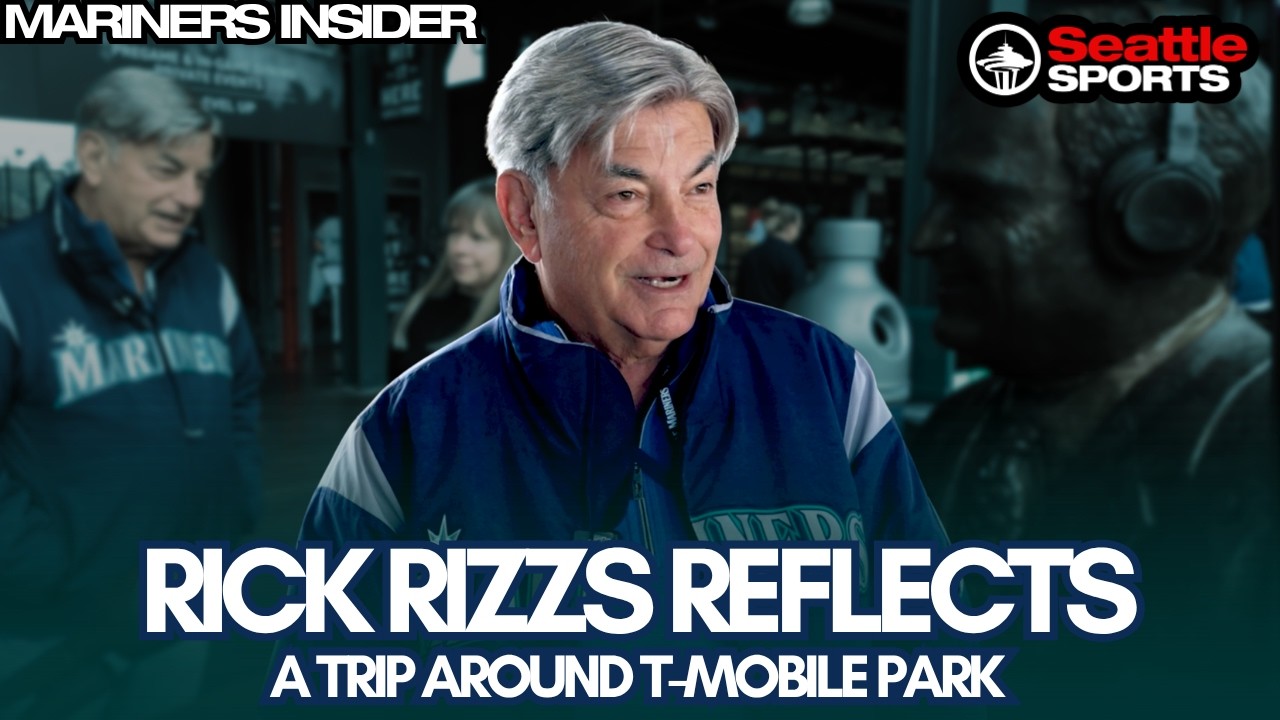
Rick Rizzs stopped at the spot along the concourse where Edgar Martinez’s double lives in his memory and said it almost the way he called it 30 years ago: the crack of the bat, Joey Cora scoring, Ken Griffey Jr. sprinting home faster than Rizzs had ever seen him run in his life. The Mariners had never been to the World Series. They still have not. But that moment in 1995 is the reason a city fell in love with a baseball team, and Rizzs was the voice in millions of living rooms when it happened. After 44 years behind a microphone in Seattle, the broadcast legend took a long, unhurried walk through T-Mobile Park with colleague Shannon Drayer to say goodbye to the place that shaped him, and to remember the people who made it matter.
Recorded Live by Only Happy News – Rick Rizzs Farewell after 41 years as the voice of the Mariners Radio #rickrizzs #mariners #baseball
The kingdom, the new park, and a roof nobody argued with
Rizzs arrived in Seattle in 1983, fresh from eight years in minor league stadiums built from wood and held together by routine. His first look at the Kingdome stopped him cold. ‘When I first got here in 1983, I thought it was the Taj Mahal,’ he said, describing the concrete dome as an almost surreal arrival into the big leagues after driving overnight buses between Memphis and Chattanooga. But the game changed around him. Camden Yards opened and rewired what every fan expected a ballpark to be, brick and open sky and the feeling of something old made entirely new. Seattle paid attention. T-Mobile Park rose directly across the street from that concrete dome, and the retractable roof, spearheaded by Chuck Armstrong, guaranteed that the Mariners could play every day while still leaving the building open to Seattle’s long, stunning summers when the weather allowed. Rizzs has no hesitation about where that places the park in baseball: ‘The most beautiful ballpark in Major League Baseball.’
Dave Niehaus, the call, and 25 years of shared joy
The walk brought Rizzs to Dave Niehaus, his broadcast partner for 25 years and the man who brought him to Seattle twice. Niehaus turned off Rizzs’s microphone after two innings on opening day 1983, leaned over, and told him he did not have to talk after every pitch. Rizzs has carried that lesson for four decades. But the deeper one came in the lean years when Seattle was losing regularly and the stands were thin. ‘The greatest lesson this man taught me was that if it’s a bad game, it doesn’t have to be a bad broadcast.’ When 1995 arrived and Niehaus made the call of his career on Edgar’s double, Rizzs waited until his partner was finished, then put on his headphones and added: ‘Dave, pandemonium here in the Kingdom. Everyone going crazy. This is a game for the ages.’ He described Niehaus going into the Hall of Fame in 2008 as something the whole world had finally confirmed what he already knew. Standing near him on the concourse, Rizzs said plainly: ‘Sitting next to him was the greatest joy of my life.’
The walk also surfaced Cal Raleigh, who Rizzs learned had been a switch hitter since the age of 3, taking exactly ten swings from each side before he had a dominant hand. When Rizzs asked him which side felt natural, Raleigh told him: ‘Don’t have one.’ That kind of pre-game conversation, catching a player in the 20 or 30 minutes before workouts get serious, is what Rizzs named as the best part of any baseball day, better even than the first call of a broadcast, though only barely.
What comes after 52 years of notes
Retirement, Rizzs said, is mostly an open question, which is exactly how he wants it. Italy is first on the list. Both sides of his family trace back there, and he has never been to Europe. He mentioned wanting to visit Rome and see Pope Leo the XIV, who, as Rizzs noted, grew up in Chicago roughly ten blocks from where he did. After that, the minor league towns: Alexandria, Amarillo, Memphis, Columbus. He wants to sit in the stands of whatever ballparks still exist and watch a game with no notes to take and no score to track. A visit to the broadcast booth in Tacoma to do an inning alongside the current crew is on the list too. But underneath all of it is one thing: ‘I want to wake up in the morning and go, I don’t have to do any notes today. I’ve been doing notes for 52 years.’
The brisket he never gets to order
Passing the Rolling Smoke barbecue stand, Rizzs greeted the staff by name and told Drayer that a brisket sandwich from that stand, encountered accidentally during a charity event a few months earlier when he turned the wrong way in the concourse, was one of the best things he had eaten in the building. It was the kind of detail that captured the whole walk: a man who had spent decades in the press dining room, finally slowing down long enough to get lost and stumble into something good.
At the end of the tour, standing on the concourse with the field visible below, Rizzs looked out and said the same thing he has said from the booth for nearly half a century. ‘Welcome to T-Mobile Park.’ This time, nobody was listening on the radio. It did not seem to change anything about how he said it.