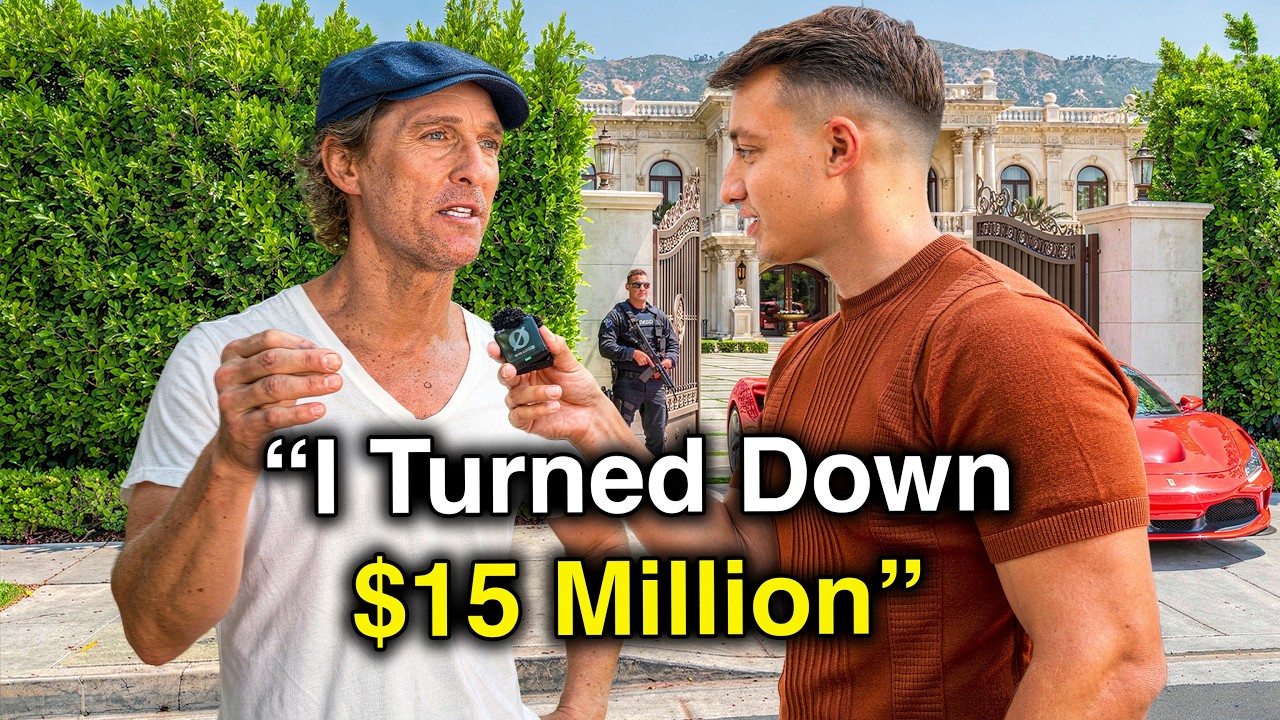
Matthew McConaughey was sitting in a bar in Austin, Texas on a Thursday night when a bartender tipped him off that a film producer was at the end of the counter. That chance encounter, four hours of loud storytelling, and a taxi ride later, he had an address, a morning call time, and a script with three lines waiting for him. What matters now is not just how he got in, but what he was willing to give up to stay on his own terms.
The conversation between School of Hard Knocks host James and McConaughey covered the pivot that most people in Hollywood assumed was career suicide. After becoming one of the most bankable romcom stars of his generation, McConaughey made a decision that his own brothers questioned out loud: he stopped taking the work.
The year he stopped flinching
McConaughey did not slowly ease away from the romcom machine. He left. He went back to Texas, kept his head down while his wife Camila was pregnant, and passed on project after project. The number that made Hollywood take notice was a $15 million offer on a script he called genuinely good. He turned it down anyway.
‘Sometimes you do have to unbrand to rebrand,’ he said. ‘The two years I was off did not rebrand me. It gave me anonymity.’
The industry, he explained, watches to see whether a pivot is a bluff. Every time he passed and did not flinch, the signal got louder. When he eventually walked away from what he described as a $50 million offer, the conversation in Hollywood changed. Roles in serious drama followed.
The lesson he offered was direct: if you are going to make a real pivot, the world will check whether you are stuttering. If you hold long enough without flinching, you pass through what he called the initiation process. You stop seeming desperate. You start seeming like someone with a plan.
The monk who said two words
McConaughey’s most specific piece of advice came from a moment long before the Oscar. Fresh off the success of ‘A Time to Kill,’ he was carrying what he described as a pile of personal demons and spiraling thoughts. He hiked 14 miles down a dirt road to reach a monastery in Abiquiu, New Mexico, sat with a monk, and walked four hours into the desert confessing everything, tears running, not stopping.
The monk said nothing the entire time. When McConaughey finally finished, he waited for judgment. After ten seconds of silence, the monk looked at him, smiled, and said: ‘Me, too.’
‘I was like, thank you. I thought it was just me,’ McConaughey recalled. The point, he said, is that the feeling of being uniquely broken is part of the human condition, not a personal diagnosis. Knowing that is enough to see a way through.
On hustle, he was blunt: a 4.9 GPA means nothing if you are not ready to move on a Saturday night at 2 a.m. or a Tuesday morning at 4 a.m. when an opportunity window opens without warning. His business philosophy around his tequila brand, Pantaleon, runs on the same logic. He and his wife built something they already believed in because, as he put it, he never has to put on a proverbial other hat to talk about anything he backs.
Standing in Austin at 56, he said he is still chasing Matthew McConaughey at 66. He has not caught him yet and does not plan to.
The 2018 Ford F250 parked in the driveway
Earlier in the day, the Undertaker, Mark Callaway, offered his own version of the same financial principle from a different angle. His father’s advice, delivered after decades of main-event paychecks, was to always live beneath your means because you never know what tomorrow has in store. Callaway drives a 2018 Ford F250. That is what he is comfortable in.
For investing, he pointed to T-bills: not exciting, but consistent, year after year, until one day the number surprises you. He added that Kevin O’Leary once called him specifically to ask for that same advice, a claim Callaway stood by without elaborating.
The 2018 Ford F250 sits somewhere in Austin, keys in a pocket, belonging to a man who headlined WrestleMania for over 30 years and still drove what he drove when nobody was watching.
 Wake up to Only Happy News!