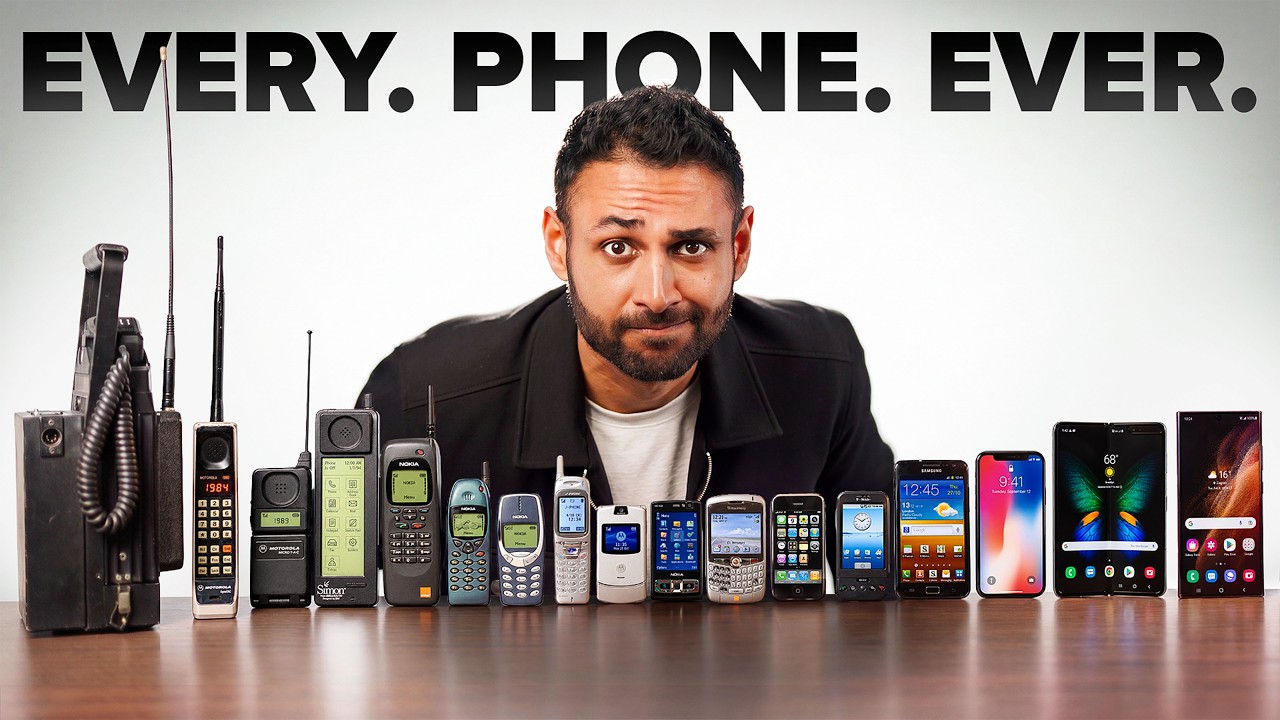
The Motorola DynaTAC 8000X sits on the table with the signature of Marty Cooper pressed into its casing, the man widely credited as the father of the cell phone. One phone, one signature, one moment that opens 42 years of mobile history that most people have never seen laid out end to end. With the help of the Mobile Phone Museum, Mrwhosetheboss worked through every era of handset from that first brick to the folding glass of today, and the patterns that emerge are genuinely difficult to believe.
When a phone call belonged to a building, not a person
The story begins in the early 1980s when making a call on the move meant bolting a 10-kilogram box of radio equipment into your car. The DynaTAC changed that in 1984, though it demanded a 10-hour overnight charge in exchange for 30 minutes of talk time and cost the equivalent of $13,000 in today’s money. By 1989, Motorola had the MicroTAC 9800X on the market at half the weight, complete with a flip mechanism that turned out to be far more satisfying to operate than anyone anticipated. The antenna on that flip phone was, as the exploration revealed, essentially decorative. The real antenna was already inside, but focus groups refused to believe a phone without one protruding from the top could possibly work, so Motorola kept it.
The move to 2G in the early 1990s reshuffled everything. Transmitting voice as digital zeros and ones rather than radio waves meant calls could be scrambled, towers could carry more traffic, and suddenly a phone could also carry text. The first SMS ever sent went out in December 1992. The person who received it could not reply because phones simply were not built for that yet.
IBM stepped in by 1994 with the Simon, a device that swapped text menus for a full graphical touchscreen interface and arrived with a notes app, email, fax, and what many consider the first mobile game. It failed commercially, running only one hour of talk time against a world that was not yet ready for it. Nokia took the same idea two years later, built it on the right network, added a full QWERTY keyboard, and in doing so planted the seed of what would eventually become the App Store.
The phones that everyone laughed at first
The Nokia 6110 gave the mainstream its most intuitive menu yet and introduced Snake, which for an entire generation was the first video game they ever touched. The 3310 followed and sold 126 million units, a figure that made the IBM Simon’s 50,000 lifetime sales look like a footnote. Nokia then swung for everything in 2006 with the N95, cramming GPS across 150 countries, a 5-megapixel autofocus camera, stereo speakers, and dual-direction sliding into a single device at a point when carrying a separate satnav, MP3 player, and camera was still normal. Performance estimates at that stage put it at roughly 300,000 times the original DynaTAC.
Meanwhile, Motorola had built the RAZR V3 in secret, its engineers working evenings and weekends because internal policy required a guaranteed forecast of 3 million units before greenlighting a product and nobody could promise that for something entirely new. It sold over 100 million.
Ben Wood, owner of the Mobile Phone Museum and present at the Nokia Communicator launch, described the reaction plainly: ‘it was just a revelation. People just could not believe such technology could exist and it was like something from the future.’
The original iPhone launched in 2007 to genuinely mixed reviews. Its Edge connection was called a dealbreaker. The camera underperformed the Nokia N95 in side-by-side tests. Apple cut the price by $200 within months and issued $100 store credit to early buyers as an apology, a rough enough stretch that the company’s value dropped $7 billion in a single day. The App Store, the thing that turned it into a cultural force, did not arrive until a full year and a half after the original announcement.
Samsung unveiled the Galaxy Note in 2011 at 5.3 inches, with a stylus, to a Wired score of 4 out of 10 and a Gizmodo score of 2.5. Within three years Apple was making plus-size phones. The first Samsung foldable broke in journalists hands within days of arriving for review in 2019. The latest iteration is 48 percent thinner than that first model with a cover screen twice the size.
A phone left behind in a museum case
The Sharp J-Phone J-SH04, the first camera phone to send photos over mobile data, sits with its tiny mirror positioned beside the lens for selfies, a word that did not exist yet when it was built. Of the 10,000 units produced, 8,000 shipped without the camera at all because Japan’s two largest networks had rejected the concept outright and only the smallest operator agreed to stock it, cautiously, with just 2,000 camera-equipped units to start.
From 30 minutes of talk time on a 10-hour charge to a modern device that converts the same 10 hours of charging into 300 hours of use. From 0.1 megapixels to 200 megapixels. From the data speed of a digital watch to a chip approaching a billion times more capable. Every single phone that created meaningful change, as the full 42-year lineup laid out side by side makes undeniable, started as something people found easy to dismiss.
 Wake up to Only Happy News!