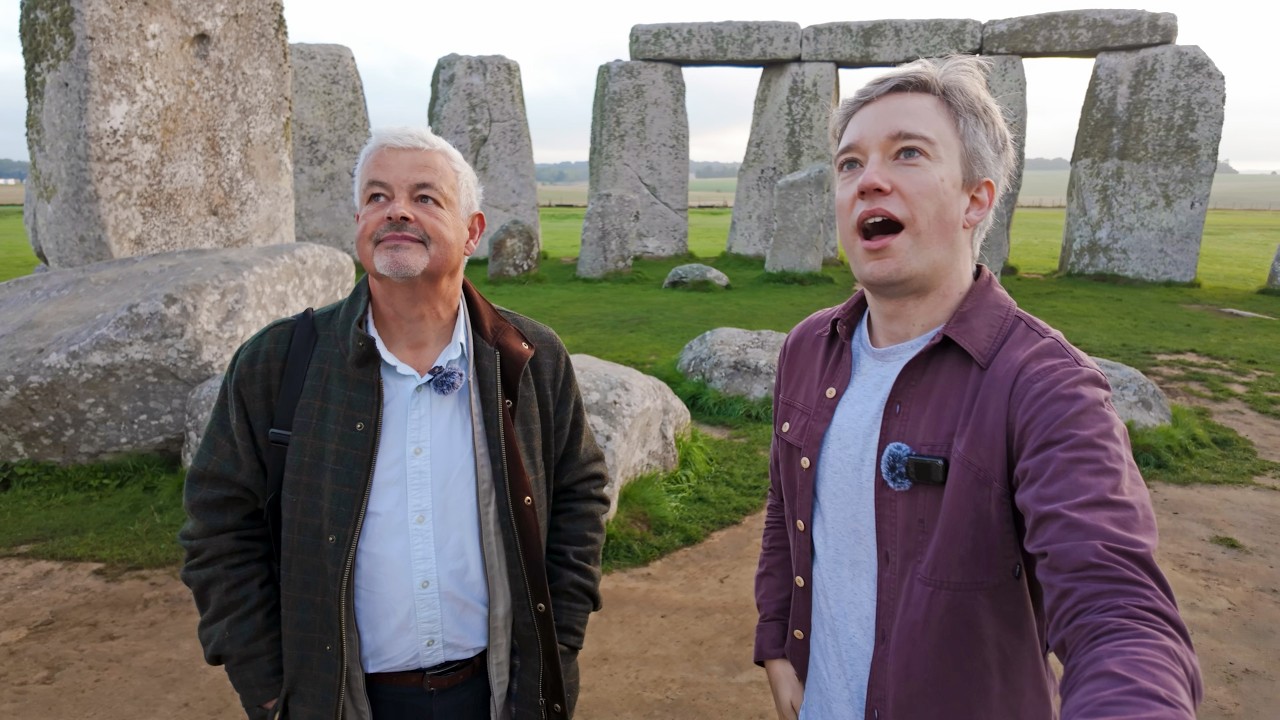
Stonehenge has been famous since the Romans visited it, referenced in medieval documents, and speculated about by Geoffrey of Monmouth long before anyone understood what prehistory even meant. Yet most people who have seen it experienced it from a car window on the A303, inching through the traffic jam it reliably causes. Tom Scott, filming one day after the equinox at sunrise, before any crowds arrived, stepped inside the rope line with Win, Curator of Stonehenge, to find out what 1.3 million annual visitors and centuries of casual souvenir-hunters have done to one of Britain’s oldest standing structures.
The tide mark that took centuries to carve itself
Step inside the stone circle and look carefully at the surface of any upright sarsen. At roughly the height an average adult can reach, the colour changes. Below that line, the stone is paler and largely bare. Above it, lichen and moss cling to the surface. Win pointed it out plainly: the lichen simply stops where human hands could reach, and lichens take hundreds of years to develop. The stone circle was closed to general public access in 1977, so there has been some recovery time, but as Win noted, it has not recovered nearly as much as the parts people could never touch.
That bare patch is not the only damage on record. Corner chips are visible at reachable height on several stones, the easiest place to knock a fragment loose, and Win mentioned that at one point visitors could apparently rent a hammer on site to help themselves to a souvenir. Sir Christopher Wren, born in Wiltshire not far from Stonehenge and architect of St Paul’s Cathedral, has his name carved in precise, serifed lettering on one of the stones. Additional carved initials from the 17th and 18th centuries are scattered across the circle. And then there are the Bronze Age carvings underneath all of that: axes and daggers dating to somewhere between 1750 and 1500 BC, now so faint they can only be detected with modern laser scans, sitting just fractions of a millimetre deep and on the verge of disappearing into background erosion.
What the builders actually understood about engineering
The construction detail that stopped Scott cold was not the scale of the stones but the joinery. The lintels connecting the uprights were not simply laid across the top. They were locked in place with mortise and tenon joints, a raised tenon carved into the top of each upright fitting into a matching mortise cut into the underside of the lintel. Some lintels also have elongated grooves that allowed for a small degree of sliding adjustment during placement. The stones were not piled; they were fitted.
Win added that the builders also made at least one measurable construction error: they began placing a stone in the wrong position and had to abandon it. The evidence is still there, thousands of years later.
The deeper puzzle, Win argued, is not the engineering at all. Isotope analysis of oxygen, strontium, and nitrogen in the teeth of cattle found at the site shows that animals, and by inference people, were travelling from granite regions, including Wales and Dartmoor, to gather at Stonehenge for midwinter celebrations. They were navigating hundreds of miles without writing, without signposts, without any fixed infrastructure, coordinating arrival times for a specific astronomical event through networks of personal communication that left no physical record. ‘For me, the elephant in the room about Stonehenge is the social networks,’ Win said. ‘It is the fact that they could mobilise very large numbers of people, and they could organise them.’
One stone is currently held upright with a solid block of modern concrete, installed during stabilisation work in 1958 when cranes were brought onto the site. The concrete is undisguised, which Win and Scott both acknowledged is at least honest: future archaeologists will know that in the 20th century, people still cared enough to repair it.
A bump on the top of a fallen lintel
On one of the toppled stones near the outer circle, the tenon is still visible: a small raised bump on the upper surface, the surviving half of a joint that once connected to its neighbour, pointing at a gap in the arc where, in a dry summer, yellow parch marks appear in the grass to show where the missing stones once stood.
Scott arrived at Stonehenge mildly indifferent, familiar with it as a source of traffic delays rather than wonder. He left converted, not by the carvings or the history alone, but by standing inside a structure built by people who coordinated thousands of participants across hundreds of miles without a single written word, and whose mistake is still visible in the earth beside the stone they had to abandon midway through the job.
 Wake up to Only Happy News!