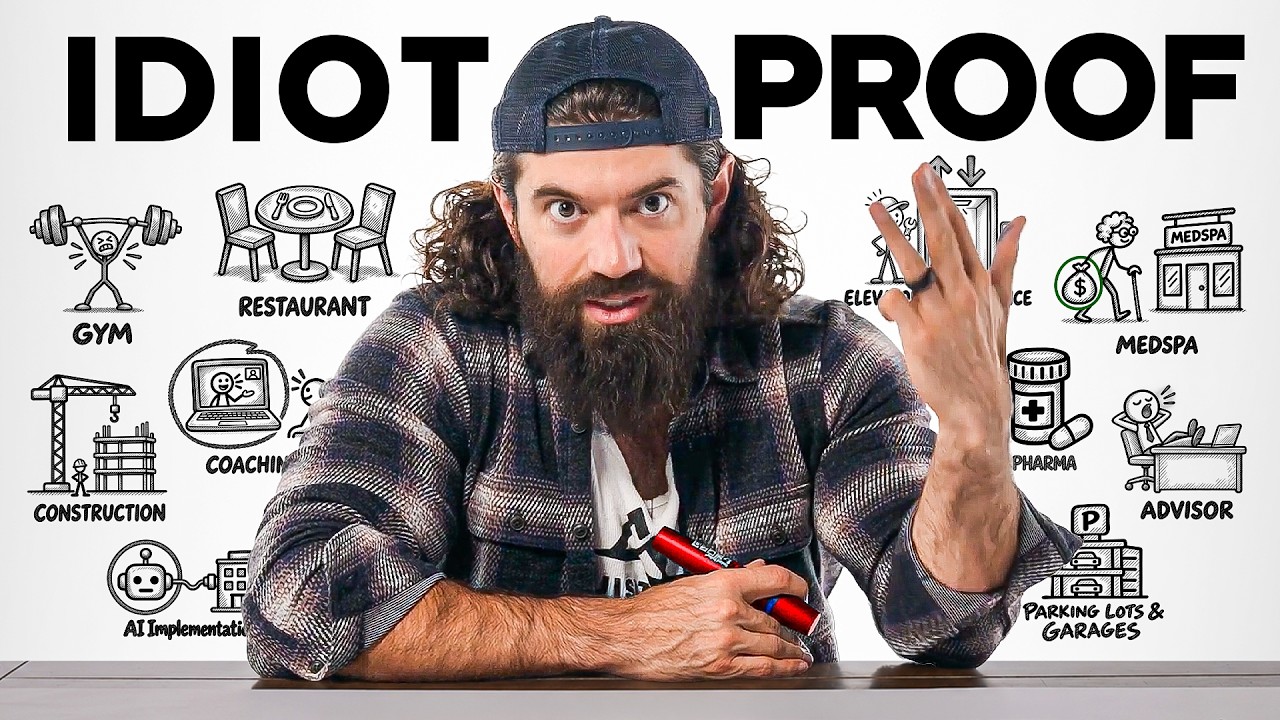
Alex Hormozi has sat across from more than 10,000 business owners at his Las Vegas headquarters, watching some brilliant, grinding operators barely scrape by while others with noticeably average instincts print money almost effortlessly. That gap kept nagging at him until he landed on a simple explanation: the business you pick matters more than how hard you work at it. The result is what he calls the Idiot Index, a framework that maps five categories of business against two axes, how hard the thing is to operate versus how much money it can realistically generate, and uses it to answer the question most entrepreneurs never think to ask before they start.
The boat matters more than the rower
Mormozi opens the whole framework with a Warren Buffett story that he treats as the founding premise. Buffett once described a business school classmate who was smarter and worked harder than him. That man went into steel. Buffett went into investing. Decades later, the classmate had made a fraction of what Buffett made, and Buffett’s explanation was simple: it was the boat, not the rower.
That logic drives every category on the index. The first and worst bucket Hormozi calls ‘labor-heavy commodities.’ These are low-barrier businesses, traditional sit-down restaurants, service-based gyms, SMB agencies, retail, and event planning, where fierce competition, thin scalability, and enormous operational drag conspire against the owner. His point is unsparing: ‘How many service-based gym owners do you know that are worth a billion dollars? None. Like there’s actually none.’ He ran a company called Gym Launch aimed squarely at that world, and he used to tell his most successful gym owners privately that if they applied their skills to a different vehicle, they would make significantly more. That is a hard thing to admit when your whole business is telling people to stay the course.
The second bucket, businesses that are easy and generate modest money, includes drop shipping, power washing, deck staining, vending machines, Airbnb arbitrage, and affiliate content. Hormozi is not dismissive here. A single skilled operator can reach a top 1% income in the United States from some of these. He just notes that the billionaire examples are essentially nonexistent, which sets a ceiling worth knowing about before you go all in.
The middle of the index, medium-hard and medium-money, covers what he calls expert-dependent businesses: online coaching, enterprise agencies, surgeons, construction, and personality-driven media. The trap here is subtle. These businesses can generate substantial income but rarely become transferable assets because they depend too heavily on the founder. As he puts it, it might be ‘a great kind of job’ but not necessarily a great company.
Where the real leverage lives
Category four, moat-built enterprises, is where true enterprise value lives. True AI companies, pharmaceuticals, specialty manufacturing, SaaS, marketplaces, consumer packaged goods, and roll-ups all sit here. These require deep skill, serious capital, time, and sometimes government approval. The counterintuitive point Hormozi makes is that all those barriers are actually the product: ‘I would rather compete with 20 people or 50 people than 5 million people.’
The fifth category is what he calls the promised land: easy and high money, businesses powered by supply and demand imbalances. His examples from businesses he has watched walk through his doors are striking. Med spas benefit from a wave of wealthy older consumers who want longevity and aesthetics and have the money to pay for it. Fire safety inspections are government-mandated for every commercial building, which means every business owner has to call someone, usually the same person they called last year. Elevator maintenance operates similarly. Commercial cleaning is sticky and trades at strong multiples. Crematoriums and funeral homes serve fixed, inelastic demand from a growing elderly population where, as he observes, the person writing the check is often spending insurance money and ‘doesn’t really care about the cost that much.’
One of his sharpest observations concerns businesses that carry what he calls ‘moral dirt.’ Debt collection, waste management, payday lending, and cash advance businesses all suffer a cocktail-party stigma that keeps competition lower than the economics warrant. ‘It sounds way cooler to say you’re a musician than you’re a debt collector,’ he says, ‘but there’s a lot of money in it.’
The fire inspector who changed how he thinks
A man walked into Hormozi’s Las Vegas headquarters with a clipboard, completed his fire safety inspection in seven minutes, and handed over a bill for $700. He does roughly ten of those a day.
The same amount of time spent building either a restaurant or a software company still costs 60 hours a week, Hormozi notes. Only one of those can become a billion-dollar company. The hours are the same. The boat is the difference.
 Wake up to Only Happy News!