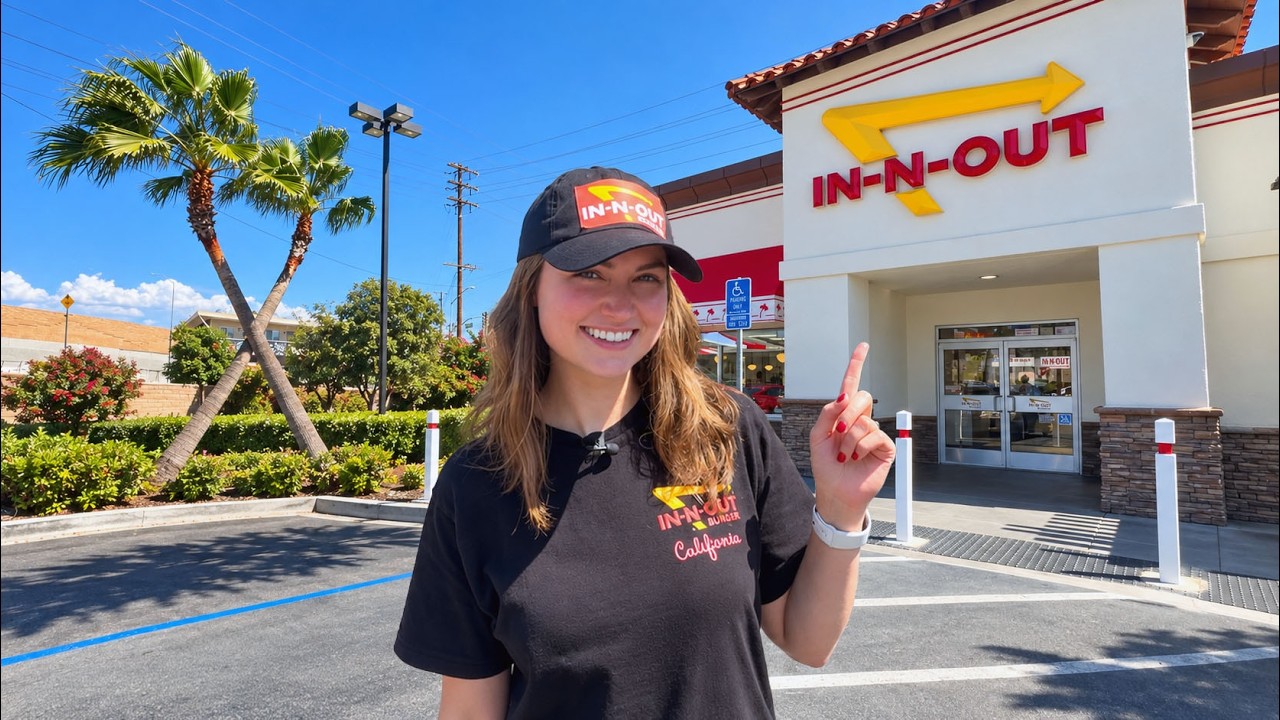
Standing outside a perfect replica of a 100-square-foot hamburger stand in Baldwin Park, California, Taylor Bell unwrapped a grilled-onion-wrapped Flying Dutchman and handed it to her mother. The reaction was immediate: ‘That’s good.’ Then, after a second bite: ‘Oh my.’ What followed was the kind of quiet, sunbaked contentment that In-N-Out has been producing since 1948, and what Bell set out to understand is exactly how a company this deliberately small generates this much devoted loyalty and this much money.
The 300-mile leash that controls every burger
In-N-Out’s four-item menu has not changed in its core form since the Double Double was permanently added in 1963. No freezers, no heat lamps, no microwaves exist inside any In-N-Out kitchen. Because the beef patties are never frozen, every single location must sit within roughly 300 miles of a company-owned processing facility, a $30 million-plus investment the chain makes before it can enter any new state. That manufacturing constraint is the real reason In-N-Out has roughly 440 locations across 10 states while McDonald’s and its peers number in the tens of thousands. It is also, as Bell put it, entirely by choice.
The supply chain philosophy traces directly to founder Harry Snyder, who drove to meat and produce markets every single morning to personally select ingredients, while his wife Esther ran the accounting from their home around the corner from the first location. That hands-on instinct never left the company. Whole potatoes are diced in-store in front of customers. Lettuce is hand-leafed until it is genuinely crunchy. Buns are baked fresh without preservatives. Milkshakes use real ice cream. The hot cocoa powder served free to children under 12 on rainy days comes from Ghirardelli.
The estimated average sales per In-N-Out location run above $6 million per year, roughly one and a half times the comparable figure for McDonald’s, and about four times that of Five Guys. The chain’s $2.6 billion in annual revenue flows from those four items done, as Bell noted, ‘really, really well.’ Lindsay Snyder, Harry’s only grandchild and current owner, carries a Forbes-estimated net worth of $8.7 billion, built entirely without outside investors, without franchising, and without debt.
Why a $160,000 manager salary is actually the cheap option
The average In-N-Out store manager salary was confirmed at $160,000 in 2018 and has almost certainly climbed since. The average manager tenure is 17 years. Every single manager is promoted from within, never hired externally. In-N-Out University, a training facility opened by Lindsay’s uncle Rich Snyder before his death in a plane crash, ensures every manager is trained the same way. The result: In-N-Out ranked number one in employee satisfaction among all American restaurant chains for 10 consecutive years, with a 91% employee approval score. Fair wage activist Su Jy Ramen put it plainly: ‘In-N-Out is just eons above everybody else on wages and benefits. They really are the best large chain.’
The compounding logic here is straightforward. High pay produces long tenure. Long tenure produces consistent training. Consistent training produces the sparkling counters, the mid-meal check-ins, and the culture that 63% of In-N-Out visits are driven by brand desire rather than convenience. When California introduced a $20 minimum wage in 2024, Lindsay went into VP meetings and pushed back hard against significant price increases: ‘I felt such an obligation to look out for our customer.’ In-N-Out remains among the cheapest options in its fast food category.
Now, with a new $30 million processing facility opened in Tennessee in 2025 and three locations launched in the state the same year, including one at an address that reads 1951 Double Double Drive, the 300-mile leash is reaching east for the first time. New Mexico expansion is planned as early as 2027. Bell, an LA native, put the cultural tension plainly: seeing an In-N-Out in Texas felt wrong. ‘What’s he doing here?’ The scarcity that made customers into a free marketing department may be the one thing the chain cannot bottle and ship alongside the never-frozen patties.
The grilled-onion-wrapped Flying Dutchman, still warm
On a 100-degree filming day outside the Baldwin Park replica, Bell’s mother held a grilled-onion-wrapped Flying Dutchman: double meat, double cheese, folded inside a single caramelized onion, no bun, no wrapper, nothing else.
The Snyder family has kept every core decision intact through four leaders, three unexpected deaths, and nearly eight decades. One double double at a time, Bell observed, is how that kind of loyalty actually gets built.