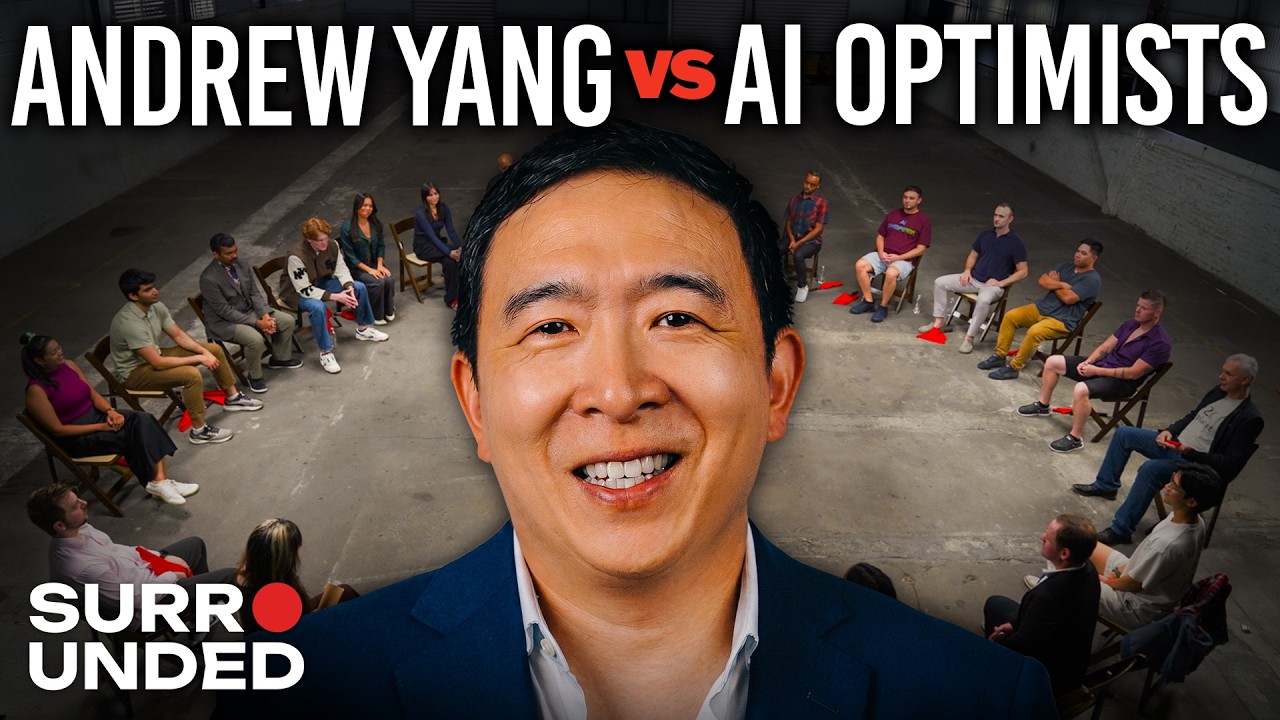
Andrew Yang walked into a room of twenty AI optimists in Los Angeles, sat down across from software engineers, small business owners, therapists, and content creators, and opened with a claim designed to make everyone uncomfortable: AI will not democratize opportunity. It will accelerate inequality on a scale the world has never seen before. What followed was one of the more honest conversations about artificial intelligence to happen in public in recent memory, not because everyone agreed, but because almost no one did. The stakes were real and personal: jobs already being erased, college graduates already underemployed, and a question that kept surfacing no matter which debater sat in the chair: who actually captures the value when machines replace human labor?
Where the money goes when AI does the work
Yang opened every exchange with the same structural argument. You have capital, AI, data, and processing power converging into what he called a multi-trillion dollar vortex. The value gets hoovered up and moves toward the top: the shareholders of AI firms, the investors, the companies that already hold the data sets and the processing infrastructure. A small business owner named Essie, who runs a jewelry brand called Zam Jewelry, pushed back by citing a surge in business registrations since ChatGPT launched in 2022 and the real cost savings AI delivers on legal, accounting, and marketing. Yang conceded the point and then immediately complicated it. His own company, he said, had taken down a job posting for a junior engineer and a junior data analyst because AI made them less necessary. The win for the small business owner was real. The loss for the person who would have been hired was equally real. ‘It is like zero sum,’ he said, ‘what you have extracted is helping you, but it is going to be less money for the accounting firm you would have hired in a past era.’
A Facebook software engineer named Nikquil argued that open-source models and locally hosted AI give everyone access regardless of what the big companies charge. Yang acknowledged the point and then landed what he called the ‘categorically wrong and meta’ fact underneath it: Americans’ data is being sold and resold commercially for $300 billion or more a year and no one sees a dime. He noted, without softening it, that Nikquil’s own employer is one of the primary compilers and sellers of that data. Nikquil agreed the data-compensation problem was real. They disagreed on the remedy.
The UBI argument, the CEOs who are already cutting, and the one debater who fully agreed
The sharpest exchange on universal basic income came from a direction Yang did not expect. A single father named Sean, who had worked as an underwriting analyst in insurance before starting his own company, sat down and told Yang flatly that UBI was not something that will become necessary. It is already necessary, and it was necessary before AI arrived. Yang laughed and said, ‘Sean, you are on my side.’ The room applauded. Yang pointed to the Roosevelt Institute study he referenced throughout the day: a UBI of roughly $1,000 a month per person would grow the economy by about 12% in perpetuity because virtually all of that money would be spent immediately at local businesses, local garages, local tutoring services.
On the jobs question, Yang cited a public company CEO who told him directly: I am going to fire 20% of my workers this year, another 20% two years from now, another 20% two years after that. Every time I do it, I get a bonus. If I do not do it, they replace me with someone who will. He also referenced Block setting what he described as a record for the percentage of workers laid off in S&P 500 history, roughly 4,000 out of 10,000, with AI tools cited as the reason. Oracle laid off 30,000. Meta cited AI for 8,000 more. The data point he returned to most often was the labor force participation rate sitting near a twenty-year low of around 61.5%, with one-third of working-age American men no longer in the workforce at all.
In the final extended exchange, Yang chose Sophia, co-host of the AI media outlet MTS, for the ten-minute open debate. She argued that pessimism is a tool authoritarian governments use to make people feel powerless, and that optimism is what fuels agency. Yang said he did not entirely disagree. His distinction was between personal optimism, which he endorsed, and what he called being clear-eyed at the macro level about who the primary beneficiaries actually are. He put it plainly: the holders of AI and the capital and the controllers of the data centers do not give serious consideration to what happens to the average person and their family. His goal, he said, was not to shut anything down. ‘I am a come together guy. I am a let us figure it out guy.’ The opportunity of the age, in his framing, is moving human society from scarcity to abundance. The obstacle is getting the winners of this era to decide that life is better outside the bunker.
For the record: Yang noted he did not use AI to prepare for the debate. He reread his own books instead.
The moment a USC professor’s veteran app complicated everything
Skip Rizzo, a professor at USC’s Institute for Creative Technologies who has spent thirty years studying virtual reality and clinical applications, described his startup Sidekick, which in the week before the debate had received VA endorsement to distribute an AI conversational agent for veterans. Yang immediately said he loved it, citing research showing that military veterans sometimes open up more to an AI conversational partner than to a human therapist because they fear that disclosing depression or PTSD to a human clinician will result in discharge. Then Yang paused and asked the question out loud: is not that going to eliminate human therapists? Rizzo cleared his throat. Yang noted he was technically on the optimist side of the room.
A psychotherapist named Jeremiah later explained the veteran preference differently: therapists contracted by the military are required to send their session notes to the veterans’ superiors, and service members know that documented mental health struggles can end their careers. The AI felt safer not because it was better, but because it could not report back.
The room in Los Angeles stayed friendly throughout. Yang said afterward that he had enjoyed the conversations, that the debaters were smart and open-minded, and that they had been forging a genuine human connection rather than performing opposition. Sophia said she thought he was more of an optimist than he had let on.