The Christopher Reeve Superman costume has survived nearly 50 years of heat, humidity, and light degradation, and it still looks the way it does because a group of people decided, early on, that it was worth saving. That choice turns out to be a career. Somewhere inside the Warner Bros. Archives, a building most people will never enter, a team of archivists, mechanics, fabricators, and costume conservators shows up every day to make sure that decision holds. Their names have never appeared above a title. But anyone who has ever been moved by a story from this studio has already felt their work.
Where the cars live and who keeps them alive
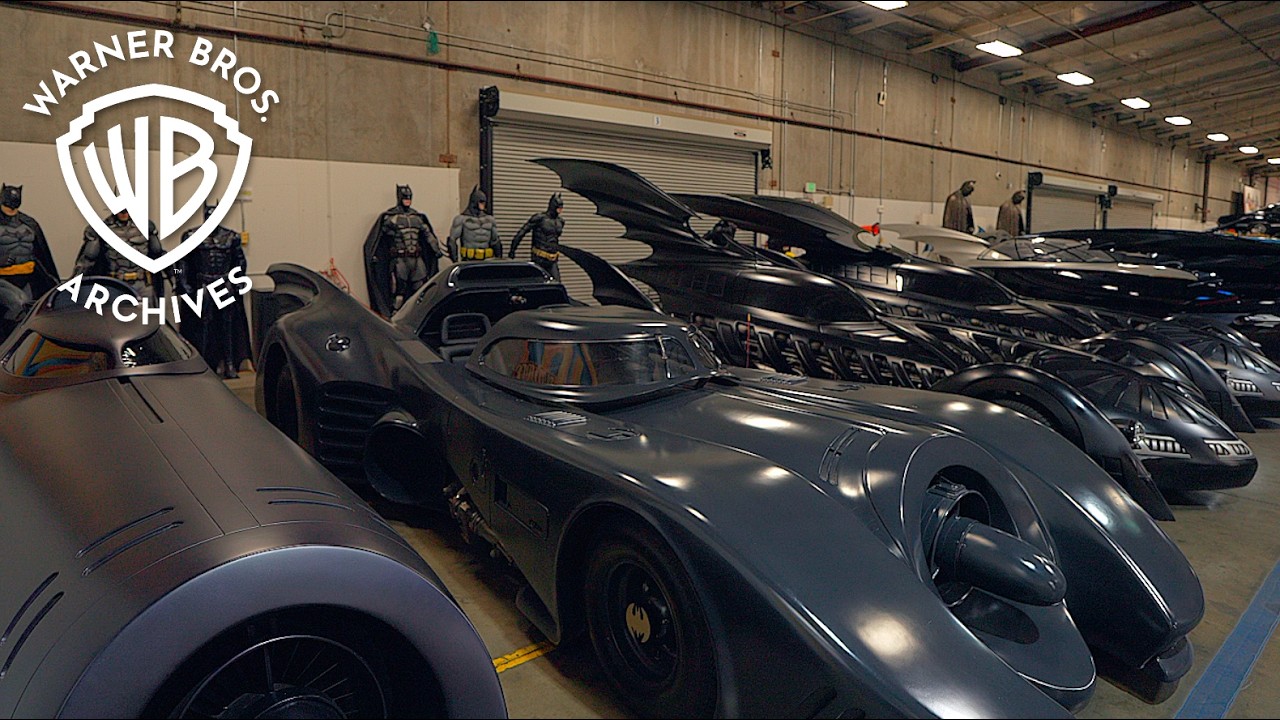
The archive floor opens with vehicles, and the first thing that registers is scale. Vintage Rolls-Royces and Bentleys from productions share space with the Elvis film car, the time machine from ‘The Time Machine,’ and the full fleet of Batmobiles, each one charged, lit, and maintained as though a shoot could be called tomorrow. Collections manager Matt oversees what comes in: his team works directly with productions to identify the iconic pieces and bring them into the permanent collection, making sure nothing significant walks off a set and disappears.
The Batmobiles are the crown of the collection, and they are not decorative. Dennis McCarthy of Vehicle Effects keeps them running. Every car in the fleet, some pushing 40 years old, runs on GM V8 engines hidden beneath fiberglass and custom lighting rigs. The one exception is the very first TV Batmobile, which used a Ford. The trickiest to move is the Batman and Robin car, the only full-size version built for that film. Because of the cost and fabrication involved, only one was made. Getting it on and off a trailer requires hydraulic systems, race ramps, and people who have done the job 50 or 100 times. Three of the Tumbler-style cars can share a single transport truck. The Batman and Robin car needs one all to itself.
McCarthy was not looking for a career in film when it found him. He had his own shop, employees, and a full workload when a producer first came asking for a custom build. He turned down the first call. He picked up on the second. He put it plainly: ‘Anytime you can build something or fix something, they’ll always be working.’
The Batman v Superman Batmobile required a solution no production designer had sketched on that cafe napkin: the motor had to sit directly behind the two seats, the transmission running up between them, with a custom differential shifted entirely to one side just to fit a working drivetrain into the available space. The director wanted the car to slide, to jump, and to launch out of the Batcave at height. The Batcave exit was eventually lost to a location change. McCarthy kept pushing until the production built a dock jump instead, because, as he put it, he ‘kept bugging’ them and would not let it go.
When the material itself starts losing the fight
Not every preservation problem has an engine underneath it. The classic costumes room holds pieces that are nearly 90 years old, and the conservators here treat the materials as patients. The Bette Davis gown visible in the collection had beads falling away not because of rough handling but because the thread holding them had become brittle with age. The team cast what remained of the original beads, manufactured new ones, and artificially aged them to match the surrounding garment. The original beads and sequins that fell off were saved and kept linked to the dress in the archive’s records.
The Catwoman suit from one of the Batman films presented a different kind of loss. The original vinyl cracked apart under dry heat, and unused backup suits from the same production were already falling to pieces the moment their storage boxes were opened. The conservators brought in the original sculptor who had created the cowl and the latex suits in the 1990s. He still had a life cast of the actress from the original production. Using that cast, he sculpted a custom 3D-printed mannequin, fitted the original boots, claws, whip, corset, and cowl around it, and recreated the surface detail of the vinyl in printed form. The suit itself could not be saved. The character still comes through.
The most temperature-sensitive pieces live in what the team calls the crypt: a refrigerated cooler commissioned specifically to house the stop-motion puppets from the studio’s first stop-motion feature in many years, along with Mars Attacks figures, Gremlins, and other foam latex pieces. Without the cooler, the moisture inside that foam evaporates and cannot be reintroduced. Discoloration comes first, then cracking, then the skin separates from the metal armature underneath. Over a couple of years in the wrong conditions, the damage becomes irreversible. The cooler keeps them stable. The 20-year-old puppets inside still show no cracking.
The mechanic who touched his father’s work
One of the fabricators on the archive’s shop team stopped in front of a specific piece during the visit and got quiet. The prop in front of him was something his father and a team of other technicians had built for a film. He had seen it once before, at the original screening, behind a rope. He had not been allowed to touch it then. Standing in the archive, he reached out and ran his hands over it. Someone nearby told him he probably had to be the one to spin it, too. He did.
The Christopher Reeve Superman costume is still here, still intact, still the specific shade it was on screen. Nylon, it turns out, outlasts latex and plastic by decades. The archivists meet each material where it is and work forward from there. That is the whole job, and there is no version of it that ends.