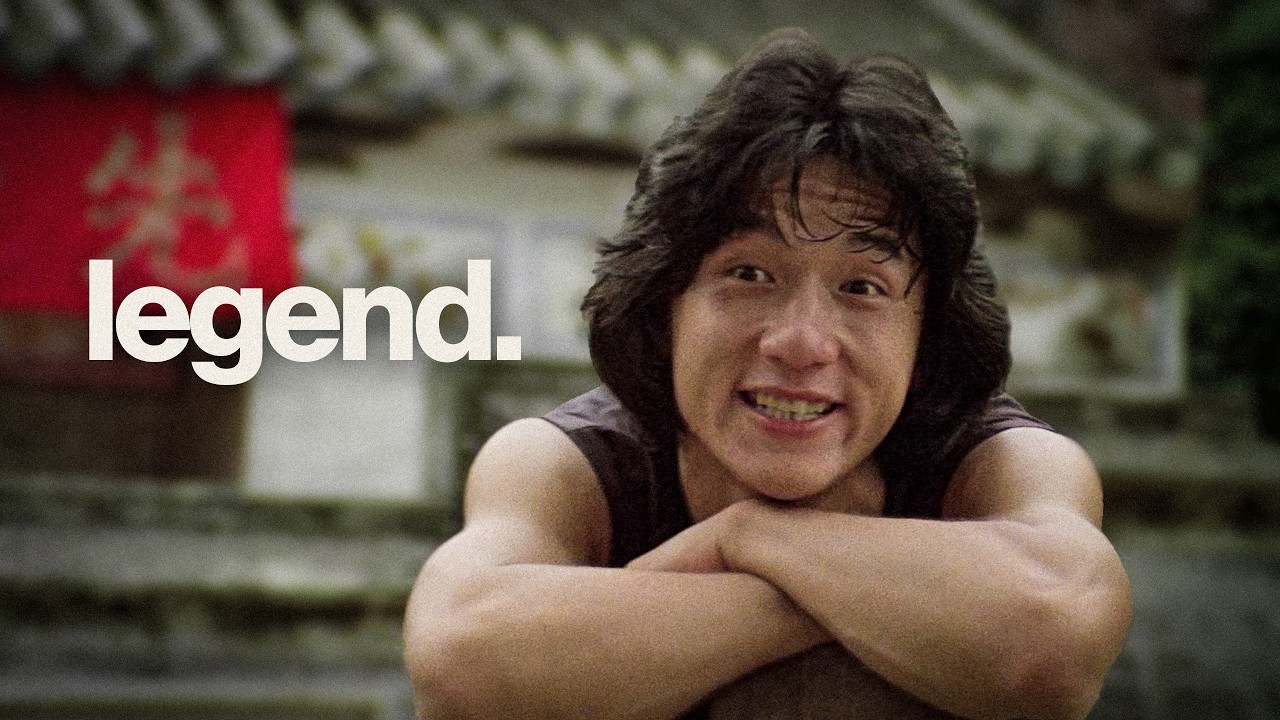
At seven years old, Jackie Chan signed a contract he did not fully understand, and one week later cried until he could not stop. The opera school his father had left him in before moving to Australia ran its students from five in the morning until midnight, with a bamboo stick for anyone who slowed down. What happened inside those walls over the next decade did not just shape one performer. It quietly rewired what action movies could be.
From stuntman’s lunch box to the youngest coordinator in Asia
Chan did not fall in love with cinema out of passion for storytelling. He has been candid about that. As a child actor brought onto sets by a visiting director, the real draw was the food. ‘I like movie because when I was young on the location, I really have a very good lunch box,’ he said. ‘I have nothing to eat in the school. But on the set, I can have my really good lunch box.’ That hunger, literal at first, eventually became something harder to satisfy.
By fourteen he was a low-ranking stuntman, routinely cut from the selection pool whenever Bruce Lee’s crew needed background fighters. Rather than accept that, he positioned himself behind directors and senior coordinators, studying every decision while others played cards. By eighteen he was the youngest stunt coordinator in Asia, teaching actors how to fall, how to react, how to die convincingly on camera.
When Bruce Lee died after only five films, distributors scrambled for a replacement. Chan was handed a role in New Fist of Fury and told to move like Lee. The poster billed him as ‘the second Bruce Lee.’ He refused the premise. Working with his older brother figure Yuen Woo-ping, he built an opposite template: where Lee kicked high, Chan kicked low; where Lee projected menace, Chan got hit and made you laugh. Snake in the Eagle’s Shadow in 1978 landed like a signal flare. Drunken Master followed the same year and hit harder. The genre had not been revived by a formula. It had been rebuilt around one very specific person.
Why Chan’s fights feel faster without actually being sped up
A persistent assumption among Western audiences was that the fight sequences must be accelerated in post-production. Chan has always rejected that. The speed is rhythmic, not mechanical. He choreographed action the way a dance director maps a musical number: full-body, full-frame, with the camera instructed to follow footwork counts rather than cut around them. ‘Let the audience see what I’m fighting,’ he explained. One shot in Young Master required two full days to complete. A single action sequence in Drunken Master 2 consumed three months.
Hollywood operated on a different clock entirely. When Rush Hour finally gave him a foothold in the American market in 1998, he navigated union rules, prop department wait times, and directors who wanted a Clint Eastwood type rather than the performer he had spent two decades building. His workaround on one Rush Hour set, when the space was too tight and no steadicam was available, was to ask for a wheelchair. The crew called it genius. Chan pointed out that in Hong Kong, everyone had been doing that for years because no one had money for a crane.
Drunken Master 2, Project A, the Police Story series, and Rumble in the Bronx remain the films audiences return to most, all made between 1978 and 1995, when budget constraints forced invention and Chan held total creative control. The limitations, as he lived them, were the engine.
The ankle cast he filmed through
On the set of Rumble in the Bronx, Chan broke his ankle in the morning and returned to work in the afternoon with a cast on, asking the crew only whether they had captured the shot. They had.
At the close of more than 56 years in the industry, Chan stood in front of a Hollywood star bearing his name and acknowledged that Sylvester Stallone had once sent him a first-class ticket and sparked the dream in the first place. He described looking at the Walk of Fame then and again a decade later when the call came. ‘My dream come true,’ he said simply. ‘Thank you, Stallone.’
Somewhere in a Hong Kong studio archive, the outtake reel from an early film still exists: the shot the editor refused to use, the one Chan retrieved after hours, cut himself through the night, and eventually used to turn the editor into his assistant. He taught himself editing because the editing bully would not listen. That is more or less how all of it began.