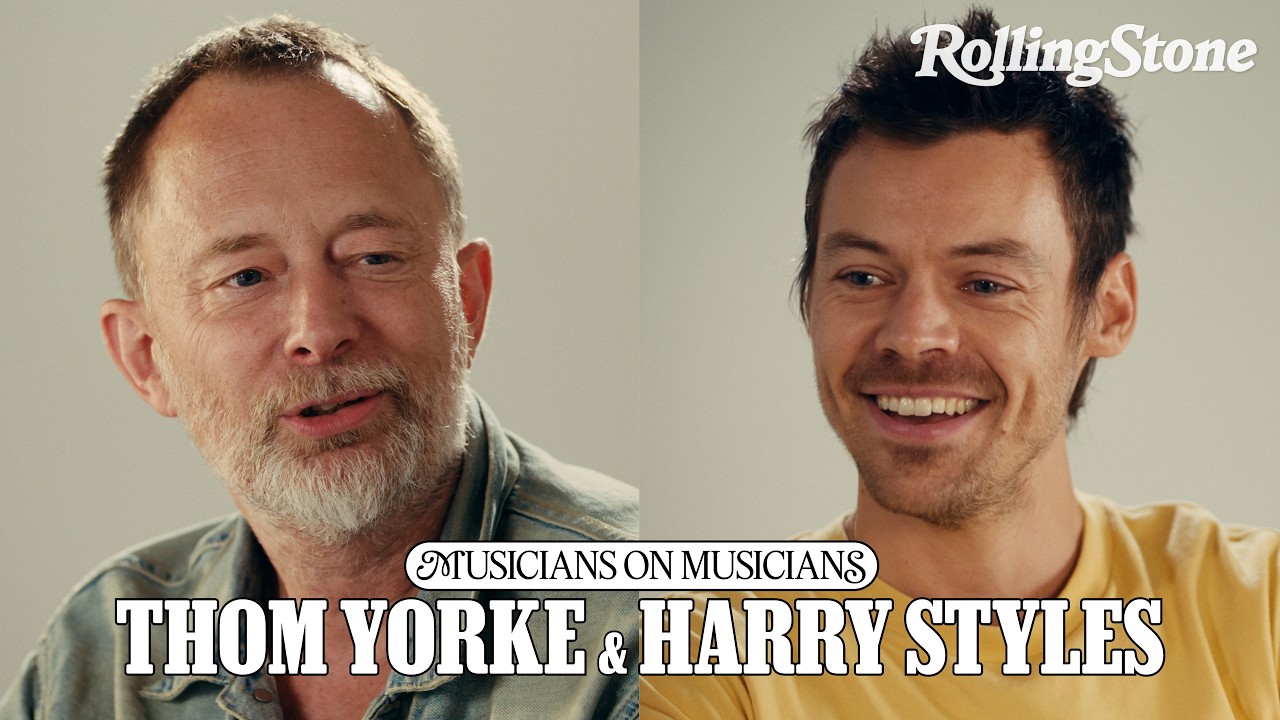
Thom Yorke was wearing a hat that said ‘acid’ on it the first time Harry Styles spotted him walking down a narrow street in Rome. Styles had A Moon Shaped Pool playing through his headphones, stopped the track mid-song, and said hello. What followed that sidewalk encounter, a proper meeting at the show later that night, became the beginning of a friendship between two artists who turned out to share an almost identical anxiety: the suspicion that the best work arrives despite you, not because of you.
That tension sits at the heart of one of the more honest conversations two major artists have shared in public in some time. Neither man arrived with talking points. Yorke brought a notebook. Styles pulled up Garage Band on his phone.
The thing Michael Stipe taught Yorke in Stockholm
Before Styles learned to walk freely through cities, he spent the early years of his career locked inside hotel rooms, convinced the outside world was unsafe. A girlfriend visiting London changed that. She was outgoing enough that staying indoors for three days straight would have looked strange, so the two of them walked everywhere instead. The realization landed quietly: it was fine to be outside.
Yorke had arrived at the same freedom through a different route. When Radiohead toured with REM, Michael Stipe noticed Yorke hiding in the dressing room before every show and dragged him out. The advice Stipe offered was simple: ‘If you don’t care, they don’t care. If you’re not looking, they’re not looking.’ Yorke tested it at a busy club in Stockholm and nobody bothered them. He has relied on that principle ever since, including the two and a half days he spent walking in the rain, notebook in hand, writing ‘Wolf at the Door’ through what he described as a really bad moment.
Both men connected walking to staying permeable enough to write. ‘You’re at ground level and you see things that you just don’t see if you’re driving,’ Styles said. Yorke put the stakes higher: without it, he said, it is really easy to get lost.
Why the good stuff arrives despite itself
The deeper conversation kept circling a single uncomfortable fact about songwriting: neither of them knows why the things they like actually work. Yorke used Pyramid Song as his example, genuinely baffled that three chords repeated over the same lyric could hold up. ‘You don’t know why you like it,’ he said. ‘Why would Pyramid Song… it’s three chords over and over again and the same lyric. How does that make sense?’
Styles described the same experience from the other direction. He tends to overwrite, accumulating verses and floating lines until a reduction reveals what the song was actually trying to say. The lines that survive are rarely the ones he chose consciously. ‘The stuff that ends up being in the song is kind of there despite itself,’ Yorke agreed. ‘It’s there because the music needs it to be there.’
Yorke traced much of his early creative paralysis to the period around Kid Amnesia, when he felt compelled to intellectually justify every creative decision while he was still making it. His eventual exit from that spiral was blunt: ‘Nobody cares, man. Nobody cares that it’s difficult. And so if you’re worried, if you’re bummed out that it’s difficult, fucking stop, go and do something else.’ That lesson, he said, took months of walking to absorb.
Styles described a surfing analogy someone had once offered him: you can practice getting up on the board, but if a wave arrives before you have practiced enough, you will not be able to surf it. The preparation and the moment have to meet. Yorke’s response was immediate and dry: ‘Or if I’m surfing, you’re not ready ever.’
The conversation ended where it began, with walking, a nod to the Suzuki book on beginner’s mind, and Yorke’s six-year-dead laptop still missing its charger somewhere.
The notebook Yorke brought to the ceremony
When Styles described the Ivor Novello fellowship ceremony, he mentioned that Yorke arrived with a notebook and read his speech directly from it. The honesty of that gesture, he said, cut through everything that felt manufactured about the occasion. Yorke admitted the recognition left him deeply confused, not ungrateful, but genuinely unable to locate himself inside the celebration. What steadied him afterward was starting his own record again two months later.
For Styles, the emotion at the end of his London run landed differently. It was not about any single song. It felt, he said, like the audience was there because they believed in what he was doing, not because they wanted to hear any one specific thing. That distinction mattered enough to bring him to tears.
Yorke, who had walked through his audience for the first time at a radio show in Madrid after years away, understood exactly what Styles meant. He and the rest of the band stood backstage beforehand telling each other to keep it together, and then walked through the middle of it anyway.