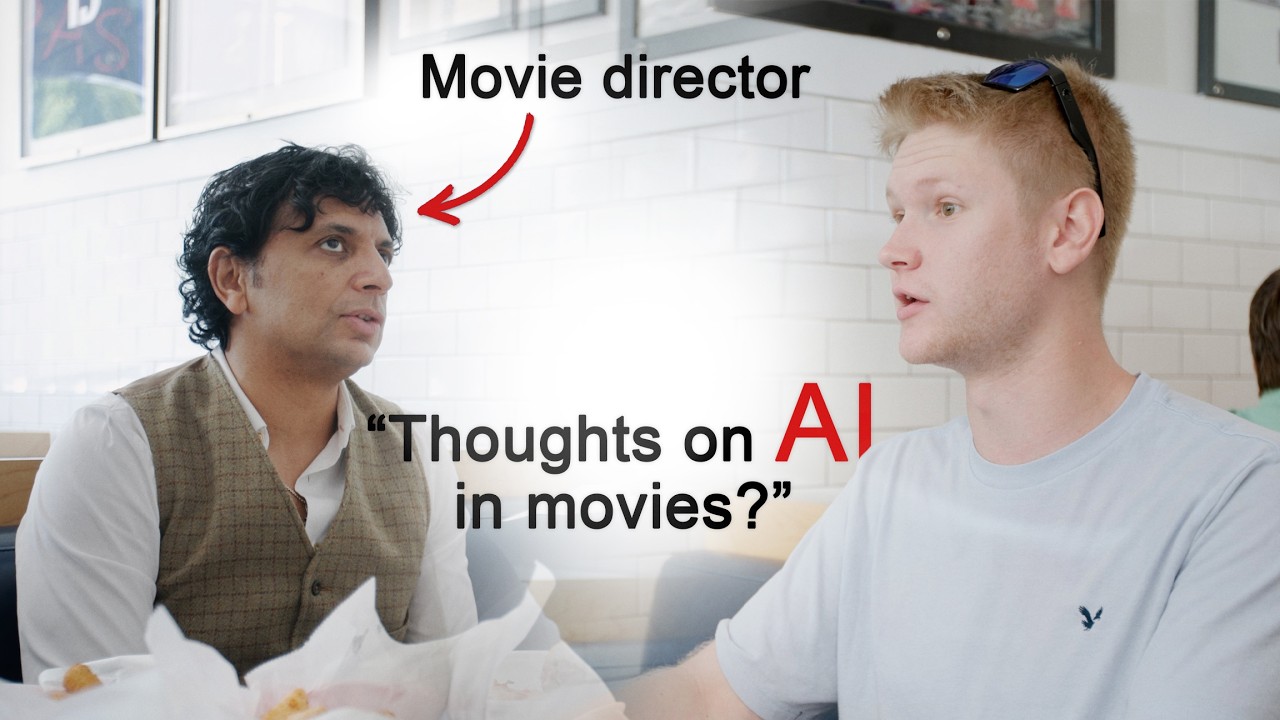
M. Night Shyamalan slid into a booth at a late-night pizza spot on Villanova University’s campus and picked up a slice before a student named Brendan sat down across from him and asked one of the sharpest questions of the night. The exchange that followed cut to the philosophical bone of what it means to make anything at all. It was not a formal panel or a press event. It was exactly the kind of conversation that can only happen when a filmmaker skips the junket format entirely and goes looking for a better room.
The camera placement story that explains everything
Shyamalan had been thinking about this question long before Brendan raised it. During the making of his television show Servant, he brought directors from around the world to helm individual episodes. One of them came to set and asked him directly where the camera should go. He refused to answer. Not out of stubbornness, but out of a specific conviction about what creative identity actually is.
‘Whatever I say there is no I have stolen from her if I answered that question,’ he explained. Even if his answer would have produced an empirically better shot, the act of giving it would have broken something irreplaceable. The director’s particular combination of strengths and weaknesses, her instincts, her doubt, her moment of discomfort when a frame wasn’t sitting right, those were not obstacles to good work. They were the work itself. A borrowed answer, even a correct one, would have made the vocabulary of her episode inconsistent in ways a viewer would feel without being able to name.
The same logic, he argued, applies to AI. ‘You can now get to third base so fast without any effort,’ he told Brendan. He described sitting with a script he is currently writing, feeling its limitations, feeling his own limitations, and fighting the urge to type the whole thing into a program and ask what could happen next. He knew exactly what would come back: fifteen options, each plausible, and a strong pull toward a variation on one of them. And he knew what that would cost him. ‘I would have stolen from myself this opportunity.’
Art is the ability to say you are not alone
Brendan pushed on the human dimension of the question, making the case that there is something irreducibly felt in knowing how much labor went into a film or a book, something an audience senses even without being told. Shyamalan agreed, and reached for the plainest definition of art he had.
‘I used to say that art is the ability to convey that you are not alone,’ he said. ‘And if AI made it, it’s saying you are alone. Because you can smell it if another human being whose limitations are that person’s beauty, their anger, their arrogance, whatever it is, you can see them clearly.’
He illustrated the point with a memory of visiting the novelist Elmore Leonard at his Detroit home, a house frozen in the 1980s, a typewriter on the desk, stacks of research beside it gathered by Leonard’s researcher. What struck Shyamalan was not the research itself but the relationship between an 80-year-old man and those stacks: which details he chose, which he ignored, how they filtered through a specific life’s worth of experience and came out as fiction only he could have written.
His summary of AI’s net effect on creative fields landed in a single compressed sentence: ‘It’ll raise the floor and lower the ceiling.’
Brendan, an economics major who studies AI and plans to work in analytics, made the distinction himself: a useful tool for pulling data together and informing a decision, but not for making one. Shyamalan agreed the division mattered. In fields built on human interpretation, the search for the answer is not a phase you get through. It is the point. ‘Are we the answers,’ he asked, ‘or are we the search for the answers? And if you’re taking the search away from us, are we anything?’
The pizza Shyamalan needed someone to take off his hands
The booth at the Villanova late-night spot had a hot pizza on the table for most of the conversation.
At the end of the night, Shyamalan pushed it toward Brendan. ‘Anything you take from me so I don’t eat it,’ he said, ‘because I will eat it all.’ He was headed to the gym that weekend and wanted the food gone. The pizza sat there, warm, between a filmmaker and a student who had just spent an hour talking about what machines cannot do.