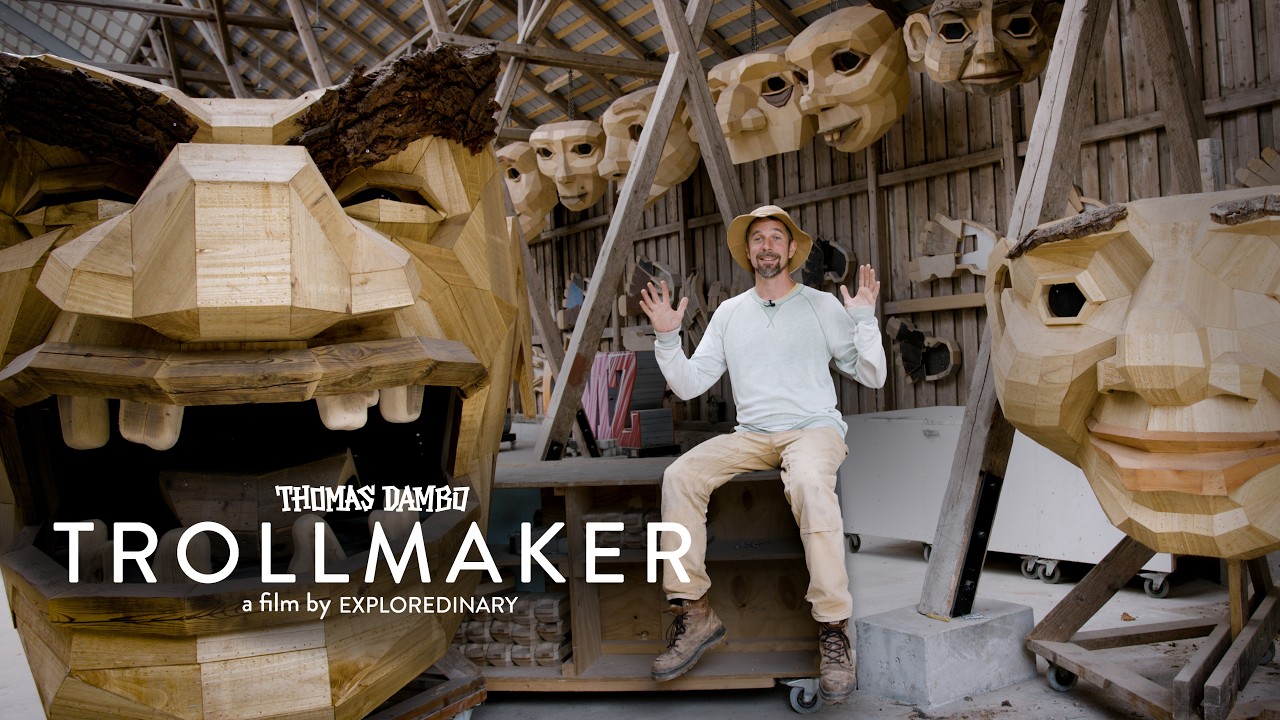
On a 200-year-old farm outside Copenhagen, inside a barn large enough to hold sculptures that would dwarf a city bus, Thomas Dambo stands beside a wall of meticulously organized screws and grins like a kid who just found treasure. For a man who once rode his bicycle to the hardware store and agonized over which single box of screws he could afford, the sight of every length and gauge sorted better than any store shelf still gives him what he calls a really warm feeling. Twelve years and 170 giant recycled wooden troll sculptures into a career that now draws more than 5 million visitors a year, Dambo operates out of a place he calls Rancho Dambo, where everything on the property is built from trash, with trash, or from scraps and leftovers. The art is the philosophy, and the philosophy is the farm.
A fairy tale built chapter by chapter from garbage
The troll project did not start as a troll project. Dambo spent years making street art and interactive installations, including a piece in central Copenhagen called Happy Wall, a large public artwork made of nearly 2,000 wooden pixels that visitors could flip by hand. But a specific vision took hold. ‘If I build a giant recycled fairy tale chapter by chapter all around the world,’ he recalled thinking, ‘that could be really spectacular.’ He simply started doing it.
The trolls are rooted in Danish folklore. Dambo describes them as Denmark’s equivalent of a dragon or a Bigfoot, the mythical creature that historically explained the unexplained. But there is a practical creative reason he chose a mythical subject over a realistic one. If he built flamingos and one came out chubby with three legs, people would call it wrong. A troll can be chubby with three legs and it looks exactly right, because no one holds a myth to a blueprint. That freedom lets each sculpture look genuinely different from the last.
Designing one involves 3D renderings used not so much for aesthetics but for proportion. A troll heading to Raleigh, North Carolina, needed to hold a tail in its hand, so the rendering existed mainly to confirm that the tail, the arm, and the head all scaled correctly relative to each other. The actual sculpting is done freehand, piece by piece. Each troll requires roughly four tons of scrap wood. Because most are installed deep in forests where heavy machinery cannot reach, the wood is carried in by hand, often by volunteers who walk boards into the trees, return for more, and repeat the process until the site is supplied.
25,000 volunteers and a troll passport
Dambo estimates that around 25,000 to 30,000 volunteers have moved through his projects over the past twelve years. He sees them as something beyond labor. They become the people who understand the work from the inside and who continue telling its story after he leaves. Each finished sculpture now carries a numbered plaque. Sculpture 116, for example, is called Big Rusty, identified by a sign that includes a QR code linking to the troll’s entry on thomasdambo.com/trollmap and a code written in a troll alphabet that fans use to authenticate their finds. Followers press the plaque with lipstick and stamp it into handmade books, and Dambo is developing an official troll passport to collect them all.
To keep every sculpture visually connected across countries and years, he keeps physical stencils for the eyes on the wall of his workshop. Building a single eye can take 45 minutes to an hour, so having the template ready lets him check proportions against the troll as it grows without losing momentum.
The concept sketch for a troll destined for High Point, North Carolina, shows it bending down toward a small human figure with the energy of someone delighted by a puppy. The human, in the sketch’s logic, wants very much to leave. Dambo described the dynamic plainly: it is exactly how humans treat animals, reversed.
He recites poems about his trolls, modern folklore written in rhyme, a habit left over from nine hip-hop albums he recorded between roughly 12 and 24 years ago. Pete, a troll who loved every flower he passed, crushed them all underfoot simply because of his size, and had to decide whether to sit down forever or keep walking in the hope of spreading their seeds.
The wooden box he built at age five or six
In the barn sits a small, rough wooden box with the inscription ‘To Morten Sut’ carved into it. Dambo’s brother returned it to him as a 40th birthday gift. Dambo had originally made it as a toddler gift for his brother, a little holder for a pacifier. He remembers the jigsaw blade catching in the wood. He figures it probably took him half a day to finish.
That half-day project, built somewhere around age five or six, sits in the same barn where a troll bound for North Carolina is currently taking shape. The screws are organized. The scrap wood is stacked. The Wizard Tower at the edge of the workshop, a multi-story structure he built because every fairy tale castle needs a tower, is full of found objects brought back from projects around the world.
Dambo has 20 full-time employees, a farm run entirely on reclaimed material, and a numbered catalogue of 170 sculptures on six continents. He still describes the best possible workday as the one where he finds unused space in the morning, sketches a design in half an hour, spends the day building it from harvested materials, and then, if it’s a bar, has a beer in it before sunset.