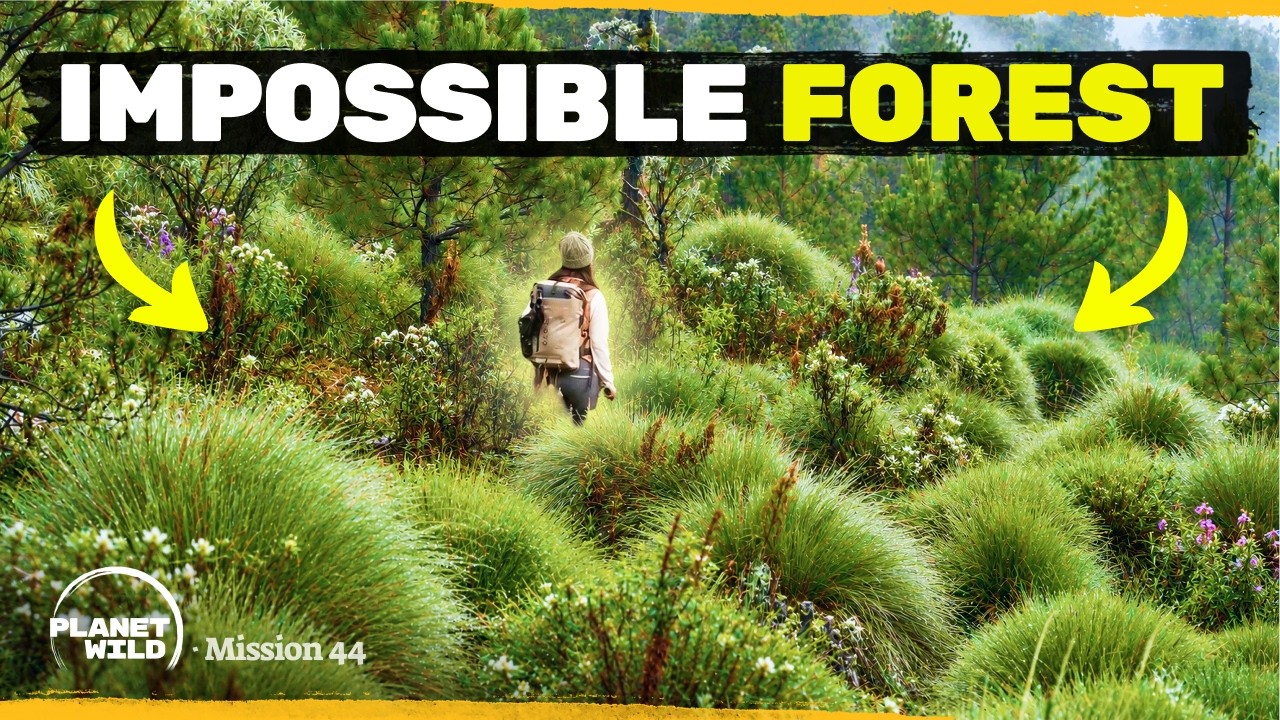
At 4,000 metres above sea level on Pico de Orizaba, North America’s highest active volcano, the air is so thin that simply standing still leaves you gasping. Up here, along the volcano’s ancient slopes, survive some of the last fragments of a forest that scientists have studied to answer one of the strangest questions in modern ecology: could these trees grow on Mars? The answer to that question matters far beyond the experiment, because what happens on this mountain determines whether millions of people in the valleys below have clean water at all. That is why a community that once earned its living cutting these trees down is now planting them back.
A mountain that feeds rivers it can no longer see
Pico de Orizaba sits at the centre of a rare ecological formation called a sky island. Just as ocean islands are surrounded by water, cold mountain peaks in this region rise above a sea of warm air, and the isolation that creates has, over thousands of years, produced a community of plants and animals found nowhere else on Earth. The Mexican dusky rattlesnake, an endemic mountain horned lizard, and a volcano rabbit called the teporingo all share this peak with the Jamapa Glacier, which indigenous peoples have long called Star Mountain because sunlight on the ice shines like a star from the valleys far below.
The volcanic soil beneath the forest functions as a giant sponge. When rain falls, the trees help it sink in and the mountain slowly releases that stored water through springs and rivers across the dry season. But more than 80% of the forest here has already been lost to industrial-scale logging, and the consequences are unravelling fast. Rain now tears downhill in flash floods and mudslides rather than soaking in, and in the dry months the riverbeds simply run empty. Communities across the valley have watched their rivers disappear.
Planting the strangest forest on the continent
At the centre of the restoration effort is Queta, who leads the work for ReforestACCION, a Mexican nonprofit partnering with the Arbor Day Foundation, an organisation founded in 1972 that has planted more than half a billion trees worldwide. The Arbor Day Foundation’s representative put the approach plainly: ‘We do this backed with science, knowing where the trees matter the most, where there are the right place, the right time, through the people that live in those areas, through local knowledge.’
The tree they are betting on is the Hartweg’s pine, known in the field as the warrior tree. Using thick bark, resin, and specialised antifreeze compounds inside its cells, it can survive forest fires, freezing temperatures, and UV radiation intense enough to threaten most plant life, and it can populate peaks up to 4,500 metres. Seedlings spend their first full year in a nursery developing a root system before any upward growth begins. Once planted, they shelter behind the grasses and shrubs already on the slope and develop a fungal network that breaks down the mineral-rich volcanic soil into nutrients they can actually use.
The Planet Wild community is supporting the planting of 41 hectares of high-altitude forest along the volcano’s slopes, with an additional eight hectares funded through a partnership with Ecosia.
The most striking part of the restoration is who is doing the planting. Jose, a local man whose livelihood once depended on the logging crews that stripped the mountain, is now among the people setting new trees into the ground. Queta described the shift with a directness that cuts through any polished summary: ‘I see they’re logging, and first of all I was really sad, but now I think it helps me to feel strong and to say, we can do it, we can do it together.’ The team Jose works with has a word for what they have become: family.
What a hundred-year-old forest feels like from the inside
A surviving old-growth stand on the upper slopes, some sections 200 to 300 or more years old, offers a glimpse of what the restored areas could become. Every surface there is covered. Nothing is bare.
A seedling in the volcanic soil, its first winter still ahead
One of the new Hartweg’s pine seedlings sits in the open slope, its root system already reaching into the mineral ash below, surrounded by low grasses doing the work of shielding it from the wind.
Somewhere far below, the rivers that ran dry are waiting for that sponge to fill again.
 Wake up to Only Happy News!