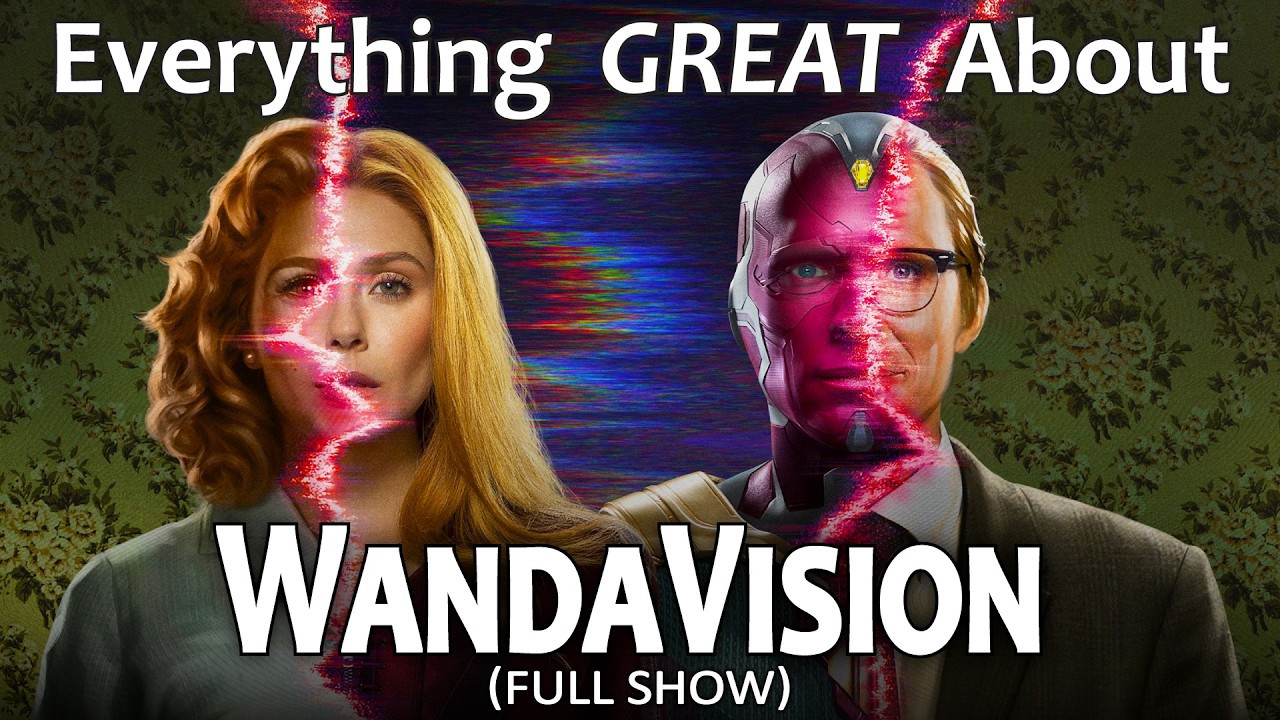
The Marvel logo shrinks. The aspect ratio collapses to the boxy 4:3 of mid-century television, and the 5.1 surround sound condenses itself to tinny mono. Before a single frame of WandaVision has aired, the show has already told you exactly what kind of story it is telling: something smaller, more intimate, and more devastating than any snap or space battle. CinemaWins creator Alex, working through the full nine-episode run in a single feature-length breakdown, argues that WandaVision is not a puzzle box that rewards trivia hunters so much as a grief map that rewards anyone who has ever lost someone and kept moving anyway.
What the opening logo change actually says
The updated Marvel logo that plays before WandaVision was already carrying weight that most viewers absorbed without registering. The old version showed Tony Stark firing his hand repulsor for the first time in the original Iron Man, the moment he realizes he built a weapon and not a flight suit. The new version replaces it with his final act using that same hand, the snap in Endgame that saves everyone. As the breakdown puts it: ‘My, how far we’ve come.’ That swap is a thesis statement for the entire show. WandaVision is not about where the MCU is going. It is about what it cost to get here.
From there, the breakdown moves through each decade of the show’s sitcom structure with the kind of granular attention that reframes everything. The toaster in the first episode’s commercial makes the repulsor warm-up sound when the lever is pulled down. The red blinking light is Wanda’s subconscious replaying the Stark missile landing in her childhood home. Agnes’s brooch, the same one Katherine Hahn wears across every decade, is one of the earliest hard tells that she was never a trapped Westview resident. The area code on the stolen house places the story in New Jersey three episodes before non-area-code enthusiasts caught up.
Five stages, nine episodes, one woman
The structural argument the breakdown makes most forcefully is that Wanda moves through all five stages of grief across the show’s run, and the decade jumps are not whimsy. Each leap forward happens because something in the previous era cracked open a wound she could not manage. Mr. Hart choking at the dinner table sends her from the 1950s to the 1960s. The beekeeper emerging from the sewer sends her to the 1970s. Monica Rambeau naming Pietro’s death sends her to the 1980s. The sitcom realities are not chosen for aesthetic reasons. They are escape hatches.
Elizabeth Olsen, Paul Bettany, and Katherine Hahn each earn extended appreciation across the breakdown, but the case for Hahn is built on something specific: the way Agatha functions as a nosy neighbor, an ideal cover for a vengeance witch trying to calculate how powerful the witch across the street actually is. ‘Nosy neighbor is the ideal cover for an evil witch trying to figure out who’s a witch and better than her,’ the breakdown notes. Hahn plays the role so perfectly that the reveal lands as confirmation rather than surprise, and the episode she earns as Agatha’s own origin is treated as one of the finest single hours in the entire MCU run.
The moment that crystallizes the show’s ambition comes midway through the breakdown: Vision comforting a grieving Wanda with a line that briefly went viral before the internet turned on it. ‘What is grief, if not love persevering.’ The breakdown insists the context is the point. Vision cannot grieve. He is intellectually analyzing something he will never experience, and his frank desire to comfort her despite that gap is what makes the line land. The meaning is in the speaker, not the sentence.
The wallpaper nobody stopped to check
In the 1970s episode, the wallpaper in Vision’s vision of Strucker’s Hydra base from Age of Ultron appears in the background of a domestic scene. No one in the story flags it. The breakdown does.
By the final episode, as Wanda dismantles the Hex and says goodbye to the version of Vision she built from grief, the show has earned every bit of its sadness. Hex Vision is probably gone, the breakdown concludes, and maybe that is the point, since he was a creation of her sorrow. White Vision is out there somewhere, carrying unlocked memories but no longer the person she mourned. The show does not resolve this cleanly. It was never going to.
The logo opened on a weapon turned into a sacrifice. The finale closes on a woman sitting alone at a mountain cabin, poring over the darkest book she could find, trying to figure out if she can bring her children back. That is not a happy ending. It is an accurate one.
 Wake up to Only Happy News!