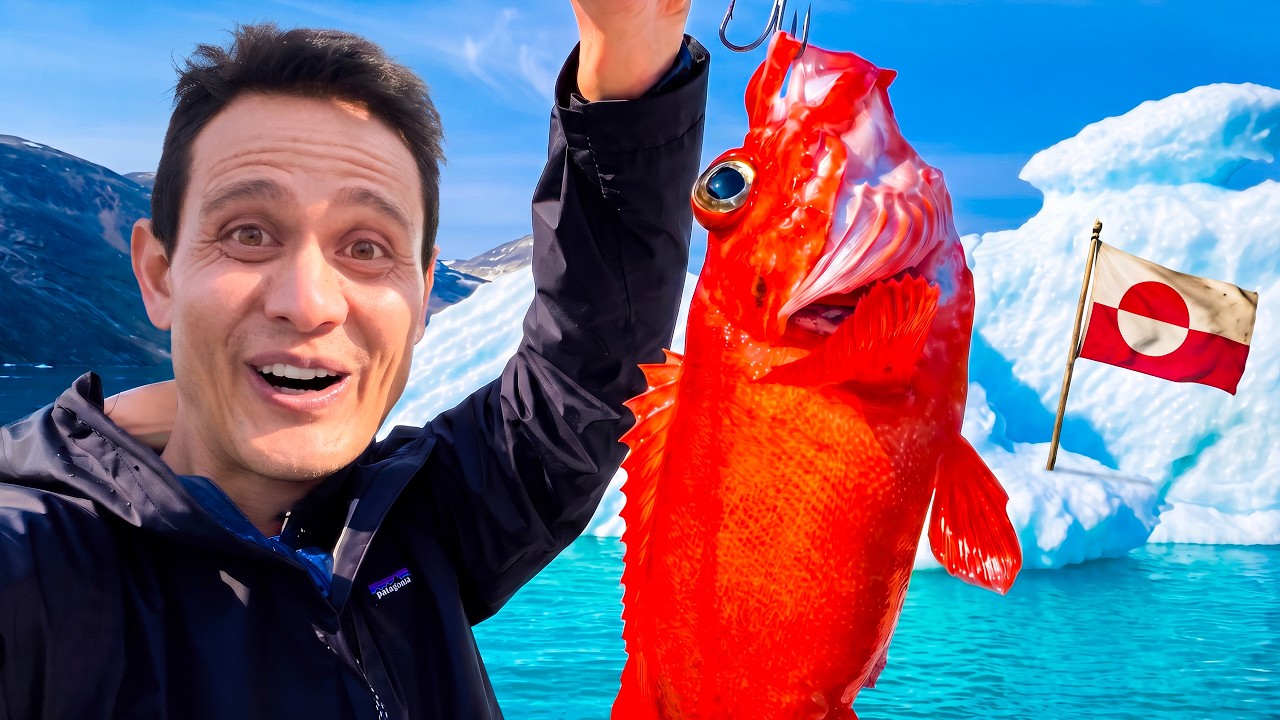
Mark Wiens was standing at the pier in Nuuk, Greenland, watching a rockfish get measured at 44 centimeters long before anyone told him the fish was over 22 years old. That single detail landed like a stone dropped into still water: the Arctic gives slowly, and what it gives is extraordinary. This is a place where lunch is not ordered from a menu but pulled up from 100 meters below the surface, and where dinner is cooked on a heated rock using shrubs gathered from the hillside, seasoned with salt drawn straight from the sea.
Fishing the world’s second-largest fjord with a 100-percent guarantee
The morning started aboard a Qooqqut Boats vessel heading out of Nuuk into what the crew confirmed is the world’s second-largest fjord, located entirely within Greenland, with the other largest fjord also on the island’s east coast. The concept was simple and almost absurd in its directness: fish and dish. Catch something in the fjord, hand it to the chefs at Qooqqut Nuan restaurant, and eat it within the hour. Wiens was promised a 100-percent success rate before the first line hit the water. It held. Two redfish came up on the first drop. Three more, including a pair of cod, came up on the second. Five fish in under ten minutes, deep-sea rockfish pulled from 110-meter depths using a traditional hand-line method that meant letting the weighted line free-fall to beat the cod and reach the bottom-dwelling rockfish first.
On the way deeper into the fjord, the boat paused at a waterfall the local crew described as the only one in the Nuuk fjord that runs all year round, fed by meltwater from glaciers still carrying ice from the last ice age, roughly 10,000 to 11,000 years old. The crew had cups ready. Wiens drank from it, soaked his sleeve reaching for the fall, and declared it the purest water he had ever tasted. The crew, entirely straight-faced, told him it is locally considered the Fountain of Youth.
At Qooqqut Nuan, the fish went straight to a preparation station outside the restaurant door and were filleted before Wiens had finished pulling on a mosquito net. The kitchen crew, many of them Thai, served a four-course set menu built around what had just been caught: fish skin chips fried from dried torsk, a cod tom yum broth that Wiens called ‘the most remote bowl of tom yum I have ever had in my life,’ a main of three preparations of redfish and cod including Thai red curry, oyster sauce with basil and chilies, and a poached version with a spinach sauce and what the chef identified as Arctic Greenlandic thyme gathered from the surrounding land.
A beach barbecue built from sealskin tradition and a first taste of mattak
Back in Nuuk that evening, the group gathered on rocks above the water near a hostel for a traditional Greenlandic barbecue. The host explained that Greenlandic ancestors spent winters in turf-and-stone homes, then opened the rooftops each summer, moved to the beach, and cooked whatever they caught over open fires in tents made of sealskin. The fuel here was not wood, because there are no trees this far north, but dried Arctic shrubs gathered from the hillside and used to heat flat rocks.
On those rocks went seal meat and whale meat, seasoned with sea salt mixed with dried local flowers and a small local berry the host called pupangnat. Before the grill was ready, Wiens was handed his first piece of mattak, raw whale blubber, described as the most delicate and expensive food in Greenland. He dipped it in herb-mixed sea salt. The texture surprised him: almost cartilaginous, a quiet crunch, then richness. He called it delicious without hesitation.
The whale came off the rock seared on the outside and tender enough to collapse. Seal followed, dark and livery and soft, rich with the taste of the fish seals eat. Wiens tried dried capelin whole, boiled redfish and cod tipped from a pot directly onto the rocks so the seawater drained away and the flesh held firm, and seal blubber that, as he put it, ‘completely liquefies’ the moment it touches the mouth.
The meal closed with a wild Arctic tea steeped from lichen, blueberries, small red flowers, and moss gathered from the surrounding rocks, the same moss, the host noted, that caribou eat for digestion. A dense Greenlandic cake came alongside it, flavored with raisins. Before the tea was poured, one of the hosts sang a traditional ceremony song over the group on the rocks.
The fish skin chips that started it all
The crispy torsk skin chips served as the very first bite at Qooqqut Nuan, fried from dried fish skin and finished in a Thai herb marinade, were still sitting on the table when the main courses arrived. Nobody rushed to clear them.
By the time Wiens climbed back into a boat for the return to Nuuk, he had fished in the world’s second-largest fjord, drunk from a glacier waterfall estimated at over 10,000 years old, eaten raw whale blubber for the first time, and cooked seal on a hot rock using shrubs as the only available fuel. The pier at Nuuk looked exactly as it had that morning, salt air, cold light, icebergs floating just offshore, utterly unchanged by everything that had just happened out in the fjord.
 Wake up to Only Happy News!