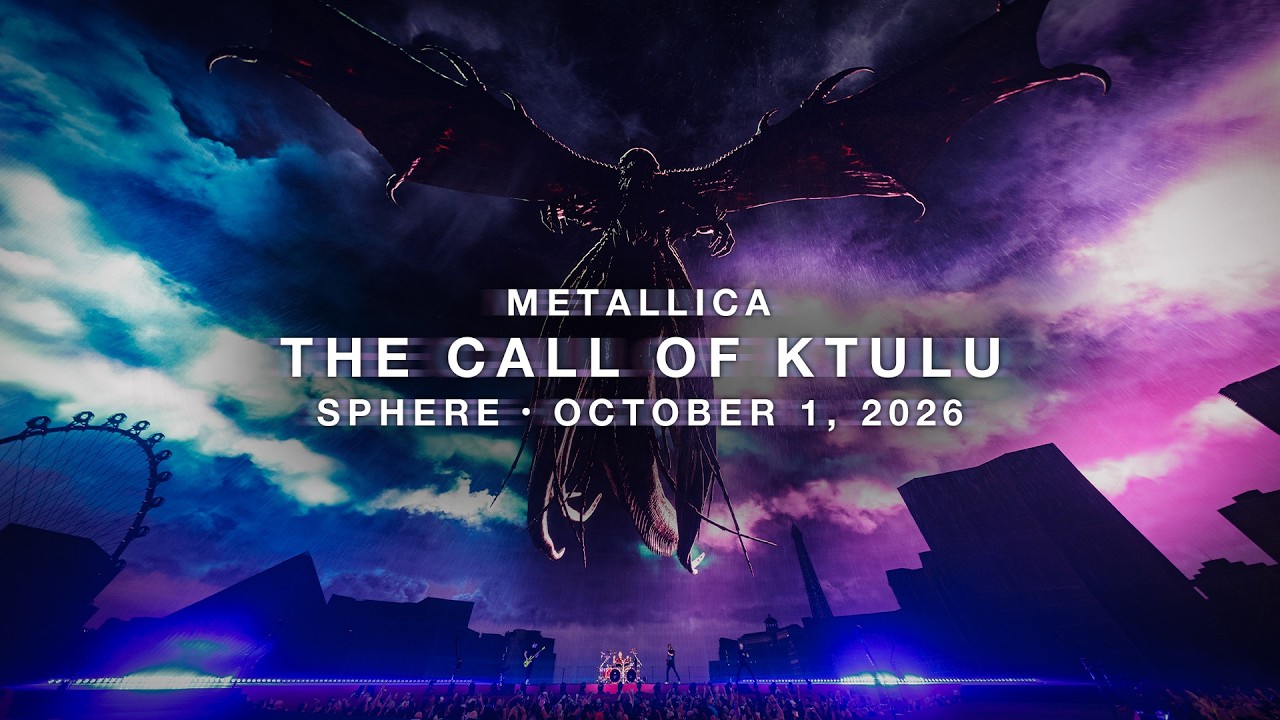
The lights inside Sphere dimmed and a single bass line unspooled into the dark on October 1, 2026, carrying the weight of forty years and one name spoken quietly before the first full note landed. Metallica had come to Las Vegas, and they had brought Cliff Burton with them. For anyone who has ever lost someone whose absence reshapes the thing they loved, the moment needed no explanation: a band honoring a fallen brother in the most overwhelming room on earth, playing the song that still belongs to him.
Clifford Lee Burton, the band’s original bassist, died in September 1986. ‘The Call of Ktulu,’ the sprawling instrumental that closes the 1984 album ‘Ride the Lightning,’ was built in no small part around his playing, and it has carried his ghost ever since. Performing it live at Sphere, the band prefaced the song with a direct, unadorned dedication: ‘In honor of our fallen brother, Clifford Lee Burton. We miss you, and we love you, brother.’
A room built for exactly this kind of moment
Sphere’s wraparound interior, one of the largest immersive display environments ever constructed, does something unusual to a concert: it removes every sight line that does not serve the performance. There is no rafters to stare at, no back wall that stays dark. When Metallica opened ‘The Call of Ktulu,’ whatever the venue’s visuals placed around that music would have filled every peripheral inch of the crowd’s vision. The song runs over eight minutes in its studio form and was designed to breathe, to feel oceanic. Sphere, for perhaps the first time since the building opened, was simply the right room for the right piece of music.
The words that landed before the first chord
What made the October 1 performance matter beyond spectacle was the economy of the tribute itself. No long speech, no archival footage teased in advance, no merchandise callback. The band said what they meant in two sentences and then let Burton’s music speak. As the dedication put it plainly: ‘The Call of Ktulu, for you, Las Vegas. In honor of our fallen brother.’
That restraint is the telling detail. Metallica has had four decades to perform this song and has chosen, repeatedly, not to retire it or to soften it into a nostalgia piece. Playing it at Sphere in 2026 was a statement that the grief is still present tense, not archived.
The note that never quite resolves
The closing movement of ‘The Call of Ktulu’ does not end cleanly. It builds and then releases into something unfinished, which is either a compositional choice or the most accurate thing anyone has ever put into a Metallica song.
On the floor of Sphere that night, with Las Vegas doing what Las Vegas does outside and completely invisible from inside that sealed, humming dark, the song played through to its end and the room held it for a moment before anything else happened.
 Wake up to Only Happy News!