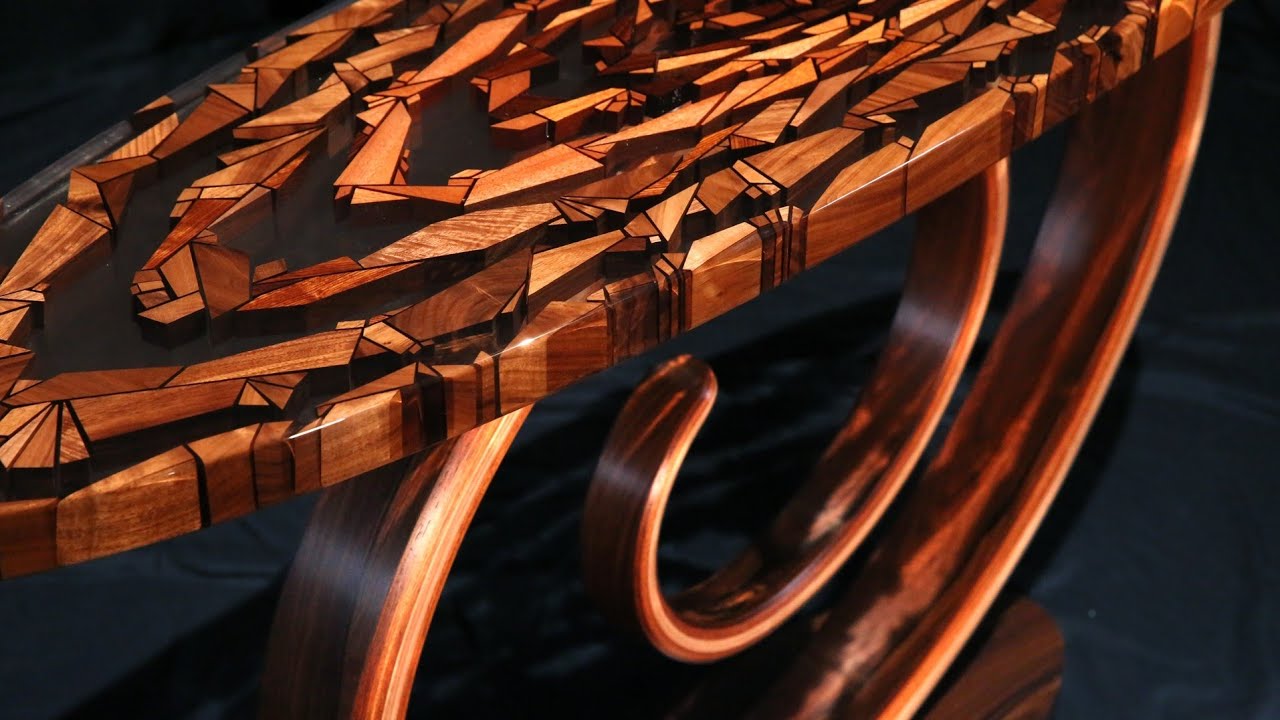
The mosaic landed its last piece with zero left over. Not one extra scrap of walnut, mahogany, leopardwood, or Marado remained after the spiral was complete, a finish so precise it felt either like mastery or outrageous luck, and the woodworker behind it, the creator at Fortress Fine Woodworks, admitted he could not decide which. That kind of exactness matters because this table was never a straightforward build. It was a bet that woodworking, sculpture, and optical illusion could collapse into a single piece of furniture, and the path to proving it nearly ended in wildfires, cracked epoxy, a chunk out of a thumb, and more than a few nights of what he described plainly as crying himself to sleep.
Where a trillion tiny pieces actually come from
The raw material was a pile of walnut offcuts left from a previous project, boards with exceptional figure and grain because they came from premium stock. Rather than letting them collect dust, the plan was to slice them into small geometric shapes and arrange them into a hypnotic spiral mosaic tabletop. The rule governing every cut was strict: outside corners only, no inside corners allowed. The shapes that made the cut were angular and clean; the ones that did not were scrapped.
To keep the pieces from vanishing through the saw table, a zero-clearance insert was 3D printed at 100 percent infill, a lesson learned after a hollow-printed version shattered mid-use. Once cut, each piece had to be hand-sanded on a belt sander small enough to threaten fingernails, then individually sealed before any glue touched them. The sealing step was not optional. Skip it, and the epoxy that would later encase the mosaic would bubble relentlessly, turning a precision art object into, as he put it, ‘a hot pile of garbage that took way too long to make and way too much money.’
The species were phased in gradually around the spiral: mahogany giving way to leopardwood, a surprise addition whose grain shifted dramatically depending on cut angle, then Marado, then walnut filling the outer reaches. Color separation won out over mixing after a direct side-by-side test on the template. The mixed version felt, in his words, ‘lackluster.’ The separated bands made it feel alive.
A bent lamination base that required inventing new tools mid-crisis
While the tabletop cured, a second catastrophe was already forming outside the shop. Evacuation notices were going out as fires moved closer. Inside, the bent lamination base for the table had to continue. The spiral base required 27 tapered veneers, each one cut from thick boards, re-sawn into thin strips, joined with scarf joints so shallow they measured less than one degree of angle, then tapered again in thickness to 0.015 degrees of taper along their entire length. A custom jig printed on his Bambu Lab machines held the taper constant. Calipers checked every single veneer because compounding error across 27 layers would have wrecked the fit entirely.
The rain that finally killed the fire also meant the veneers could be glued into the 3D printed spiral form without panic. When the clamps came off, the compression between the 27 layers was flawless. ‘Take that, Baltic birch plywood. I win,’ he said, laughing at a stack most furniture makers would not attempt.
A hot pipe, a luthier bending iron he built himself between eight and ten years ago for acoustic guitar sides, handled the curves the thicker Marado veneer could not take cold. The base was veneered to match the spiral, finished in solvent urethane, then coated in a ceramic coating to push the Marado’s luster further on both the satin and high-gloss surfaces.
The first pour that failed and the one that did not
The epoxy pour that was meant to float the mosaic in crystal-clear resin cracked. Bubbles crawled across the underside. The mosaic had to be rebuilt from scratch. The second pour, done without covering it, cured correctly. Two coats of art resin went on the bottom, then the top was finished at the precise interval where any small holes could still be filled. The high-gloss surface cleared to glass.
With the top flattened, the base fitted to within a level joint, and a trapezoid mounting pattern ensuring the piece could never be assembled backwards, the table stood upright for the first time. Stable, despite being, structurally speaking, a giant spring.
Little Toby Bubs, currently under coyote restrictions
Somewhere during the finishing stages, the shop’s one support creature, a small dog named Toby Bubs, was confined indoors because of a coyote problem in the area. He sat looking sad about it.
The last piece of mosaic dropped into place with nothing left over. Zero pieces remaining from a build that began with a pile of offcuts and a rule about corners, passed through fire evacuations and a failed epoxy pour, and ended with 27 tapered veneers locked into a spiral that the first handful of offcuts had only hinted at.
 Wake up to Only Happy News!