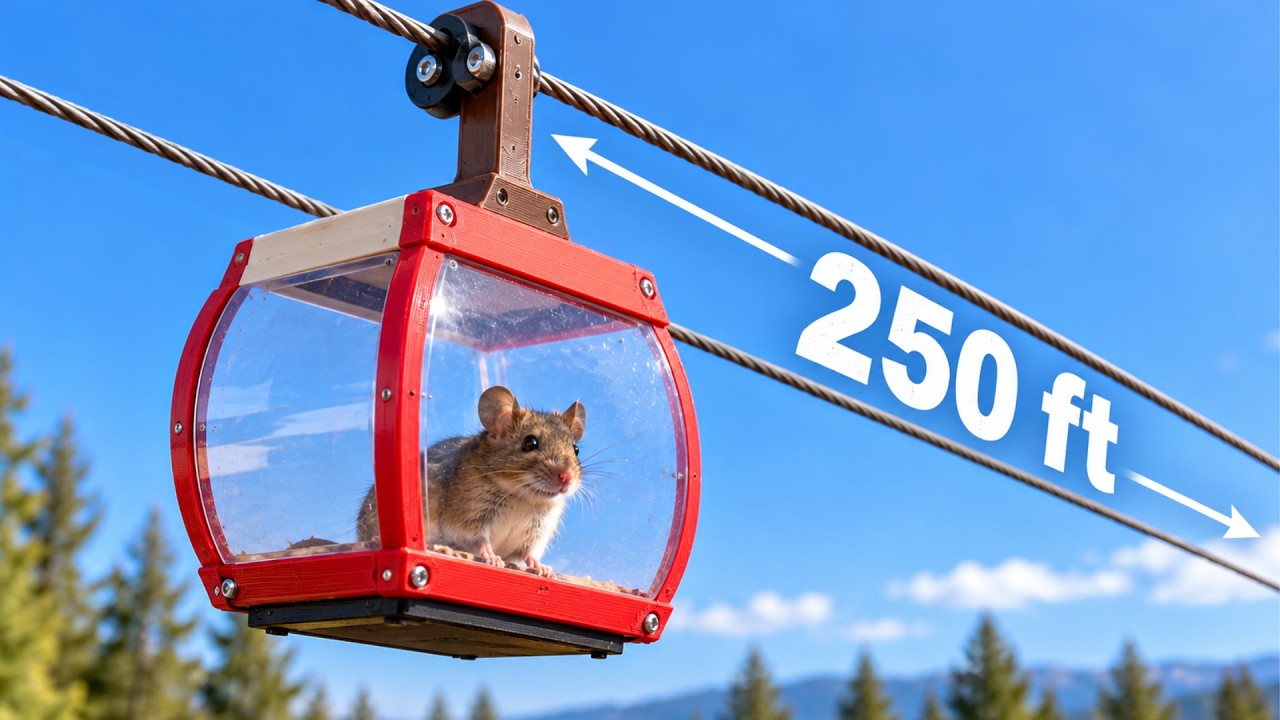
Somewhere on a steep wooded hill, three miniature gondola cars in red, blue, and yellow were finally riding a 250-foot cable loop through the trees, each one carrying a live mouse away from a chicken coop and toward a release point deep in the forest. The project had taken months, cost roughly $100 in cable alone, and nearly broke the person who built it. But the mice were riding in style. Jeff, the creator behind Super Valid Designs had a mouse problem and a conscience, and the collision of those two things produced one of the more impractical and quietly moving builds in recent memory.
The situation started simply enough. Native mice kept flooding into a backyard chicken coop, drawn by the food and warmth, creating a real health risk for the family living there. The standard fix is a lethal trap. But as the builder put it, eliminating them becomes a daily chore, and every mouse removed is replaced almost immediately because the surrounding land holds what he described as a practically unlimited supply of the same native species. Killing felt both futile and corrosive. So the answer, obviously, was a gondola.
Clearing the hill before the real work could start
Before a single cable could be strung, the overgrown hillside needed a clear line of sight between the top station near the coop and the bottom release point in the woods. That meant weeks of brush clearing in brutal summer heat, compounded by wildfire smoke that eventually made the air barely breathable. Tick anxiety was a constant companion. Once the path was open, he measured the run using string, then ordered 500 feet of cable to create the 250-foot loop. Bull wheels came from an old bicycle, its tires sliced into strips and fitted around the rims to grip the cable. The frames holding everything together were built from scrap wood with zero measuring involved. ‘We are not measuring anything,’ he announced at one point, coining the project’s unofficial motto: embrace the jank.
The gondola cars themselves got the opposite treatment. Designed in 3D-printing software and printed in three colors, they served double duty as both the traps that sat inside the coop overnight and the transport vessels that released the mice automatically at the bottom without any electronics. A simple gravity door on top captured a mouse; a mechanical release at the bottom let it go. A wiper motor salvaged from his mother’s old car drove the whole cable loop through a chain-and-sprocket system bolted, somewhat crudely, to the bull wheel.
Two months of failures before a single clean run
What followed was a long, genuinely brutal stretch of troubleshooting. The cable sagged and needed two extra towers. The gondola cars warped because PLA plastic cannot hang on a sun-baked cable for days at a time, which he only discovered after leaving them out in the heat repeatedly while exhausted. The chain fell off. The cable jumped its pulleys. Every failure meant hiking back down the hill in shoes filling with barbed seeds, through smoky air, in high summer heat. ‘Imagine trying to troubleshoot something,’ he said, ‘and every time it breaks, you have to do 20 push-ups with splinters in your shoes inside of a sauna while smoking a cigarette before you can try again.’
He nearly quit. After two months and failure after failure, he admitted out loud that no one in their right mind would keep going. Then he kept going. Once the wildfire smoke cleared and cooler temperatures arrived, the fixes came quickly: the stations had never been properly aligned, a new chain guide eliminated the dropout problem, an automatic stop switch prevented overruns, and freshly printed replacement cars stopped the warping for good. The first clean round trip down the hill and back produced a result he described simply as ‘so clean.’
Three tiny passengers who did not ask for any of this
The first real mice to ride the Rodent Tram Express, as the builder christened it in a short mock advertisement he filmed for their benefit, completed the trip and were released into the woods at the bottom of the hill.
At the time of the build’s completion, only a few rounds of mice had made the journey, and whether any of them simply walked the 250 feet back up to the coop remains an open question. The builder wants to mark the mice to find out. The gondola, by his own assessment, still needs work: faster loading, more reliable mechanics, better materials throughout. What it does have is three brightly colored cars, a working motor, a cable loop through the trees, and a mouse-sized door that opens by gravity.
 Wake up to Only Happy News!