Erik grabbed his camera and walked into a forest to hunt a fictional dinosaur, fire arrows, and blow himself up on film. It sounds absurd until you realize the footage was the opening move in a genuine cost-versus-quality experiment, one that pitted a $10 freelancer against a $1,000 specialist against a professionally built AI pipeline against Erik’s own $10,000 production, all working from the same shaky, motion-heavy plate. The stakes were straightforward: could artificial intelligence actually replace the human craft that makes big-screen visual effects convincing, and if so, at what price?
How you build a shot a video model cannot easily copy
Erik designed the footage specifically to punish AI. The sequence included a slow-motion arrow in flight, a charging dinosaur shot with a violently shaky handheld camera, and a practical grenade explosion where the device appears to snag on his jacket. Each element was engineered to require real camera tracking, rotoscoping, and motion-blur calculation, the kind of work that collapses when an AI model tries to infer motion from a clip shorter than a second.
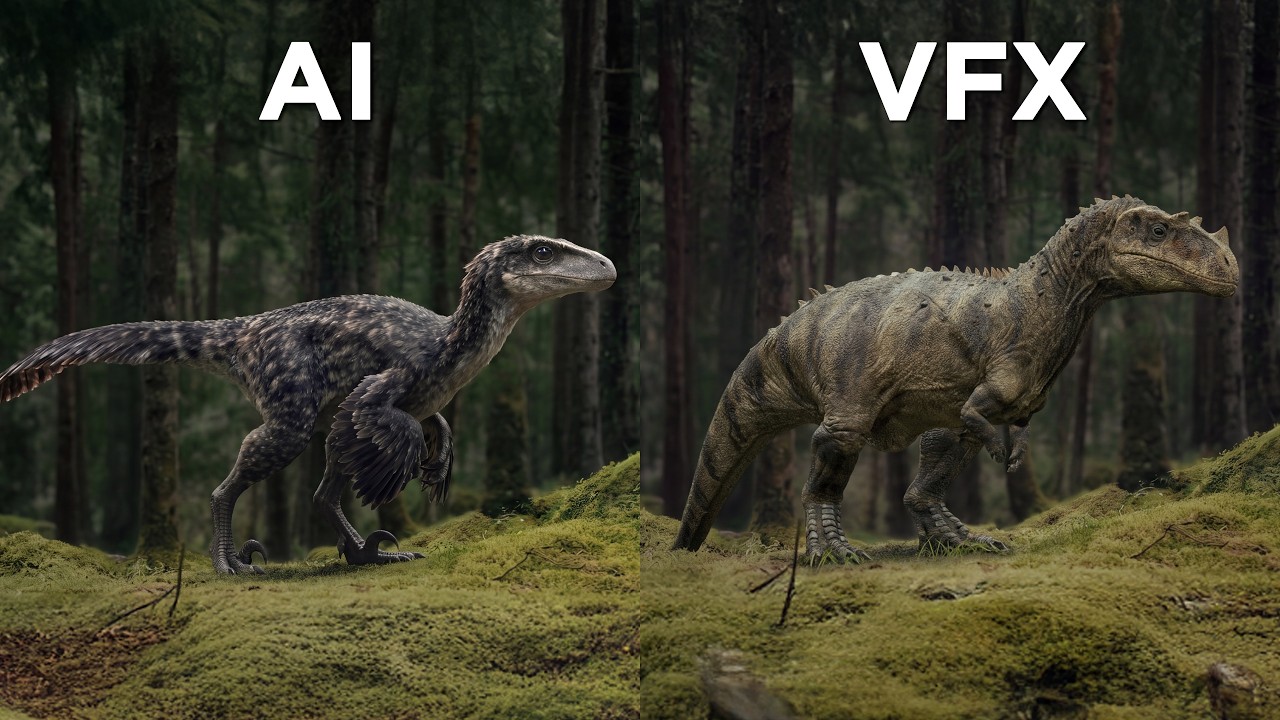
For his own $10,000 version, Erik sourced a high-resolution 3D dinosaur model from the same artists who built the dragon for one of his earlier projects. The animator he hired had worked on Game of Thrones and House of the Dragon, and had reached out after that earlier production offering to animate the next creature in exchange for a mention of his animation school. Erik sent him the brief with a note that this project was ‘way bigger than Game of Thrones, so he better bring his A-game.’ The animator agreed without hesitation. The result, once tracked, lit against a forest HDRI, and composited in Nuke with rotoscoped foreground trees, was a dinosaur that moved with visible muscle jiggle in every stride.
The most difficult shot in the sequence was a running scene so shaky that neither Erik nor the animator could lock a 3D track to it. Their solution was to render the dinosaur against a static camera and then manually apply a 2D track of the plate inside Nuke, calculating motion blur frame by frame afterward.
What each price point actually delivered on screen
Mr. Revish, returning from a previous challenge where he had built a full Godzilla sequence for $10, finished the entire video while Erik was still completing two shots. Erik’s assessment when he finally watched it: ‘I am so impressed by what this guy is able to do with only $10.’ It read flat in places, but the tracking held and the ambition was genuine.
Kika’s $1,000 version drew praise from both Erik and his wife Maria, herself a VFX artist, for integration quality and a fire-on-trees explosion detail they both loved. Their one shared criticism was the absence of camera shake on the explosion, which broke the physical reality of the moment.
The AI side told a sharper story. The $10 AI entry generated what amounted to a flickering montage that substituted full generation for compositing. Maria put it plainly: ‘That was like worse than I would ever expect. Like everything was off. Like everything.’ The premium AI production agency, which actually cost $500 rather than $1,000 because, as Erik noted, genuinely $1,000 AI production options were simply not available at that tier, delivered a result Maria compared to stop-motion toy animation. The agency used Claude to write prompts, fed real-world ostrich footage as locomotion reference, and leveraged a generative model for compositing passes. Their running shot lost motion blur detail on close inspection. The color grading across their sequence, dark and deliberately moody, was the one element Maria said she preferred over Erik’s version.
The moment Maria stopped being diplomatic
When the $10,000 Hicksfield AI version finished playing, Erik asked Maria to be completely honest about whose work she preferred. She paused, gave credit to the AI agency’s color work, then said: ‘I definitely think yours won. Animation is really good. The details on the dinosaur, the integration all together, definitely yours.’ Erik’s arrow shot, his blood effect on the tree bark, and the muscle fidelity of the animated dinosaur were the details she kept returning to.
The Houdini render of a single arrow spinning past the lens took Erik several hours of render time before it ever reached the compositing stage. That time cost, invisible to the audience, is where most of the $10,000 actually lives.
 Wake up to Only Happy News!