The liquid in the beaker looks perfectly still, almost like glass, and then someone shines a torch at it and helium shoots straight up into the air with no pump, no moving parts, nothing. That image sits at the center of one of the strangest stories in modern physics, a story about a substance that empties its own container, flows through solid walls, and took scientists three decades of staring directly at it before they understood what they were looking at. The journey begins in a Leiden laboratory in the early hours of July 10, 1908, when a physicist named Heike Kamerlingh Onnes arrived before dawn with 25 liters of liquid air, a chain of nested vacuum flasks, and a determination to reach a temperature no human had ever touched.
The morning Onnes finally saw the reflection
Onnes had been chasing liquid helium for years, and the chase itself was absurd. Helium barely attracts itself at all. Its outer electron shell is full, it bonds with nothing, and the van der Waals force holding its atoms together is the smallest of any element. No one even knew whether helium atoms pulled toward each other enough to ever form a liquid. To hedge against the worst-case scenario, Onnes built an elaborate thermal fortress: several Dewar flasks nested inside each other, the innermost vessel shielded by a bath of liquid hydrogen at 20 Kelvin and liquid air beyond that, so the helium would see a wall of cold rather than a room sitting at 300 Kelvin. He compressed helium to 100 atmospheres, pre-cooled it, expanded it rapidly, and fed the colder exhaust back to cool the incoming gas. By 6:30 that evening his team had reached six degrees above absolute zero, closer than anyone in history. Then the temperature stalled. A chemist in the room remarked that the thermometer read almost too steadily, as if it were submerged in a liquid bath. Onnes grabbed a torch and aimed it at a low angle. He saw a reflection. ‘After the surface had once been seen, it was no more lost sight of,’ he wrote. The edge stood out sharply against the glass wall like a knife. Liquid helium existed.
Onnes kept pumping, trying to freeze it. It never froze. It just sat there at 1.7 Kelvin, colder than outer space, eerily calm. He called it a night, never suspecting the calm itself was the discovery.
Thirty years of clues nobody believed
Over the following decades, the helium kept signaling. Its density peaked oddly at 2.17 Kelvin. Its latent heat showed a discontinuity at the same point. Its specific heat plummeted as temperatures fell, then spiked sharply right at 2.17 Kelvin, a curve that looked so much like the Greek letter lambda that physicists named the temperature the lambda point. Onnes and his successors explained each anomaly away as experimental error and published only the data above 2.61 Kelvin where the curve fit their formula. When Onnes placed one container of helium inside another and watched the levels equalize almost instantly, he thought it was distillation, too fast for comfort but not impossible. He never raised the container to see what was actually happening.
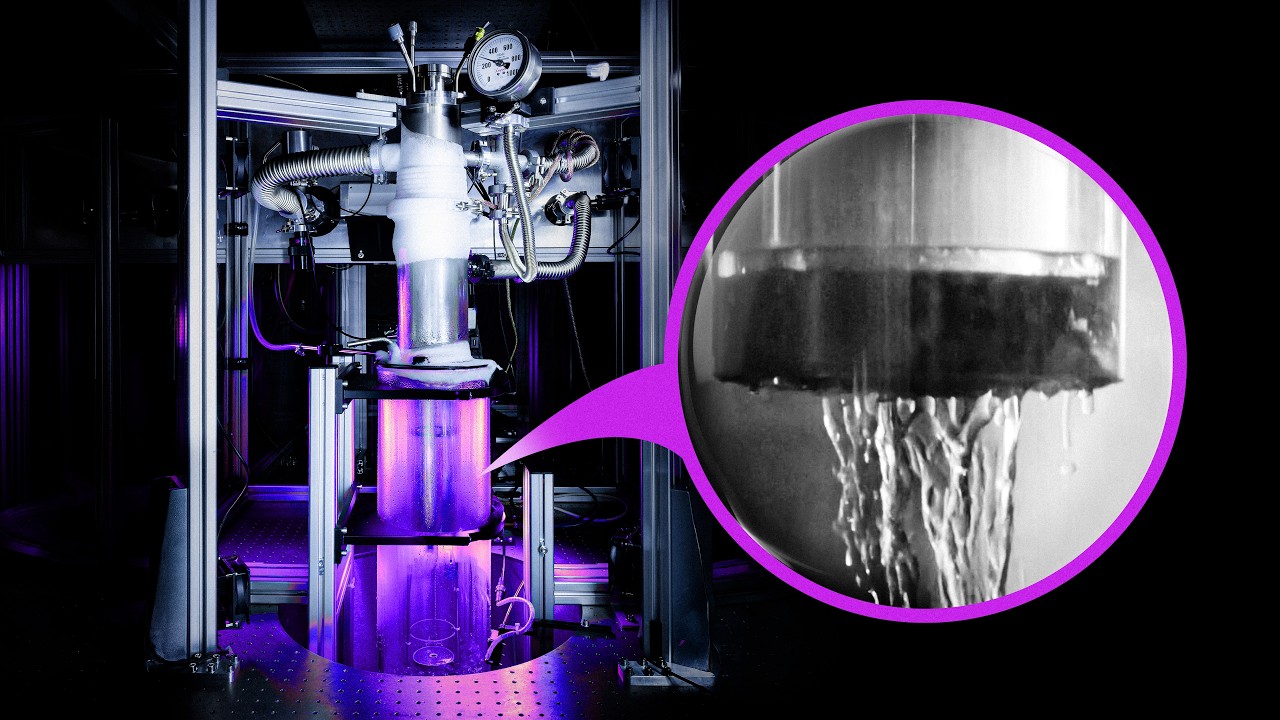
What was actually happening, demonstrated at Professor Weinfurtner’s gravity laboratory at Nottingham University when the same experiment was recreated, is that the helium climbs up and over the walls of its own container and drips out the bottom. A thin film roughly 30 nanometers thick coats the entire wall surface, acting as a siphon. Normal fluid cannot flow through because friction pins it. Superfluid flows through with no friction at all, so the container empties itself.
The explanation, built by Soviet physicist Lev Landau after Pyotr Kapitsa literally pledged his life to free Landau from one of Stalin’s prisons in 1938, comes down to collective quantum behavior. Below 2.17 Kelvin, helium atoms behave as bosons. A macroscopic fraction condenses into the lowest energy state, losing their individual identities. Roughly a trillion trillion atoms begin acting as one. Landau then showed that in this interacting system, friction is not vanishingly small. It is strictly zero, because the only ways to create energy-losing excitations, phonons and rotons, require the flow to exceed speeds between 60 and 240 meters per second. At everyday flow rates inside capillaries, friction is simply forbidden.
As Weinfurtner put it during the recreation: ‘This is quantum mechanics with your own eyes.’
The two-fluid model that Landau completed explains everything at once. Below the lambda point, helium is a mixture of a superfluid component carrying no heat and a normal component made of phonons and rotons carrying all of it. When light hits the powdered emery stone inside a fountain apparatus, it converts a fraction of superfluid into normal fluid. Fresh superfluid rushes in through the porous base to restore the balance. The normal fluid has nowhere to go but up, and so it spouts. The heat from the light becomes the mechanical energy of the jet. When the light goes off, the fountain stops.
That heat transfer also explains why the violent boiling visible above 2.17 Kelvin abruptly vanishes below it. In ordinary helium, the latent heat of vaporization is only about 23 joules per gram, so tiny thermal fluctuations form bubbles constantly. Below the lambda point, thermal counterflow redistributes heat roughly a thousand times more effectively than copper, eliminating every hotspot before a bubble can nucleate. The liquid goes mirror-smooth and silent.
CERN now keeps around 700,000 liters of superfluid helium on hand to cool the 9,000 superconducting magnets of the Large Hadron Collider.
The flask Onnes never raised
A polymer cup suspended just above a bath of superfluid helium at 1.5 Kelvin, with helium dripping steadily from its underside onto the surface below.
Onnes had 18 years with superfluid helium, saw every hint it offered, and never assembled the picture. He won the Nobel Prize in 1913 for discovering superconductivity on the same afternoon he first saw the boiling stop, and he noticed that too, writing it down and moving on. The signs were all there. The curve, the stillness, the equalization that happened too fast. He just was not ready to see them for what they were.
 Wake up to Only Happy News!