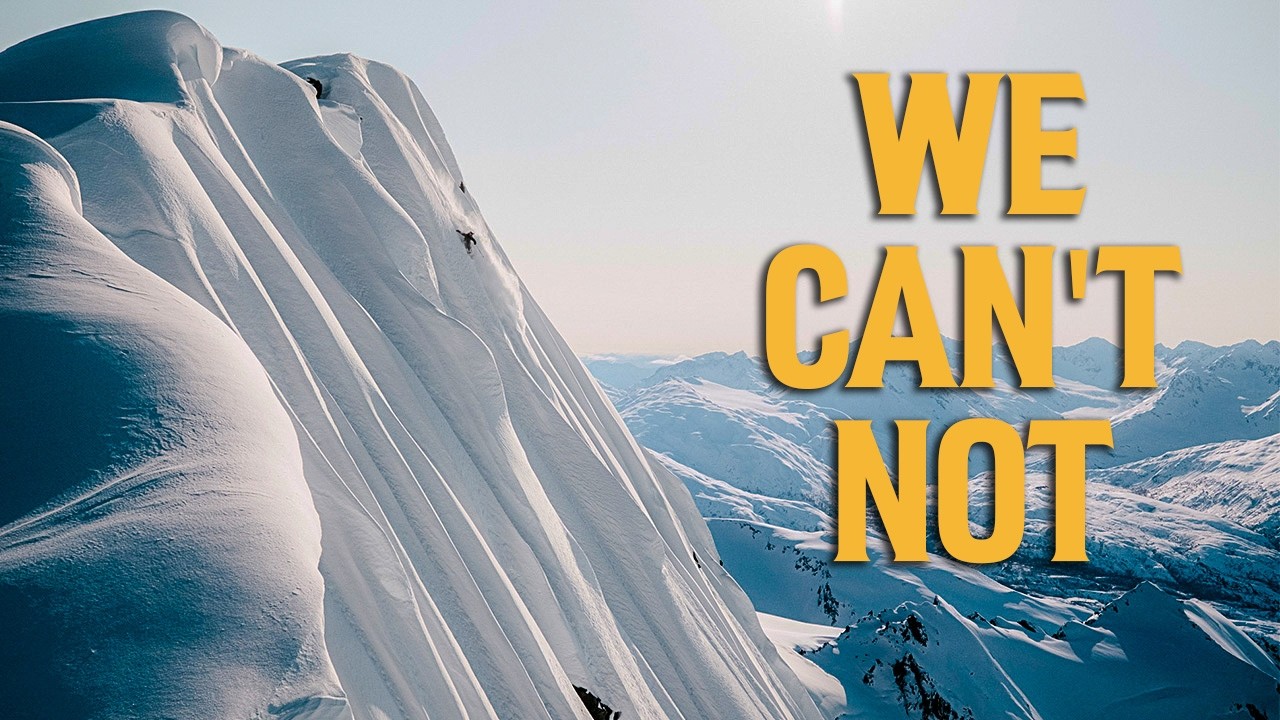
Paddy Graham stood at the top of an Alaskan face he had spent three hours scouting from a helicopter, and somewhere back in Sheffield his dad was still asking whether the skiing was going well or whether he’d picked up ski instructing. The gap between those two realities is the entire engine of this project: a professional skier with over 20 films to his name, a family who still cannot quite name what he does, and a trip to the Northern Chugach Mountains designed to close that distance for good. The film is a ski film about making a ski film to show a family why anyone would make ski films. As Graham put it himself, simple, though the mission is far from it.
Graham grew up in Sheffield watching ski movies on tiny screens, devouring each new season’s release for the progression, the new tricks, the familiar faces. At 11 he hit his first jump on the plastic slope at Sheffield Ski Village, a surface that hurts when you fall and rewards nothing except commitment. At 16, against the quiet doubts of parents who thought it sounded like a phase, he left for his first winter season in France. He never came back to a conventional path. Twenty-plus years later, he has starred in more than 20 films, produced his own, met the person he would build a life with through skiing, and relocated to Switzerland, which, as the narration notes with perfect economy, is expensive but has nice chocolate.
The team Graham fished for in a Canadian river
Recruiting for Alaska required a specific kind of skier, and Graham’s pursuit of Kye Petersen began with a fishing rod he did not particularly want to hold. Petersen has been a professional skier since he was 11, already appearing in films on VHS while young Graham was watching them. He keeps his competition trophies in the garage rather than the house. ‘They’re just things,’ Petersen said, gesturing at an Extreme Sports Maui vert contest third-place award before moving on. His father’s ice axe is mounted to the rock on Blackcomb Peak as a memorial, and Petersen still skis past it regularly.
Markus Eder arrived from Ahrntal, Italy, carrying a Freeride World Tour title and what he described as a simple internal standard: ‘I kinda stopped competing against others quite a while ago. Yeah, just wanting to be better than myself.’ That standard took him to Helsinki at minus 20 to hit street rails, a discipline he openly described as one where he considers himself a beginner. He threw a pole into a bush on one attempt. He kept going.
Tom Ritsch, a softly spoken Austrian and one of Graham’s closest friends, arrived from a summer of ankle rehabilitation in Japan, where the two of them had been filming in deep powder. He has a jump named after him: Ritsch’s Roll. His father died when Tom was 17, and he described skiing as the only clear route out of that grief. ‘I’d not be skiing here with you in Japan,’ he said, ‘so I guess at some point we just have to trust that everything’s gonna work out.’
Finn Bilous, born and raised in Wanaka, New Zealand, completed the lineup with an account of his off-season that included a broken-down truck in Whistler, a ferry crossing described as windy, surfing on Vancouver Island, Indonesia, Bali, a golf cart stuck somewhere, and a cheese scone from a bakery back home. ‘I guess I did do a bit, eh,’ he concluded.
What the Chugach actually looked like once the helicopter landed
Alaska delivered its conditions honestly and badly. Graham had, by his own admission, timed the dream trip to coincide with one of the worst Alaskan snow seasons in decades. Two drones were lost in a single day, one in the snow and one somewhere up in the air with the crew unsure of its location. Rock fields appeared at the bottom of lines the team had scouted clean. Kye Petersen’s ankle injury cut his trip short before the full team had properly found its rhythm. There were days when the first run did not happen until 6:30 in the evening after three hours of scouting, positioning camera operators on exposed ridges, negotiating light with a cinematographer, and one more trip to what the team diplomatically called a nervous wee.
But the footage came. Eder dropped first on most mornings, then Graham, then Ritsch threading through what the team called pepper, the polite in-field word for rocks. Bilous did not complete a single jump without a 720. Graham landed what he described as possibly his last double cork 10, surrounded by the full team in a zone he had dreamed about for two decades. ‘Best company, best location,’ he said afterward. ‘It might’ve been my last dub 10 ever, but I’m glad I did it with you guys.’
The part where Sheffield still does not fully follow along
Back in the edit, Graham’s family watched the finished segment. His daughter announced that Markus is her favorite. His son offered that Dad was a bit weak and should work on that. His own father asked again about the ski instructing.
Graham, catching a final moment with his daughter on camera, got the closest thing to an answer the film was ever going to find. She said she loved him. The narration, provided by a Sheffield-born actor who cheerfully admitted he is not really an expert when it comes to skiing, offered a workable summary: if sliding around on snow with planks of wood under your feet makes you happy, why wouldn’t you. Sheffield Ski Village, the plastic slope where it started, is gone now. Graham noted it himself, standing at the empty site. It doesn’t look much like a big air jump anymore.
 Wake up to Only Happy News!