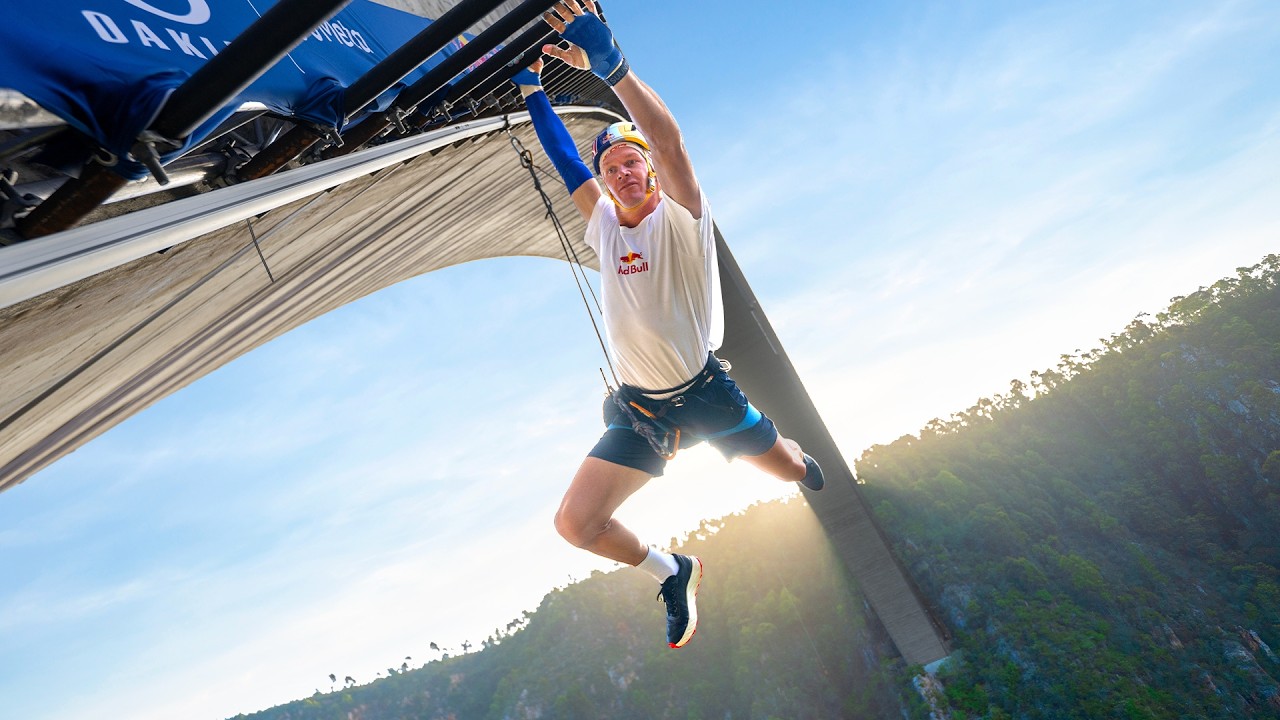
Thomas was hanging from the underside of Africa’s highest bridge, 200 meters above a gorge, fingers wrapped around the first of 600 monkey bars strung across a 300-meter span. For anyone who has ever dropped from a single set of playground bars mid-swing, the physics of what he was about to attempt feel almost fictional. But the structure was real, the drop was real, and there would be no second attempt.
Building something that had never existed before
The idea was deceptively simple: take the monkey bar, the most elemental of obstacle course challenges, and scale it to its absolute outer limit. Thomas partnered with his friend Richard to figure out how to actually make it happen. What followed was 21 days of rigging work by a team of 12, using 9,700 meters of straps to anchor 300 meters of bars beneath the bridge. The structure follows the arch of the bridge itself, which created the central problem: the first 150 meters climb steeply uphill, forcing Thomas through what amounts to roughly 120 continuous pull-ups before he could even approach the halfway point. Richard put the construction plainly: ‘It’s taken a team of 12 guys, 21 days to rig this thing.’
Training began in stages. Thomas built a flat 6-meter rig in his garden and focused on rowing for upper-body strength, finger exercises for grip endurance, and running for stamina. He also consulted Stefan, a climber who carries serious credibility in the world of technical movement. Stefan studied the incline problem and offered a measure of the undertaking: ‘We’re talking about 5 to 600 single moves. That’s a whole route in the mountains. Maybe it’s not possible.’
To simulate the bridge’s steepest section, the team built a 48-meter uphill rig on a mountain near Thomas’s home, covering roughly 100 bars at 10 degrees less than the actual bridge incline because no suitable terrain existed to match the real 45-degree pitch. The first full attempt on that rig did not go cleanly. Thomas could not complete the up-and-back without falling, and the gap between where he was and where he needed to be became concrete. ‘If I have to be a bit more honest,’ he said afterward, ‘I am scared.’
The revised strategy centered on ‘shake-out points,’ spots on the bridge where Thomas could hook his legs around the bars, hang inverted, and let blood drain from his forearms to stave off grip failure. Stefan confirmed it was not optional: ‘You have to get in the shake-out position. Otherwise you will lose your grip.’
When the doubt becomes louder than the coaching
On the day of the attempt, with Richard on comms below and Stefan watching from the bridge deck, Thomas set off from the first bar. The uphill section was everything the training rig had warned him it would be. He took his first inverted shake-out break early, dangling upside down over the gorge to buy his forearms a few seconds of recovery. Richard, watching from below, noted quietly that the blood pooling in Thomas’s head was its own risk.
At the grip-switch point near the middle, Thomas turned his body to face forward, shifting to the descent. The movement looked small from a distance. From underneath, with 150 meters of bar still ahead and hands already burnt through, it was the only decision available. His movements slowed visibly in the final stretch. The coaching from below condensed to single words: ‘Focus. Keep going. This is the end.’
He reached the far side.
One bar left behind
Somewhere near the midpoint of the bridge, 168 meters in during one of the training sessions, Thomas had stopped and called that distance a good day. That number is still out there, hanging in the middle of the gorge, the bar he turned around on before he went back and crossed every single one.
Thomas had said before the attempt that he wanted to feel he had not left anything out there. The bridge is still up.
 Wake up to Only Happy News!