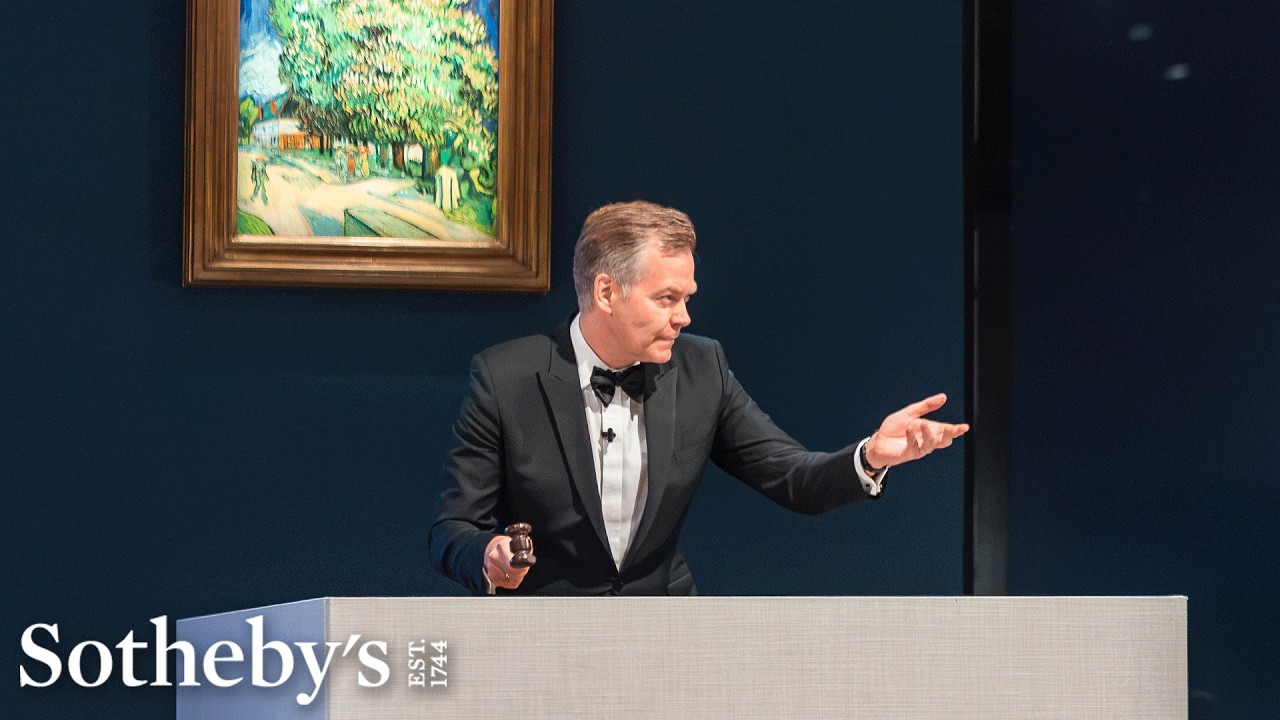
The room at Sotheby’s fell into a charged stillness as auctioneer Oliver Barker raised his hammer over Vincent van Gogh’s Châtaignier en Fleurs, a painting unseen in public for more than 60 years, and brought it down at $165 million. That single lot, a blossoming chestnut tree painted just days after Van Gogh arrived in Auvers and mere weeks before his death, anchored an evening that would total $412 million across 12 lots. The sale marked the first time the Blackie Arrieta collection, assembled by Carlos Pedro Blackie and Nelly Arrieta de Blackie from the great galleries of London and Paris, had been offered to the public in over half a century.
A collection hidden from the world for half a century
The 12 masterworks had lived almost entirely outside public view since the Blackie Arrieta family built the collection during a period when works of that caliber could still be acquired privately. Oliver Barker described the gathering of impressionist and post-impressionist paintings as ‘one of the most extraordinary collections of Impressionist and Post-Impressionist art ever to appear at auction.’ Many of the lots had never appeared at auction before. Sotheby’s catalogued every work under its authenticity guarantee, and the Van Gogh was offered pursuant to a specific agreement between the seller and the heirs of the Hedwig and Samuel Fischer family.
The evening opened at a measured pace. A Maurice de Vlaminck from the height of the Fauve movement sold for $2 million, with telephone specialist Elena Davey securing the paddle. An André Derain depicting the port town where Fauvism was born, painted alongside Henri Matisse in 1905, went to Lisa Dennison, chairman of Sotheby’s North America, at $4 million. A Paul Gauguin still life from the artist’s final years in Tahiti, lush with Polynesian fruit and flowers, reached $5 million through Simon Shaw. A Claude Monet Paris cityscape from 1876, described as one of the last of the artist’s rare Parisian urban scenes to remain in private hands, generated one of the evening’s most competitive bidding sequences before closing in the room at $17 million.
The Cézanne and the Van Gogh anchor the night
Then came the two paintings Barker had called the collection’s mythical heart. Paul Cézanne’s Harlequin, one of only four works in the artist’s iconic series and the sole example still in private hands, the other three held by the National Gallery of Art in Washington, the Pushkin Museum in Moscow, and a museum in Kanagawa, opened at $90 million and climbed through a sustained back-and-forth between multiple telephone bidders before Helena Newman secured it at $99 million.
The Van Gogh followed. Of the 48 landscapes Van Gogh painted during his Auvers period, the present work is among eight still remaining in private hands. Barker opened the lot at $135 million. Bidding moved through Julian Doors on the telephone and a bidder in the room, stalling and surging in increments of $5 million before the room buyer held firm at $165 million and Doors declined to advance. Barker, in a moment of deliberate theatre, addressed the telephone directly: ‘Julian, this is it. The moment of no return.’ The head shook. The hammer fell.
A Pierre-Auguste Renoir canal scene from 1877, the very year the Impressionist movement adopted its name, sold for $24 million to Wendy Leng, chairman of Sotheby’s in Asia. A Camille Pissarro Parisian streetscape sold at $21 million. An Edgar Degas large-scale pastel of horse racing, described as ‘sold as viewed,’ reached $15.5 million through Ben Dollar. A Toulouse-Lautrec portrait from 1890, requested for a forthcoming exhibition at the de Young Museum in San Francisco and the Guggenheim in New York running from September 2027 to July 2028, sold for $3.1 million. A Camille Pissarro winter landscape from 1875, the final lot of the collection, closed at $1.6 million, with Elena Davey’s paddle the last to hold.
The room that watched Adela close it out
After the final hammer fell, Barker called out a name that drew sustained applause: Adela Casella from Sotheby’s Wandsworth series office, singled out for what Barker called ‘a truly amazing journey of client loyalty.’ She stood at the front of the room, the 12 masterpieces now sold, the walls that had held them suddenly lighter.
The hammer that opened the Blackie Arrieta sale at $1.6 million for a Vlaminck and ended it at $1.6 million for a Pissarro winter landscape bracketed one of the most concentrated auctions of impressionist art in a generation. The chestnut tree Van Gogh painted in his final weeks, hidden for 60 years and carried into the room on a single easel, left Sotheby’s at $165 million.
 Wake up to Only Happy News!