The police were never supposed to ram you. In a small programming studio in Scotland in the mid-1990s, a glitch in an obscure prototype called Race and Chase caused the cop cars to stop pulling players over and start smashing into them from behind, relentlessly and without mercy. For the first time in two years of grinding development, the game was actually fun. That single accident planted the seed of a franchise that, three decades later, produced what is now the highest-scoring video game ever made.
When a broken game found its soul
The studio was DMA Design, a group of Scottish programmers best known for Lemmings. In March 1995 they pitched Race and Chase, a top-down prototype where players chose to be either cops or robbers. Nobody wanted to be the cops. As producer Gary Penn put it at the time, following traffic laws made it feel ‘more like a simulator as opposed to a game.’ Switching the player to the criminal side was the first transformation: pedestrians stopped being navigational obstacles and became, in the cold logic of the prototype, bonus points. Then the ramming bug arrived and confirmed something nobody had consciously planned. The real fun was not in the missions. It was in giving people a giant sandbox and letting them see what happened when they poked it.
The wanted system was born directly from that moment. Those small police-head icons at the top of the screen tracked how much damage a player had caused and calibrated exactly how hard the law would chase them back. The risk-reward loop was set. The name changed too, to Grand Theft Auto, the American legal term for stealing a car, because the three cities they had designed were now modelled on real American ones: Liberty City after New York, Vice City after Miami, and San Andreas after San Francisco.
Publisher BMG Interactive, which was part of a record company, marketed the game the way a record label would launch a controversial album. They hired Britain’s most notorious tabloid publicist and told him to lean into the scandal. GTA was being debated in government six months before anyone could buy it, which only made kids want it more. Three million copies sold, despite mixed reviews.
When BMG shut its games division, a small New York company called Take-Two Interactive bought the rights for roughly 14 million dollars in shares. The two brothers who had fought hardest for GTA inside the record company, Sam and Dan Houser, came with the deal. They founded a new studio inside Take-Two that ran like a record label, right down to the attitude. They called it Rockstar.
From flat cities to a world that fights back
The jump to three dimensions on the PlayStation 2 in 2001 was not simply a graphics upgrade. Liberty City in GTA 3 was about 100 megabytes of models and textures on a console with 32 megabytes of memory. Rockstar solved it by building an invisible bubble around the player: whatever fell inside loaded off the disc, whatever fell outside was discarded, constantly, as the player moved. The console held only a couple of city blocks at any one time, yet it felt like a continuous permanent space.
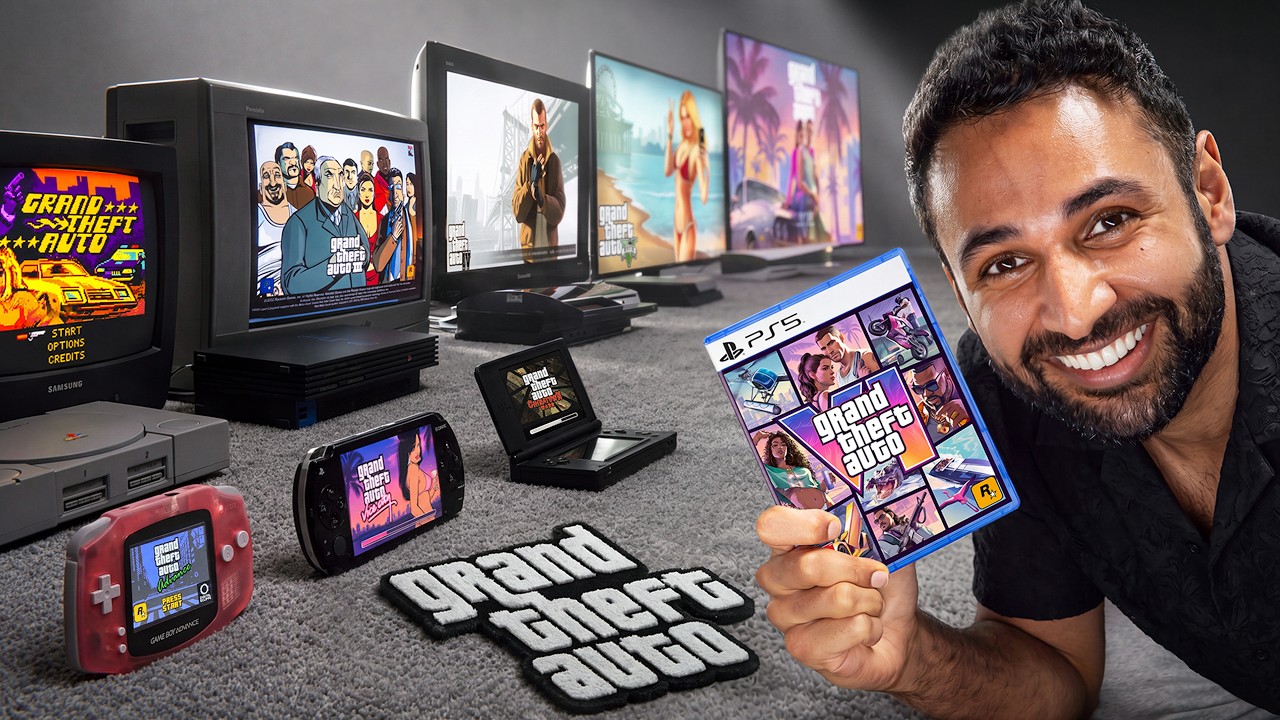
GTA 3 scored 97 out of 100 on Metacritic and became the bestselling game of 2001, single-handedly reversing Take-Two’s looming financial collapse. Vice City followed a year later on the same engine, topped GTA 3, and sold 17.5 million copies to become the bestselling game of 2002. San Andreas followed two years after that, expanded the sandbox to an entire state across three cities, and shifted 27.5 million copies to claim the same title in 2004. For three separate years, the bestselling game on the planet was a GTA.
The Hot Coffee scandal of 2005, in which a modder re-enabled a scrapped animated sequence still buried in San Andreas’s code, cost Take-Two 24.5 million dollars in returns, pulled the game from Walmart, Best Buy, Target, and GameStop, and landed Rockstar in front of the FTC and the US Senate. Hillary Clinton proposed a 5,000-dollar fine for any retailer that sold a mature-rated game to a minor. If there was ever a moment to play it safe, that was it. Rockstar started work on GTA 4 instead.
GTA 4 required an entirely new engine built from scratch, known as Rage, roughly a thousand people, and an estimated 100 million dollars, making it the most expensive video game ever made at the time. Its physics system meant that objects and people responded uniquely to every specific collision, turning the sandbox from a pre-drawn coloring book into a blank canvas. Take-Two described its 2008 launch as the biggest launch in the history of entertainment, not just games. It sold 25 million copies.
GTA 5, released in 2013, introduced three playable protagonists and, two weeks after launch, quietly switched on GTA Online almost as an afterthought. Online became the engine that kept the game selling across three console generations. By the time GTA 6 arrived, GTA 5 had moved 235 million copies.
A trailer that broke YouTube and a game that broke the record books
The wait for GTA 6 lasted 13 years. According to journalist Jason Schreier, fans tracked pizza delivery orders to Rockstar’s studio at night to gauge whether a development milestone was approaching. When the one-and-a-half-minute reveal trailer dropped in 2023, it became the most watched trailer in YouTube history, nearly doubling the view count of the Avengers: Endgame trailer. When Rockstar eventually showed gameplay, they premiered it on Netflix, where it went straight to number one on the movie chart and briefly crashed the platform.
The game is set in Leonida, a fictional Florida-like state built around a present-day Vice City. The playable area, including ocean, covers roughly 160 square kilometres, doubling GTA 5’s map. The wildlife roster runs to over 170 animal species. The wanted system now tracks specific evidence: the clothes a player is wearing, their face, the car they are driving. Shed those details and the heat drops. It launched with a Metacritic score of 99, making it, alongside The Legend of Zelda: Ocarina of Time, the highest-scoring video game ever made.
The alligator that ended the argument
Somewhere out in Leonida’s countryside during a sunrise, there is an alligator sitting beside a road it has apparently decided belongs to it now.
Thirty years after a police pathfinding bug made a cancellation-bound Scottish prototype briefly worth playing, the franchise it accidentally created is the most profitable entertainment product ever made, built from a glitch nobody intended and a risk-reward loop nobody planned.
 Wake up to Only Happy News!